Programmable Stripe Light Source
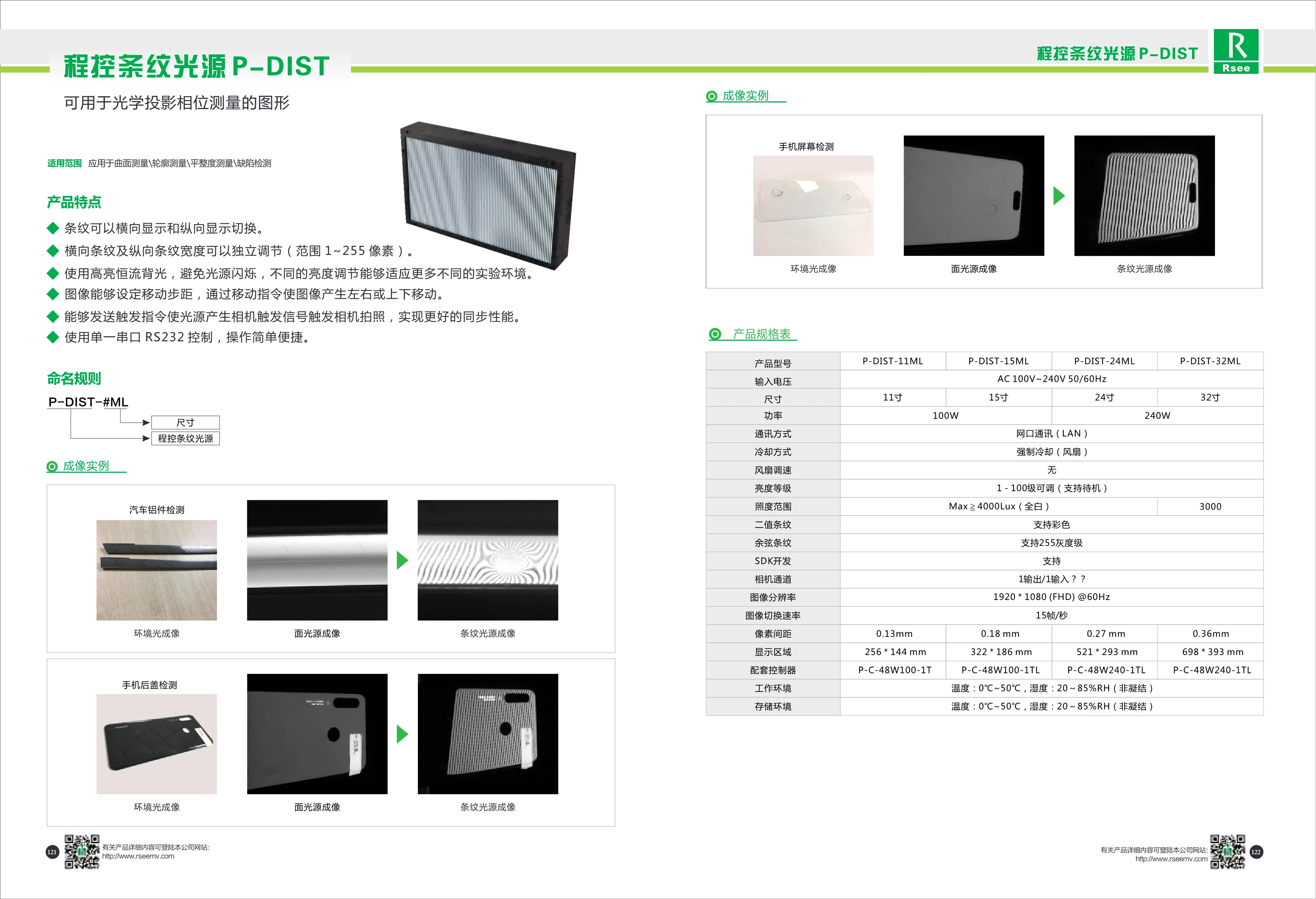
Programmable Fringe Light Source P-DIST
The P-DIST series programmable fringe light source is a pattern light source for optical projection phase measurement. It supports switching between horizontal and vertical fringes, with independently adjustable fringe widths (1–255 pixels). Its high-brightness constant-current backlight prevents flicker, and brightness is adjustable across 100 levels. The image movement step can be set, and camera triggering is supported for synchronized image capture. Simple operation is provided through control via a single RS232 serial port. Available in 11-, 15-, 24-, and 32-inch sizes, with 100 W or 240 W power, AC 100–240 V input, LAN communication, and forced-air cooling. Maximum illuminance is ≥4000 lux (full white). The source supports color binary fringes and 255-grayscale-level cosine fringes. Compatible controllers are P-C-48W100-1T, P-C-48W100-1TL, and P-C-48W240-1TL. Applications include inspection of automotive aluminum parts, mobile phone back covers, and mobile phone screens.
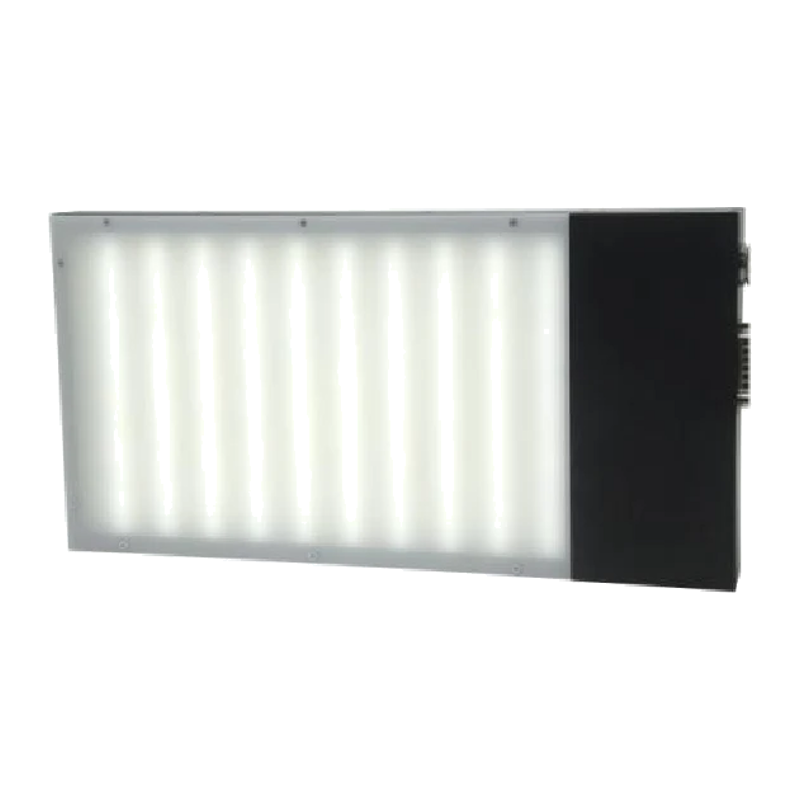
Programmable Stripe Light Source P-DISL2
The programmable stripe light source P-DISL2 is a new type of light source capable of generating horizontal and vertical stripe patterns at high speed at the same workstation. It can project horizontal and vertical stripe patterns and adjust parameters such as stripe width, spacing, and offset, with support for freely editing stripe patterns. It supports both line-scan and area-scan modes. The maximum line-scan rate is 71,428 lines/s (internal trigger); the maximum strobe switching frequency is 1,000 Hz (internal trigger), and the maximum constant-on/off switching frequency is 500 Hz (internal trigger). It comes with an external line-laser pointer for quickly setting the angle. Communication is via a DB15 interface. Cooling is provided by forced-air fans (fans supplied by the customer), and the drive modes are strobe drive and PWM drive. The stripe grating has no dividers, and stripe patterns can be custom-edited. Operating environment: 0°C to 40°C, 20–85% RH (non-condensing); storage environment: -20°C to 60°C, 20–85% RH (non-condensing). Multiple sizes are available, with varying overall dimensions, illuminated areas, input voltages, power ratings, and other specifications.