Model · Round Compression Force Sensor
Round Compression Force Sensor
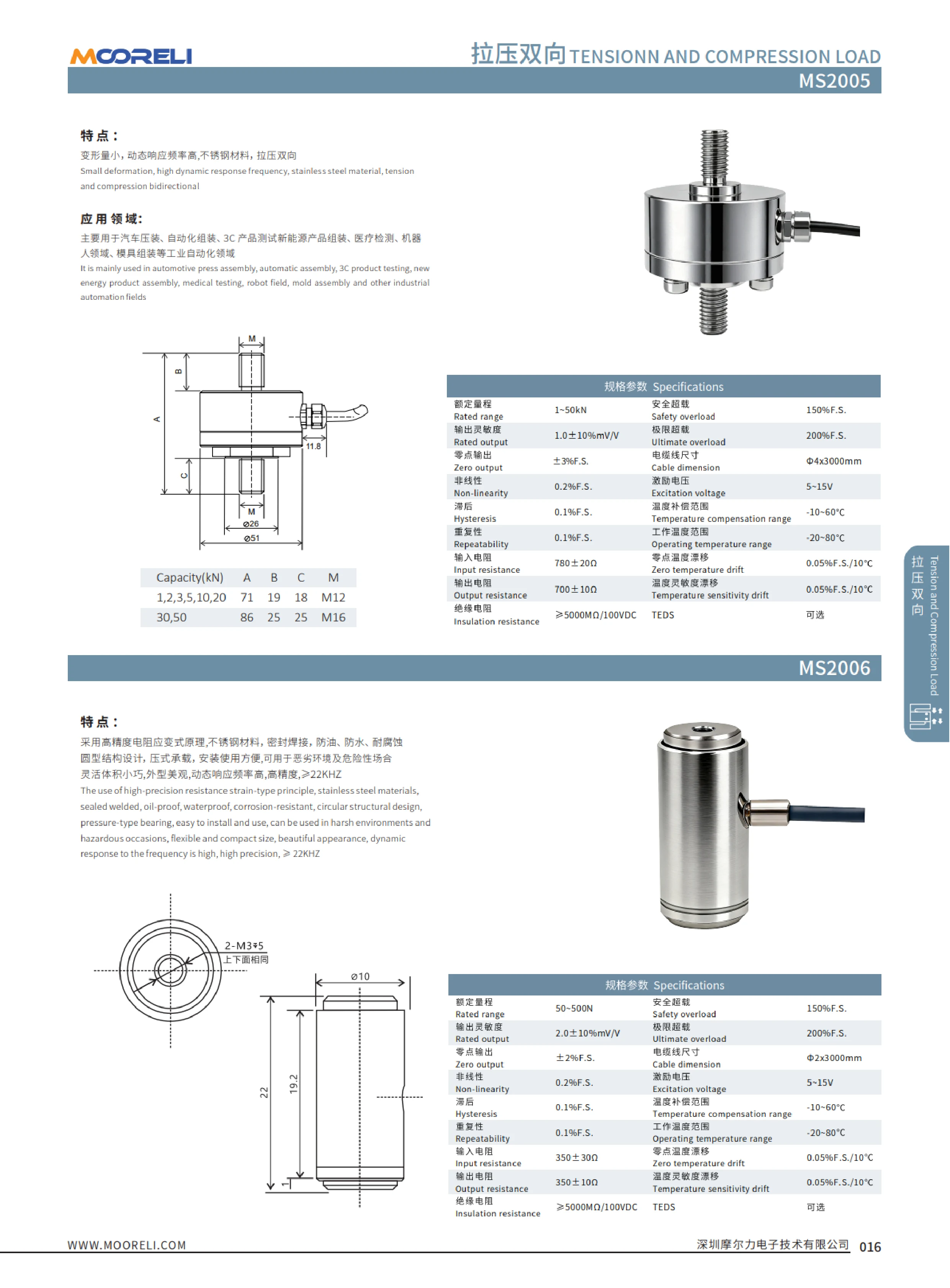
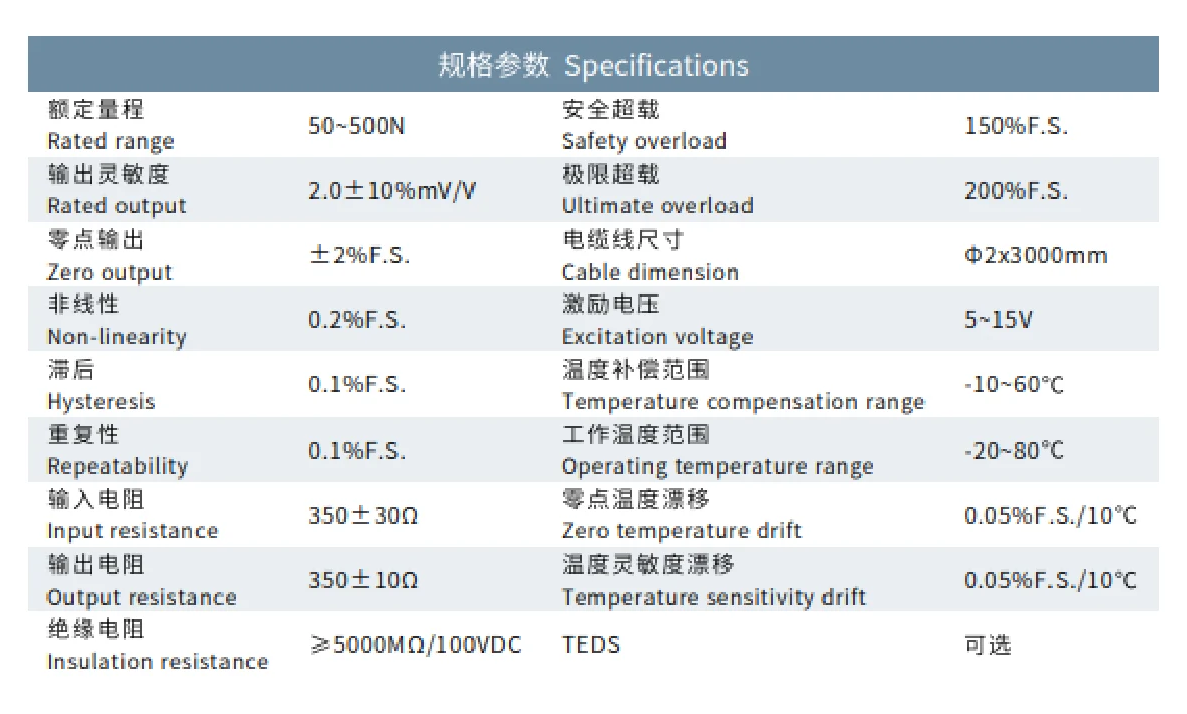
The round compression force sensor uses a high-precision resistance strain gauge principle and features a stainless steel sensing element with a welded seal. It is resistant to oil, water and corrosion, making it suitable for long-term use in humid, dusty and other challenging environments, including hazardous locations. Its round design is intended primarily for compression loading, with minimal deformation under load, a high dynamic response frequency (≥22KHZ), high stiffness and strong resistance to off-center loads. It is compact, attractive and easy to install and use. Some models support bidirectional tension and compression measurement, allowing both forces to be detected. Typical specifications include rated capacity, output sensitivity, nonlinearity, repeatability, hysteresis, zero temperature drift, input/output impedance, insulation resistance, recommended excitation voltage, safe and ultimate overload, operating temperature range, protection rating, cable length and cable exit configuration. These sensors are primarily used for force measurement and process control in industrial automation applications such as automotive press fitting, automated assembly, consumer electronics testing, new energy product assembly, medical testing, robotics and mold assembly.
Overview
The round compression force sensor uses a high-precision resistance strain gauge principle and features a stainless steel sensing element with a welded seal. It is resistant to oil, water and corrosion, making it suitable for long-term use in humid, dusty and other challenging environments, including hazardous locations. Its round design is intended primarily for compression loading, with minimal deformation under load, a high dynamic response frequency (≥22KHZ), high stiffness and strong resistance to off-center loads. It is compact, attractive and easy to install and use. Some models support bidirectional tension and compression measurement, allowing both forces to be detected. Typical specifications include rated capacity, output sensitivity, nonlinearity, repeatability, hysteresis, zero temperature drift, input/output impedance, insulation resistance, recommended excitation voltage, safe and ultimate overload, operating temperature range, protection rating, cable length and cable exit configuration. These sensors are primarily used for force measurement and process control in industrial automation applications such as automotive press fitting, automated assembly, consumer electronics testing, new energy product assembly, medical testing, robotics and mold assembly.
Product category: Sensors/Force Sensors/Compression Force Sensors

Dimensions & drawings
Original catalogs