Crossed Cylindrical Roller Bearing
BX0118 Series Crossed Roller Bearings
The BX0118 series crossed roller bearings feature rollers arranged at right angles to one another, enabling them to support axial loads, radial loads, and overturning moments simultaneously. They offer high rotational accuracy, high rigidity, and a compact design, making them suitable for applications requiring smooth, precise rotation, such as precision rotary tables, CNC machine tool rotary tables, robot joints, semiconductor equipment, and medical and measuring instruments. The catalog lists models including BX011814–BX011880 and BX011850, with bore diameters ranging from 70 mm to 500 mm, outside diameters from 90 mm to 620 mm, roller pitch circle diameters from 80 mm to 560 mm, widths from 10 mm to 56 mm, and individual weights of approximately 0.3–44 kg. BX0118 is the main series designation; the trailing digits in each model number indicate different overall dimensions. Mounting interface dimensions can be referenced against leading international crossed roller bearing series. Select a model based on the actual load, speed, and available installation space.
EDRX Series Bearings
Crossed Roller Bearings
A crossed roller bearing is a precision bearing in which cylindrical rollers are arranged alternately at right angles in a 90° V-shaped raceway, with spacers between the rollers. Its inner and outer rings can be designed to be compact and ultra-thin. While maintaining high rigidity, it can achieve rotational accuracy grades of P5, P4, and P2. The crossed roller arrangement and spacers prevent the rollers from tilting or rubbing against one another, avoiding roller displacement or jamming and ensuring stable rotational torque. The inner or outer ring has a split design, making it easy to install the rollers and spacers and then secure the assembly as a whole. Installation is simple, and preload can be applied by adjusting bearing clearance to achieve high-precision rotational motion. A single bearing can support loads in multiple directions, including radial, axial, and moment loads. Its rigidity is 3–4 times greater than that of conventional models. These bearings are widely used in industrial robot joints and rotary sections, machining center rotary tables, precision rotary tables, medical equipment, measuring instruments, military equipment, and IC manufacturing equipment.
BRB Crossed Cylindrical Roller Bearing
The BRB crossed cylindrical roller bearing is a precision slewing bearing with a split outer ring and a rotating inner ring. Its rollers are arranged crosswise in the raceways, allowing it to withstand radial loads, axial loads, and overturning moments simultaneously. It offers high rigidity, excellent rotational accuracy, and a compact design. Applications include machine-tool rotary tables, industrial robot joints, indexing devices, rotary measuring tables, and rotating components in precision machinery. The complete model designation consists of BRB + size code + suffix. In the example BRB12025UUCC0P2, 12025 indicates a 120 mm bore and 25 mm width, UU indicates seals on both faces, CC0 indicates negative clearance (preload), and P2 denotes a high-precision grade. Options include U for a seal on one face, C0/C1 clearance, P5/P4/P0 accuracy grades, and the USP rotational accuracy grade.
BRE-Type Crossed Cylindrical Roller Bearings
BRE-type crossed cylindrical roller bearings feature a split inner ring and an integral outer ring. They are suitable for applications requiring high rotational accuracy of the outer ring. Based on the BRE design concept, these bearings retain standardized series dimensions for their main profile and mounting dimensions. The split inner ring facilitates preload adjustment, while the integral outer ring helps ensure support rigidity and positioning accuracy during rotation. The crossed arrangement of cylindrical rollers allows the bearings to withstand radial loads, axial loads, and overturning moments simultaneously. They are compact, highly rigid, and provide stable rotational accuracy. Common applications include robot joints, rotating sections of robotic arms, CNC rotary tables, machine tool spindles, and precision rotary devices.
BRU Crossed Roller Bearing
BRU crossed roller bearings belong to the “BRU, BSU, and BXY types (integral inner and outer rings)” category in the catalog. Both rings have an integral design, and mounting holes are machined into the product, so no separate mounting flange or support seat is required. The integrated inner and outer rings with built-in mounting seats minimize the effect of installation on bearing performance, providing stable rotational accuracy and torque. This design can be used with either the inner or outer ring rotating. The rollers in crossed roller bearings are arranged alternately, allowing the bearings to withstand radial loads, axial loads, and overturning moments simultaneously. They are suitable for rotating components in machinery where high rotational accuracy and rigidity, as well as a compact installation, are required. This page provides an overview of the type; specific size series, load ratings, and complete order codes are not listed. Refer to the dimension tables for detailed specifications.
BSU Crossed Roller Bearings
BSU is a type of crossed roller bearing with an integrated inner and outer ring design. The mounting holes in both rings are machined during manufacture, so no separate mounting flange or support seat is needed during installation. The integrated ring-and-seat design helps prevent installation from significantly affecting bearing performance, ensuring consistent rotational accuracy and torque. The rollers are arranged crosswise, providing high rigidity in a compact footprint. These bearings can be used with either the inner or outer ring rotating. Typical applications include joints in industrial robots and robotic arms, where lightweight construction, compactness, and high rotational accuracy are required.
BXY Crossed Cylindrical Roller Bearings
BXY crossed cylindrical roller bearings feature an integrated inner and outer ring design. Mounting holes are pre-machined, so the bearings can be installed directly without a fixing flange or support housing. The integrated, housed inner and outer rings mean installation has virtually no effect on performance, ensuring stable rotational accuracy and torque. The design is suitable for rotation of either the inner or outer ring. With cylindrical rollers arranged alternately, crossed cylindrical roller bearings offer high rigidity and rotational accuracy, making them suitable for precision equipment applications that require a compact design, high rigidity, and stable rotation.
BX-Type Crossed Cylindrical Roller Bearing
The BX-type crossed cylindrical roller bearing features a split outer ring and is designed for applications with a rotating inner ring. Its structure is similar to that of the BRB series. The outer ring has a two-piece design joined by three retaining rings, while the inner ring is made as a single piece, making it suitable for applications that require high inner-ring rotational accuracy. The cylindrical rollers are arranged crosswise, enabling the bearing to withstand radial loads, axial loads, and overturning moments simultaneously while offering high rigidity and rotational accuracy. The split outer ring of the BX bearing makes preload adjustment easier, while the one-piece inner ring ensures accurate positioning during rotation. It is suitable for automation equipment requiring high rotational accuracy, such as machine-tool rotary tables, indexing devices, and industrial robot joints. For available models, dimensions, and detailed specifications, please refer to the product catalog.
BBH Series Crossed Cylindrical Roller Bearings
BBH series crossed cylindrical roller bearings feature an integral inner- and outer-ring design. Both rings are made as one piece, allowing either the inner or outer ring to rotate and helping ensure rotational accuracy and operating stability. The rollers are arranged in a crossed pattern, enabling the bearing to support radial and axial loads as well as overturning moments simultaneously. These bearings are suitable for applications requiring high rigidity and precise rotary support, such as robot joints, rotary sections of manipulators, machine-tool tables, and indexing tables. This catalog page introduces the different types of crossed cylindrical roller bearings but does not provide a specific dimensional specifications table. When selecting a bearing, confirm the inner and outer diameters, width, and load ratings for the specific BBH model. The same page also lists other structural types, including BRB, BRE, BRU, BSU, BXY, BX, BRA, and BBS. BBH belongs to the integral inner- and outer-ring category.
BRA Type Crossed Cylindrical Roller Bearing
The BRA type crossed cylindrical roller bearing features a split outer ring and is designed for applications where the inner ring rotates. Its construction is similar to the BRB series: the outer ring is split into two sections joined by three retaining rings, while the inner ring is a single piece. Based on the BRB type, this compact design reduces the thickness of both rings to a minimum. It is particularly suitable for applications requiring a lightweight, compact design, such as the rotating joints of robots and robotic arms. The bearing offers high rotational accuracy and is ideal for applications that require high inner-ring rotational accuracy.
BBS-Type Crossed Cylindrical Roller Bearings
BBS-type crossed cylindrical roller bearings feature an integral inner- and outer-ring design. Both rings are formed as complete, single-piece components, with no split raceway parts. This design helps prevent additional deformation caused by assembly or clamping during installation, supporting consistent rotational accuracy and torque. The series shares the same dimensions as the BRA series, and both the inner and outer rings offer high rotational accuracy. The cylindrical rollers in crossed roller bearings are arranged alternately at right angles in a V-shaped raceway, allowing the bearings to support radial loads, axial loads, and overturning moments simultaneously. They are suitable for applications that require a compact structure, high rigidity, and precise rotation, such as robot joints, rotating sections of manipulators, CNC rotary tables, and machine-tool rotary tables.
BRB/BRE/BRU Crossed Roller Bearings
This series comprises crossed roller bearings in BRB, BRE, BRU and other models. The rollers are arranged crosswise at 90° intervals, allowing a single bearing to withstand radial loads, axial loads and overturning moments simultaneously. These bearings offer high rigidity, high rotational accuracy and a compact design, making them suitable for applications such as industrial robot joints, machine-tool rotary tables, precision indexing devices and direct-drive motors. This page provides rotational accuracy standards for BRB/BRE and BRU types. Across bearing outer diameters from 30 to 1,600 mm, it specifies the permissible radial runout values for inner-ring and outer-ring rotational accuracy at the P5, P4 and P2 accuracy grades. Values are given in micrometres (μm) and can be used as a reference for product selection and accuracy inspection.
BRU-Type Crossed Roller Bearings
BRU-type crossed roller bearings are a series of high-precision crossed roller bearings. The rollers are arranged crosswise at 90° between the raceways of the inner and outer rings, allowing the bearings to support radial loads, axial loads, and overturning moments simultaneously. Their compact design, high rigidity, and excellent rotational accuracy make them suitable for robot joints, rotary tables, rotary axes in CNC machine tools, and precision positioning equipment. This page provides the rotational accuracy standards for the BRU series, specifying the permissible radial runout (rotational accuracy) values for the inner and outer rings at three accuracy grades: P5, P4, and P2. Values are given in micrometres and listed by bearing model. Higher accuracy grades have tighter runout tolerances, helping you select and inspect bearings for a range of precision rotary applications.
BRB/BRE/BX Series Bearings
BRB, BRE, and BX series precision bearings are designed for applications requiring high-rigidity rotary support, such as robot joints and rotary units. The catalog lists allowable outer-diameter tolerances for bearings with bore diameters ranging from 18 to 1,600 mm, grouped by bore size, and covers multiple precision grades: PO, P6, P5, and P4/P2. It also offers three radial clearance (preload) options: CC0, C0, and C1. A fit recommendation table specifies key combinations for inner- or outer-ring rotating loads and impact torque conditions, recommending g5 or h5 shaft tolerances and an H7 housing tolerance to help ensure the required preload and service life. A bolt-tightening torque table (M3 to M22) is also included to help control torque during installation and ensure reliable assembly.
BRB Series Crossed Roller Bearings
The BRB series features crossed roller bearings with cylindrical rollers arranged at 90° angles. They can simultaneously support radial loads, bidirectional axial loads, and overturning moments, while offering high rigidity, high rotational accuracy, and a compact design. This catalog covers large sizes with shaft (bore) diameters from 120 to 1,250 mm and outside diameters up to 1,500 mm. Roller pitch circle diameters and widths vary by model, with widths ranging from 13 to 110 mm. Model numbers follow the format “BRB + bore diameter + width”; for example, BRB12016 indicates a 120 mm bore and 16 mm width, while BRB1000110 indicates a 1,000 mm bore and 110 mm width. The table also lists the outside diameter, pitch circle diameter, chamfer, shoulder dimensions ds/Dh, basic dynamic radial load rating C, static load rating Co, and weight per set. These bearings are suitable for automation applications requiring high support rigidity and rotational accuracy, including industrial robot joints, CNC rotary tables, dividing heads, rotary worktables, and precision slewing supports.
BRE Series Crossed Roller Bearings
The BRE series comprises large crossed roller bearings, with cylindrical rollers arranged alternately at 90°. A single bearing can support radial and axial loads as well as overturning moments. These bearings are commonly used in low-speed, high-rigidity rotary applications such as CNC rotary tables, machine-tool rotary axes, robot joints, and welding and metrology rotary tables. This page covers large sizes with bore (shaft) diameters of 130–600 mm, outside diameters of 160–700 mm, roller pitch-circle diameters of approximately 146–650 mm, and widths of 13–50 mm. The table lists basic dynamic radial load ratings C of approximately 25–284 kN, basic static load ratings C₀ of approximately 46.7–721 kN, and weights of approximately 0.68–41.7 kg per bearing. It also provides reference dimensions for the shaft-side and housing-side mounting shoulders (ds and Dh), as well as the minimum chamfer radius r. The model designation consists of BRE followed by the bore-diameter code and width code; for example, BRE25030 indicates a 250 mm bore and a 30 mm width. The entire series consists of steel, integral crossed-roller slewing bearings, designed for rotating load-bearing structures requiring high rigidity and precise positioning.
BRU (CRBF) Series Crossed Roller Bearings
BRU (CRBF) series crossed roller bearings feature crossed cylindrical rollers and 90° V-shaped raceways. They can simultaneously withstand radial loads, axial loads, and overturning moments, offering high rigidity and rotational accuracy. Mounting holes are machined into both the inner and outer rings for direct fastening to equipment flanges or rotary tables. These bearings are suitable for machine-tool rotary tables, industrial robot joints, gearboxes, and precision rotary mechanisms. The range includes various sizes, with shaft diameters of 10–350 mm, outer diameters of 52–540 mm, roller pitch-circle diameters of 28.5–445.4 mm, and widths of 8–45 mm. The suffix (G) indicates the standard mounting-hole configuration. The catalog also provides mounting-hole distribution parameters for product selection and comparison.
BXU Series Crossed Roller Bearings
BXU series crossed roller bearings feature cylindrical rollers arranged at 90° between the raceways of the inner and outer rings. The rollers make line contact with the raceways, providing high rigidity, excellent rotational accuracy, and strong resistance to overturning. They can simultaneously support axial, radial, and combined loads. The models listed here begin with BXU and span multiple size ranges, with bore diameters of 40–384 mm, outer diameters of 112–646 mm, roller pitch-circle diameters of 77–515 mm, widths of 15.87–86 mm, and weights of approximately 1.2–115 kg. Both the inner and outer rings have mounting holes or threaded holes for direct fastening to a rotary table, base, or flange. These bearings are suitable for high-precision rotary applications such as robot joints, indexing tables, CNC rotary tables, and precision rotary worktables. The table lists parameters for each model, including mounting-hole center distances, mounting-hole specifications, and basic dynamic load ratings, allowing direct selection by model.
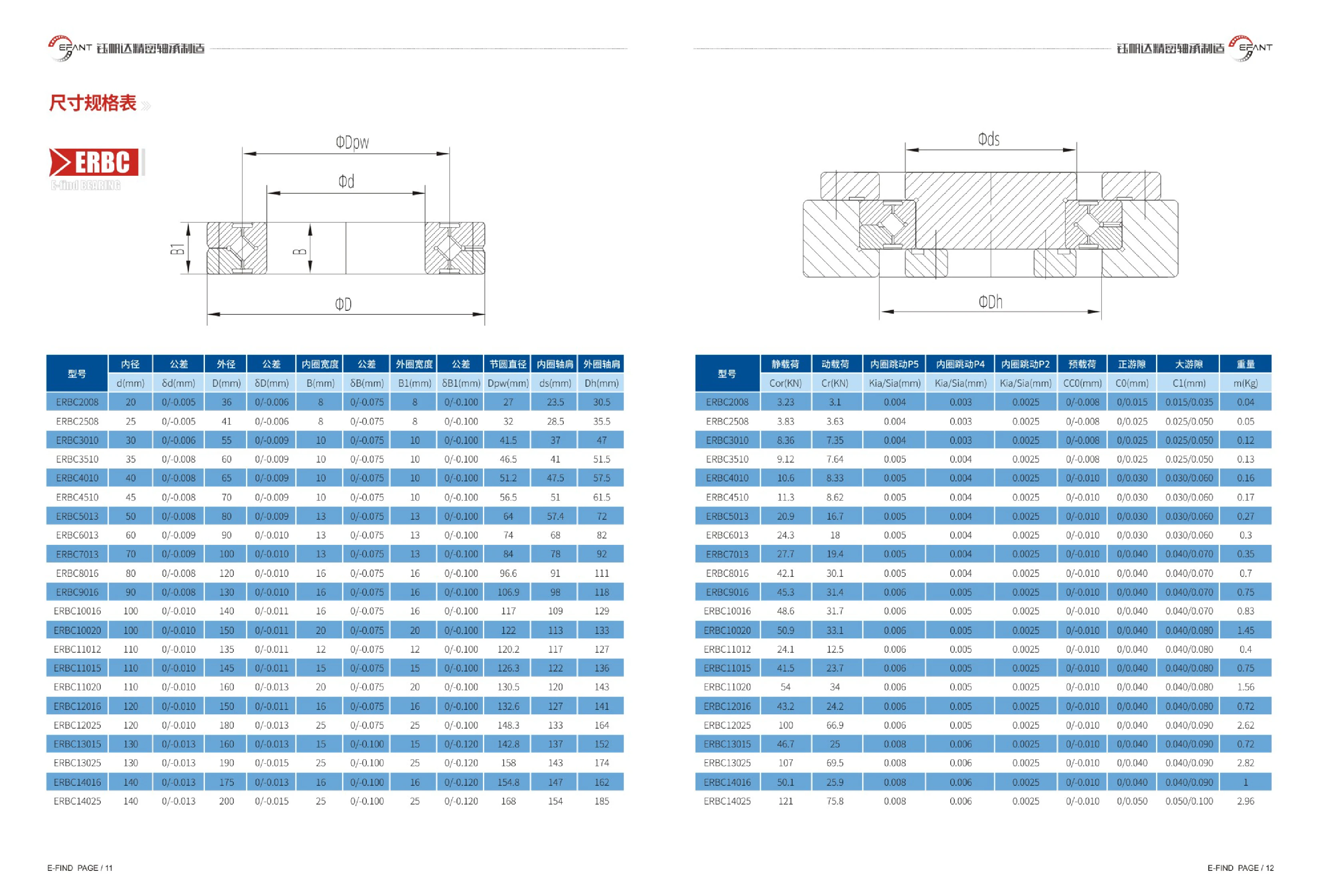
ERBC Series Crossed Roller Bearings
ERBC series crossed roller bearings feature rollers arranged at 90° to one another, allowing them to support radial, axial and moment loads simultaneously. They offer high rigidity, high rotational accuracy and a compact, thin-wall design. The catalog covers bore diameters of 20–1250 mm, outer diameters of 36–1500 mm and widths of 8–110 mm. For each model, it specifies bore diameter, outer diameter, inner ring width and outer ring width tolerances, pitch diameter, and inner and outer ring shoulder dimensions. Three accuracy grades (inner ring runout) are available: P5, P4 and P2, along with three clearance configurations: CC0 (preload), CO (positive clearance) and C1 (large clearance). Static load Cor, dynamic load Cr and weight are also listed. Model numbers consist of the ERBC prefix followed by bore diameter and width figures (for example, ERBC2008 has a 20 mm bore diameter and an 8 mm width). These bearings are commonly used in the rotating sections of CNC rotary tables, swiveling milling heads, direct-drive motors and precision testing equipment. Internal or external gears, additional flanges, surface heat treatment, and matching bearing housings and shafts can be customized.
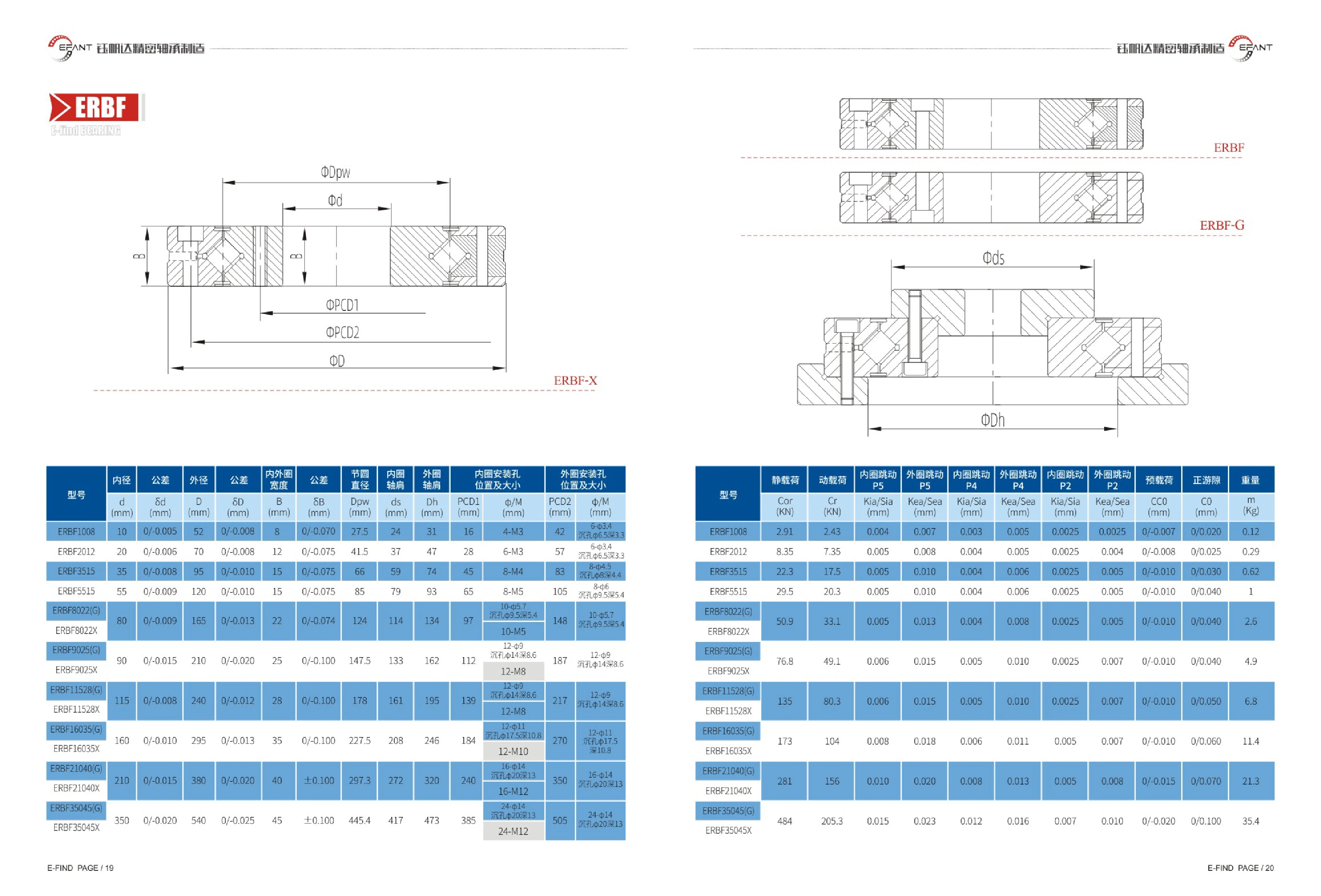
ERBF-X Series Crossed Roller Bearings
The ERBF-X series comprises crossed roller bearings with mounting holes in both the inner and outer rings. Their rollers are arranged at 90° to one another, allowing them to support radial, axial and moment loads simultaneously. They offer high rigidity, high rotational accuracy and a compact design. Applications include robot joints, precision rotary tables, indexing tables, medical equipment and rotary mechanisms in industrial automation. Models cover inner diameters of 10~350 mm and outer diameters of 52~540 mm, with P5/P4/P2 runout grades and preload or positive clearance options. The main difference between G and X types is the outer ring mounting hole design: the X type uses threaded holes.
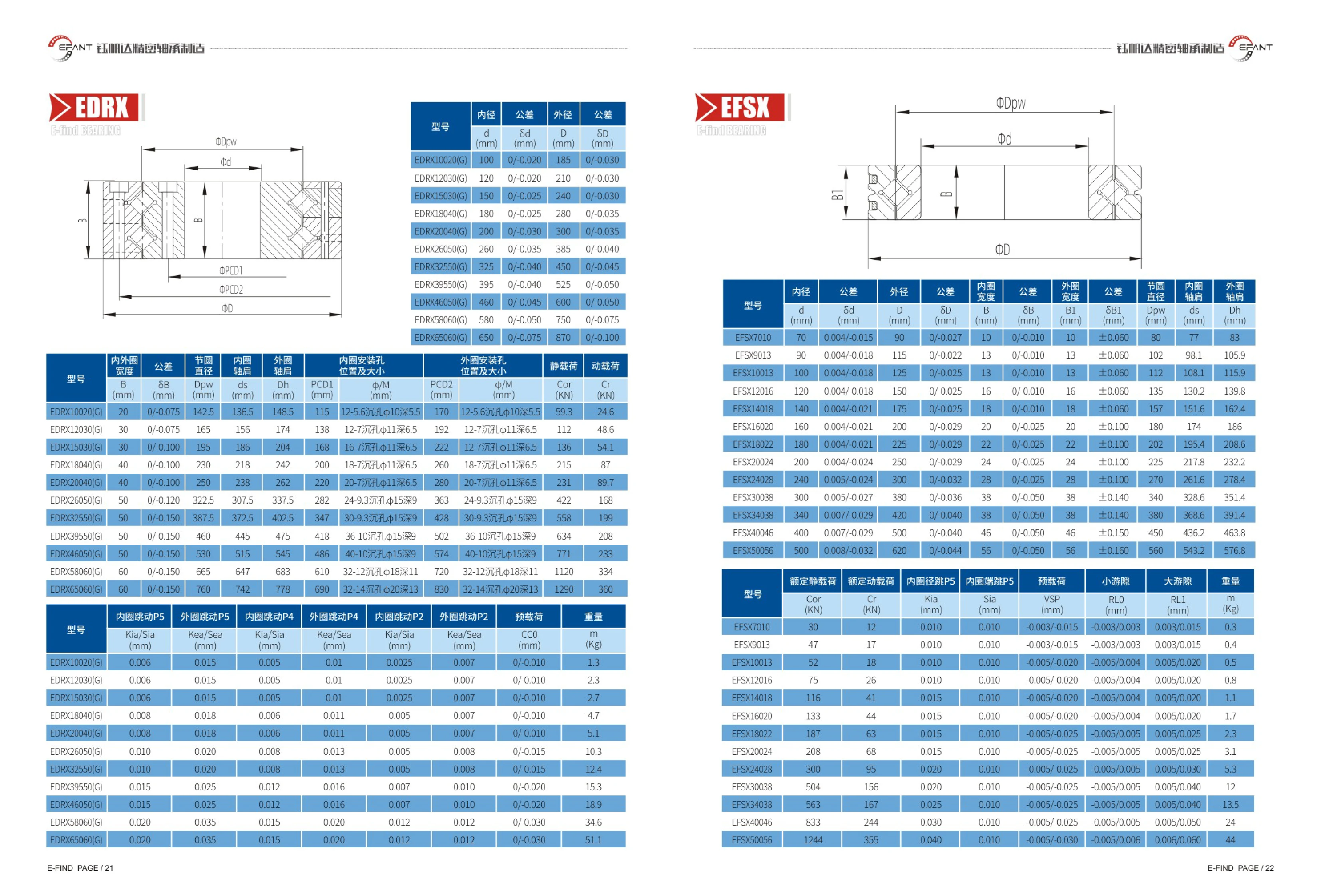
EDRX/EFSX Series Thin-Section Bearings
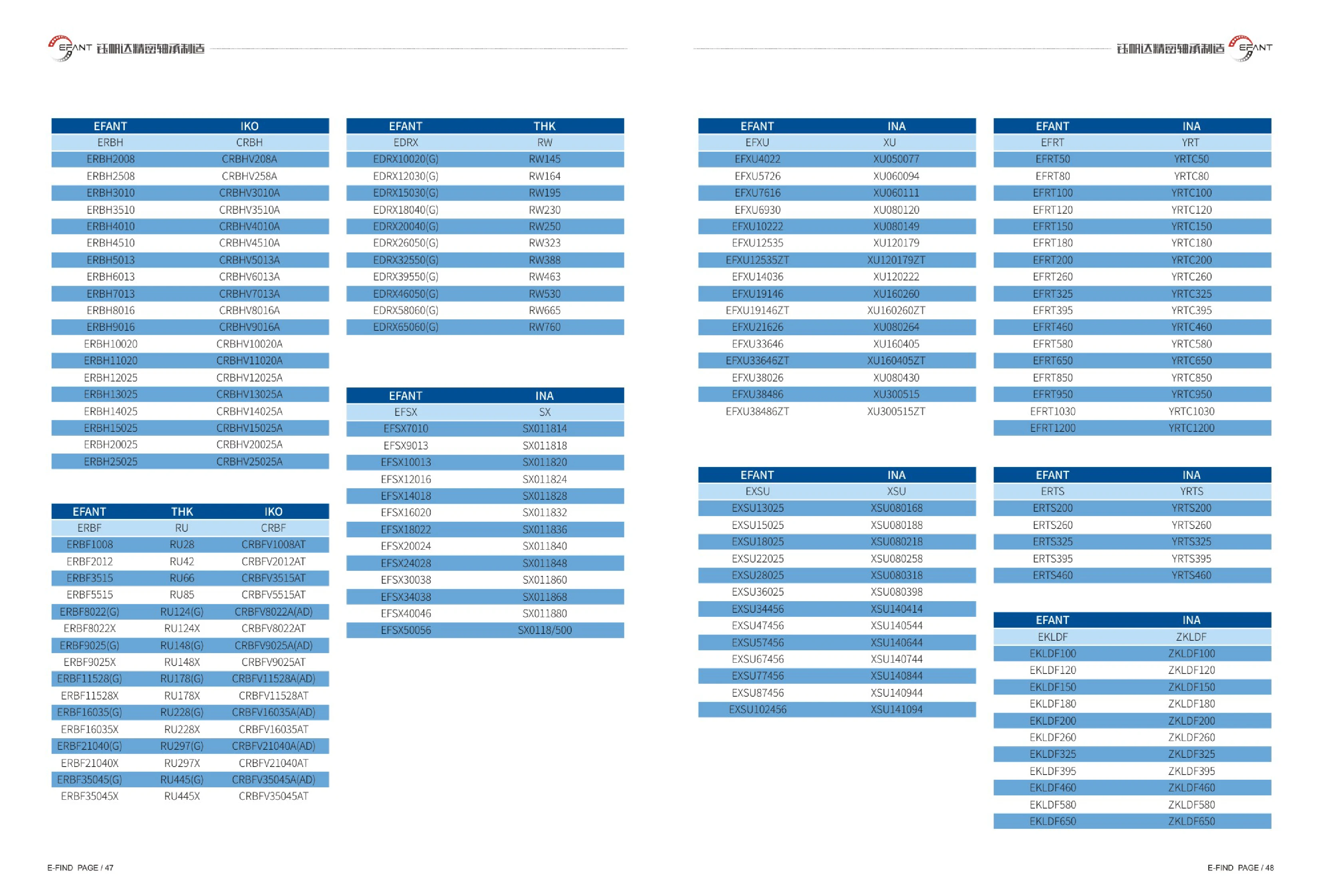
EDRX/EFSX series thin-section bearings are suitable for precision rotating assemblies with limited installation space, such as robot joints, precision rotary tables, and indexing tables. The EDRX type is available in 15 sizes, with bore diameters of 100~900 mm and outer diameters of 185~1100 mm. Bore tolerances range from 0/-0.020~0/-0.100 mm and outer diameter tolerances from 0/-0.030~0/-0.100 mm. The EFSX type is available in 13 sizes, with bore diameters of 70~500 mm and outer diameters of 90~620 mm. Inner and outer ring widths, pitch circle diameter, and inner and outer ring mounting-hole pitch circle diameters are also specified. Bore tolerance is tightened to 0.004~0.008 mm, width tolerance is 0/-0.010~0/-0.050 mm, and mounting-hole pitch tolerance is ±0.06~±0.16 mm, facilitating direct bolting to adjacent structures. Select the size by matching the bore diameter, outer diameter, and tolerance class to the equipment shaft system's accuracy requirements.
EFSX Series Crossed Roller Bearings
The EFSX series consists of thin-section crossed roller bearings with the same dimensions as the SX0118 series. Rollers are arranged at 90° to one another, allowing the bearings to accommodate radial loads, axial loads in both directions, and overturning moments simultaneously, with high rigidity and rotational accuracy. Model numbers consist of EFSX + bore diameter + width; for example, EFSX7010 denotes a bore diameter of 70mm and a width of 10mm. The catalog covers 13 sizes with bore diameters of 70~500mm, outside diameters of 90~620mm, and widths of 10~56mm. Bore diameters have unilateral negative tolerances starting at 0.004~0.008mm; outside diameter tolerance is 0~-0.044mm, inner ring width tolerance is 0/-0.010~0/-0.050mm, and outer ring width tolerance is ±0.060~±0.160mm. The catalog also specifies the pitch circle diameter and the mounting hole pitch circle dimensions (center distances) for the inner and outer rings, facilitating direct bolt mounting. These bearings are widely used in applications requiring high rigidity and rotational accuracy, including robot joints, precision rotary tables, indexing tables, radar, and medical equipment.
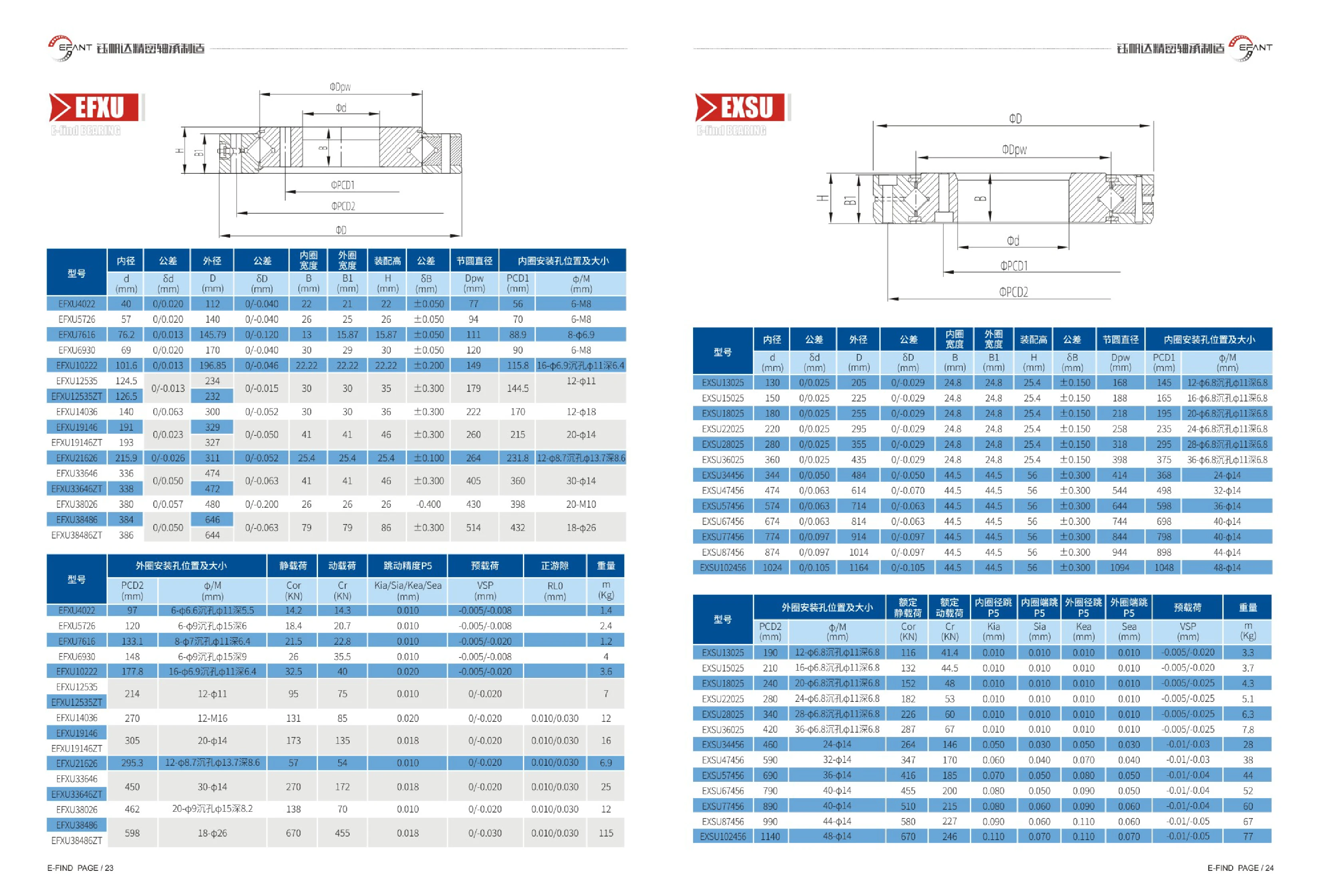
EFXU Series Bearings
The EFXU series consists of slewing bearings (turntable bearings) with mounting holes in the inner ring. The catalog provides a complete range of dimensions and tolerances in tabular form. The series covers inner diameters of 40~384 mm (including the imperial conversions of 76.2, 101.6, and 215.9 mm for EFXU7616, EFXU10222, and EFXU21626, respectively), outer diameters of 112~646 mm, inner ring widths of 13~79 mm, outer ring widths of 15.87~79 mm, and assembly heights of 15.87~86 mm. Each size specifies the inner diameter tolerance (e.g., 0/0.020), outer diameter tolerance (e.g., 0/-0.040), assembly height tolerance (±0.050~±0.300), pitch circle diameter Dpw, inner ring mounting hole pitch circle PCD1, and the type and number of inner ring mounting holes (M8 and M10 threaded holes, φ6.9, φ8.7, φ11, φ14, φ18, and φ26 through holes, and counterbored versions). The ZT model suffix denotes a variant with inner and outer diameters different from the standard model. These bearings are suitable for load-bearing and drive structures in low-speed rotation, oscillation, or positioning applications.
EXSU Series Bearings
EXSU series bearings are listed in the catalog under both EXSU and EFXU designations, covering bore diameters from 40mm to 1024mm. Key dimensions include bore diameter d, outside diameter D and its upper and lower deviations, inner ring width B, outer ring width B1, assembly height H and its tolerance, pitch circle diameter Dpw, and inner ring mounting hole pitch circle PCD1 and hole type (such as 6-M8, 12-φ11, and 20-φ14; some have φ6.9 holes with φ11 counterbores 6.4 deep). Tolerances vary by size: smaller sizes typically have bore tolerances of 0/0.020 and outside diameter tolerances of 0/-0.040; medium and large sizes use wider tolerances of 0/0.063 and 0/-0.063, respectively, while assembly height tolerances increase from ±0.050 to ±0.150 or ±0.300. Models with the ZT suffix have dimensions similar to standard models and are distinguished by their structure or variant. This series is widely used in rotary tables, indexing tables, articulated mechanisms, and other applications requiring high rigidity and rotational accuracy.
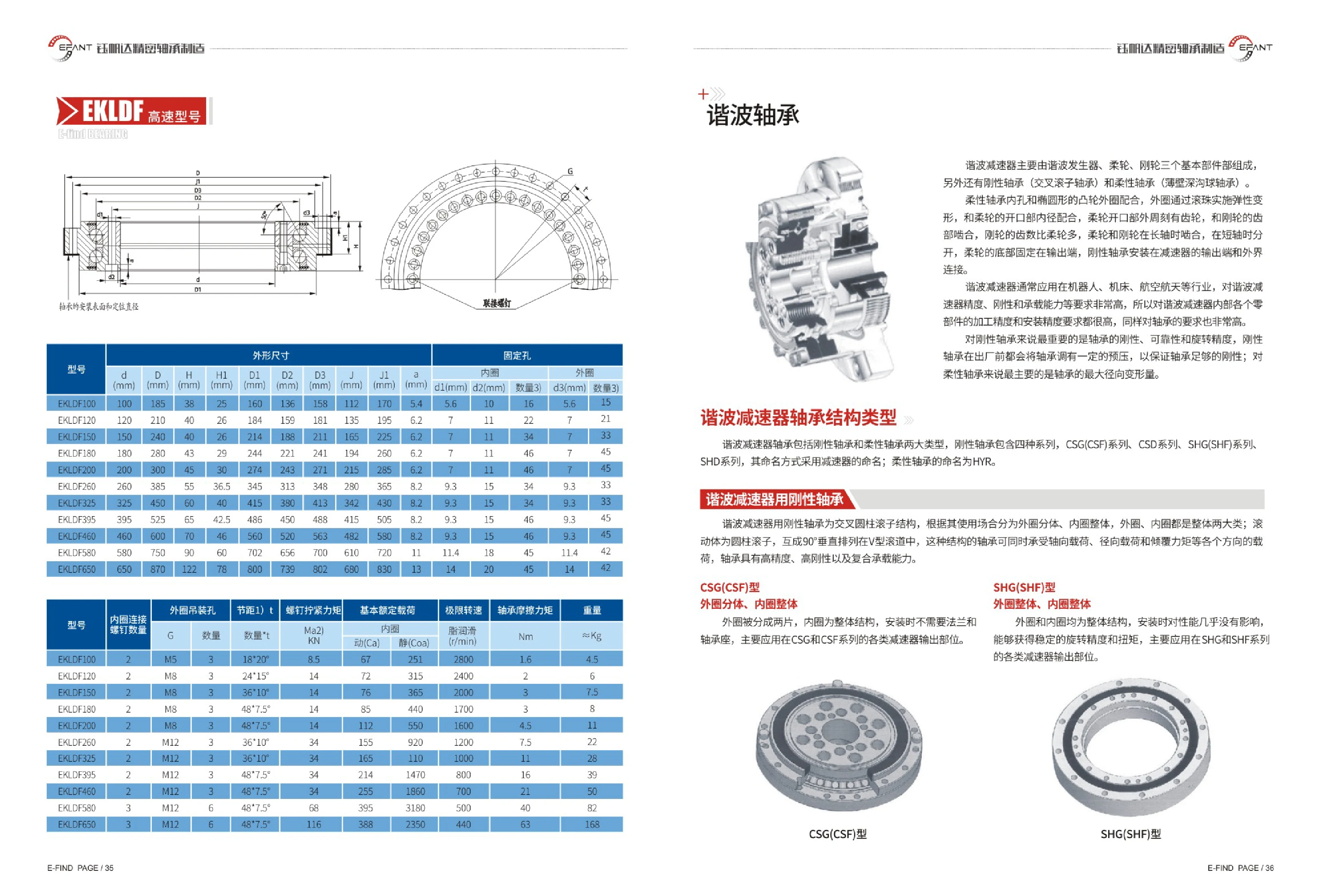
EKLDF Series Rigid Bearings for Harmonic Drive Reducers
EKLDF series rigid bearings for harmonic drive reducers feature crossed cylindrical rollers arranged perpendicular to each other at 90° in a V-shaped raceway. They can simultaneously accommodate axial loads, radial loads, and overturning moments. Depending on the application, they are available in two configurations: a split outer ring with an integral inner ring, or integral outer and inner rings. They offer high precision, high rigidity, and combined load capacity. The range covers d=100~650 mm in 11 sizes and is suitable for harmonic drive reducers, robot joints, and precision rotary mechanisms.

CSG(CSF) Series Rigid Bearings for Harmonic Reducers
CSG/CSF series rigid bearings for harmonic reducers feature a crossed cylindrical roller design, with rollers arranged perpendicular to each other at 90° in a V-shaped raceway. They simultaneously accommodate axial loads, radial loads, and overturning moments, providing high precision, high rigidity, and combined load capacity. Depending on the application, they are available in two main configurations: a split outer ring with an integral inner ring, or integral outer and inner rings. Rigid bearing series include CSG(CSF), CSD, and SHG(SHF). This page lists 11 sizes with bore diameters d=100~650mm, along with overall and mounting dimensions including d, H, H1, D1, D2, D3, J, J1, and a, as well as mounting hole specifications for the inner and outer rings. These bearings are suitable for harmonic reducer output support and precision rotary applications.
CSD Series Rigid Bearings for Harmonic Drives
Rigid bearings for harmonic drives feature crossed cylindrical rollers arranged at 90° to one another in a V-shaped raceway. They simultaneously accommodate axial loads, radial loads, and overturning moments, offering high precision, high rigidity, and strong combined-load capacity. Depending on the application, they are available in two main designs: a split outer ring with an integral inner ring, or integral inner and outer rings. Rigid bearing series include CSG(CSF), CSD, and SHG(SHF), and are commonly used in precision drive applications such as harmonic drives, robot joints, and precision rotary tables. This page lists EKLDF specifications with bore diameters d=100~650 mm, outer diameters of 185~870 mm, and heights of 38~122 mm. Mounting hole and raceway dimensions are also provided to support selection and installation design.

SHG(SHF) Series Rigid Bearings for Harmonic Reducers
Rigid bearings for harmonic reducers use a crossed cylindrical roller design, with cylindrical rollers arranged at 90° to one another in V-shaped raceways. They can simultaneously support axial loads, radial loads, and tilting moments, providing high precision, high rigidity, and combined load capacity. Depending on the application, they are divided into two main types: split outer ring with integral inner ring, and integral inner and outer rings. The rigid bearing range comprises four series: CSG(CSF), CSD, SHG(SHF), and SHG(CSF). The catalog lists 11 sizes from EKLDF100 to EKLDF650, with bore diameter d ranging from 100mm to 650mm. Overall height, mounting hole dimensions, and other dimensions increase with bore diameter. These bearings are widely used in precision transmission applications such as industrial robot joints and harmonic reducers.
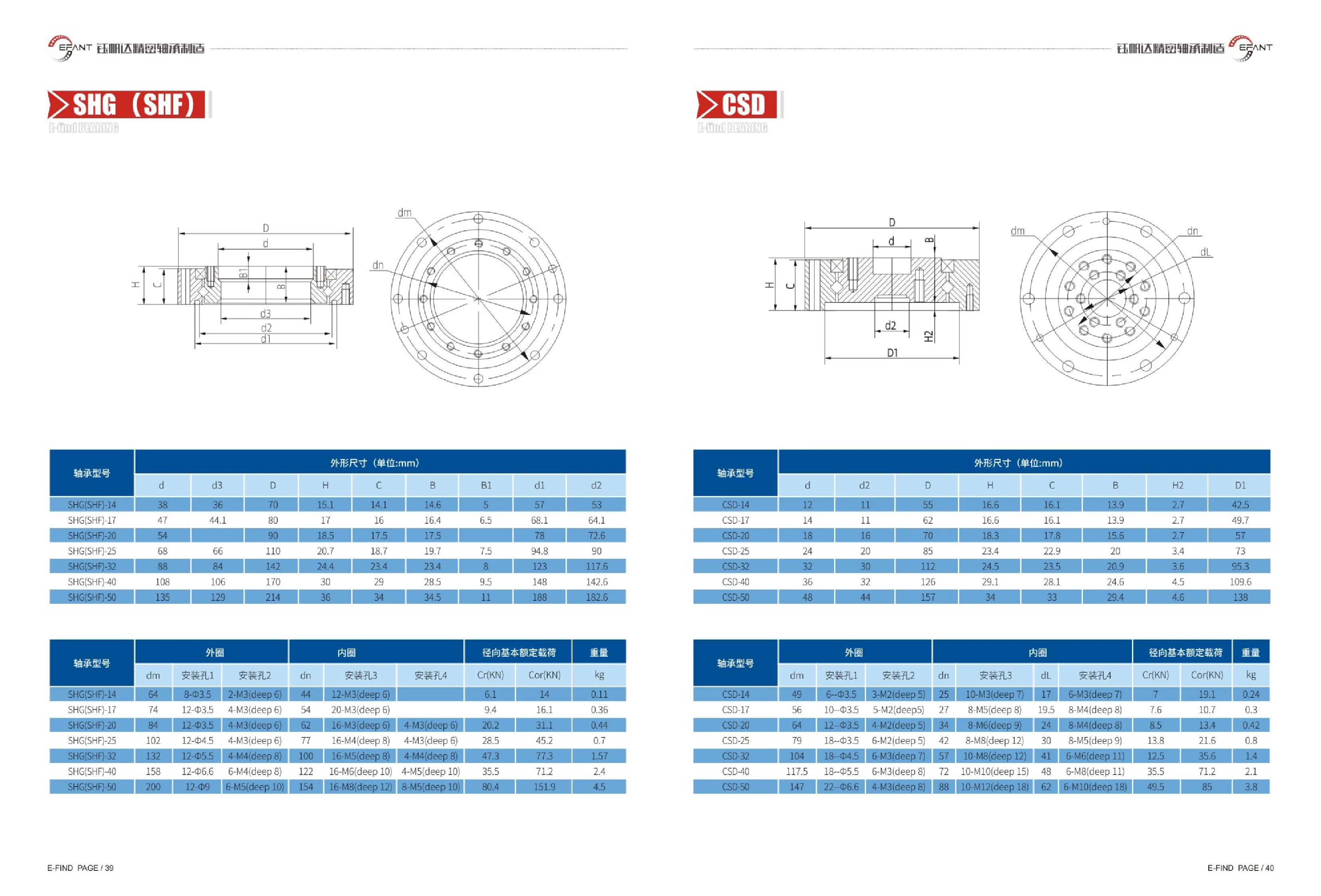
SHG(SHF) Series Crossed Roller Bearings
The SHG(SHF) series comprises thin-section crossed roller bearings in seven sizes: 14, 17, 20, 25, 32, 40, and 50. SHG and SHF models in the same size share the same overall dimensions. The bearing bore diameter d is 38~135mm, the outer diameter D is 70~214mm, and the assembled height H is 15.1~36mm. Mounting and mating dimensions including d3, C, B, B1, d1, and d2 are also provided. The series features a single row of rollers arranged crosswise at 90°, allowing it to support radial, axial, and tilting moment loads simultaneously. It offers high rigidity, high rotational accuracy, and a compact design, and is commonly used for rotary support at harmonic drive outputs, industrial robot joints, precision rotary tables, and semiconductor equipment. When selecting a model, use the size code (14~50) to determine the inner and outer diameters and mounting hole positions. During installation, ensure that the inner- and outer-ring bolts are preloaded evenly.
CSD Series Crossed Roller Bearings
CSD series crossed roller bearings have a thin-walled structure with rollers arranged at 90° to one another and mounting holes integrated into both the inner and outer rings. They offer high rigidity and precision in a space-saving design and can simultaneously support radial loads, axial loads, and overturning moments. The catalog covers 7 sizes from CSD-14 to CSD-50, with inner diameters of 12~48 mm, outer diameters of 55~157 mm, overall heights of 16.6~34 mm, basic dynamic radial load ratings of 7~49.5 kN, static load ratings of 10.7~85 kN, and weights of 0.24~3.8 kg. Applications include industrial robot joints, precision rotary tables, measuring instruments, medical equipment, and semiconductor manufacturing equipment.
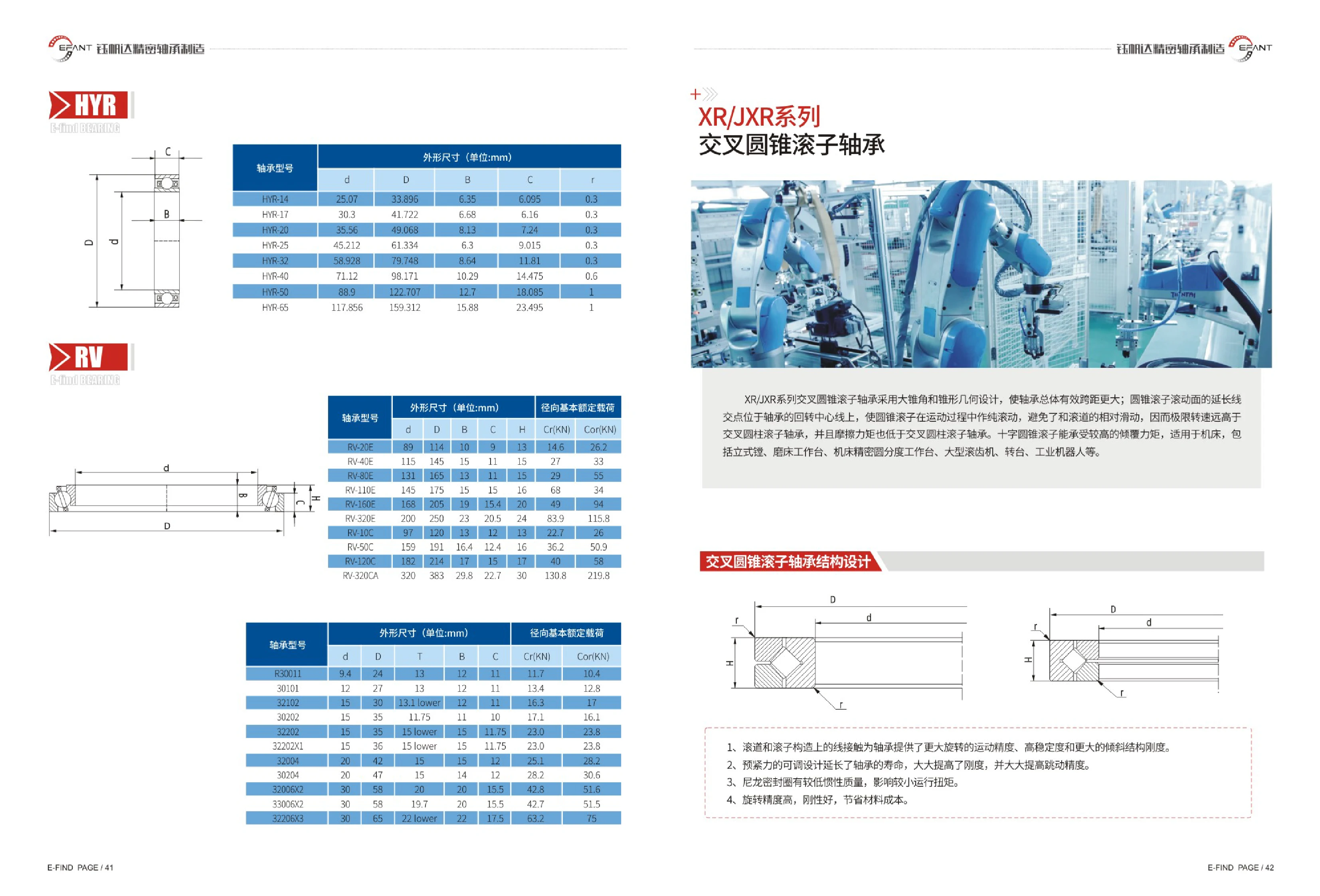
RV Series Crossed Roller Bearings
The RV series of crossed roller bearings is available in three configurations: RV-E, RV-C and RV-CA. Model designations consist of RV followed by a size code, with ten sizes ranging from 20 to 320. These thin-section bearings have rollers arranged at 90° to one another in V-shaped raceways. A single bearing can simultaneously support radial loads, axial loads in both directions and overturning moments. Features include a compact design, high rigidity, high rotational accuracy, low starting friction torque and long service life. The catalog lists the bore diameter d and outer diameter D (in mm) for each model to assist with selection based on available mounting space and the design of mating components. The series is widely used in applications requiring high rigidity and rotational accuracy, including machine tool rotary tables, vertical boring and grinding machine tables, precision indexing tables, large gear hobbing machines, turntables and industrial robot joints. To select a bearing, first determine the size code based on mounting space and load requirements, then choose the final model according to preload, lubrication and sealing conditions.
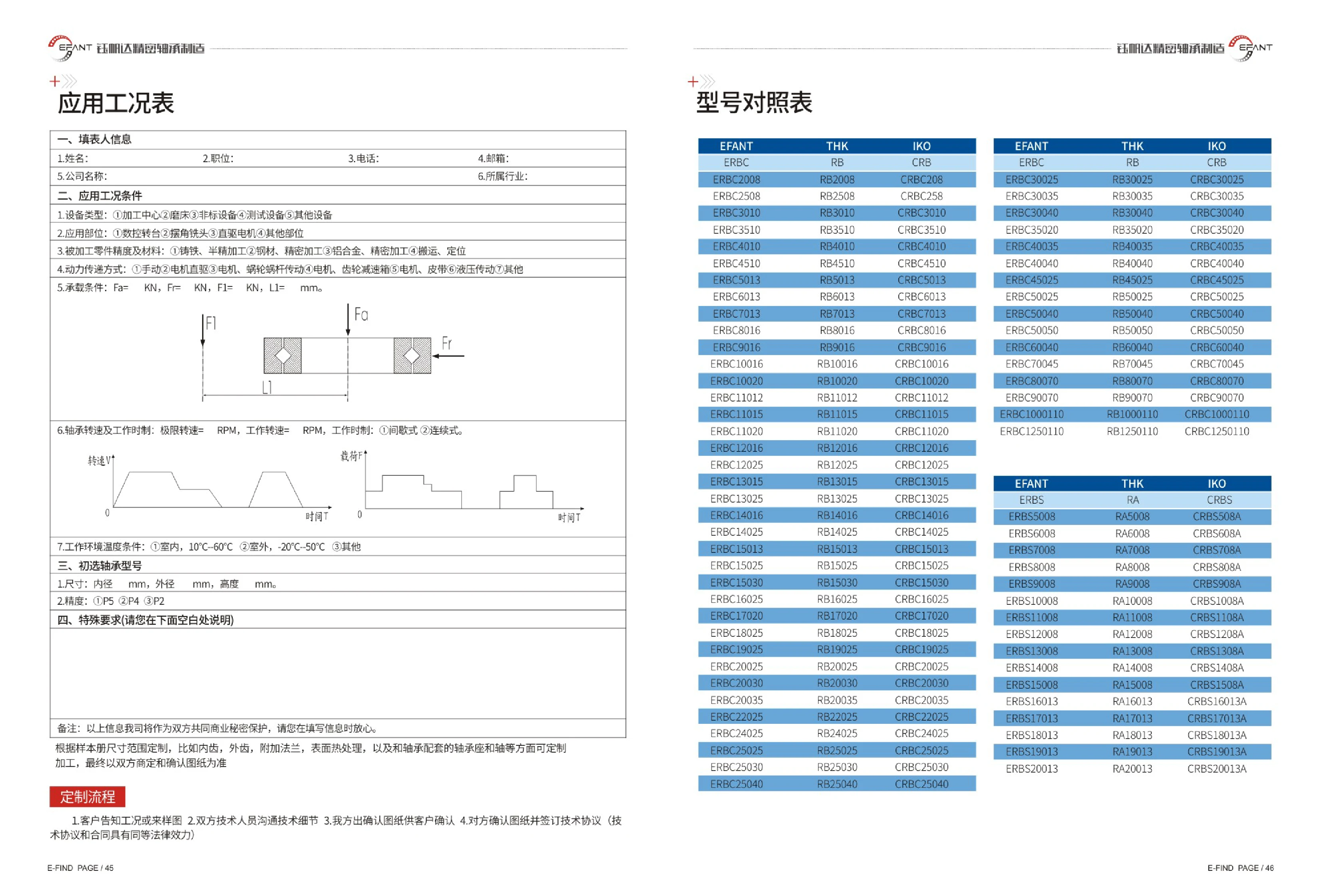
ERBS Series Crossed Roller Bearings
The ERBS series consists of thin-section crossed roller bearings with a single row of rollers arranged alternately at 90°. They can simultaneously support radial loads, axial loads in both directions, and overturning moments, while offering a thin cross-section, high rigidity, and high rotational accuracy. Catalog models are designated as “ERBS+bore diameter+width” and cover bore diameters of 50~200mm. They are available in two width ranges: 8mm (ERBS5008~ERBS15008) and 13mm (ERBS16013~ERBS20013). They correspond to and are interchangeable with the THK RA series and IKO CRBS series. Available accuracy grades are P5, P4, and P2. Typical applications requiring high rigidity and rotational accuracy include CNC rotary tables on machining centers, swiveling milling heads, direct-drive motors, robot joints, and test equipment. In addition to standard models, internal or external gear teeth, additional flanges, surface heat treatment, and matching bearing housings and shafts can be customized to suit operating conditions. Final specifications are subject to drawings approved by both parties.
ERBH Series Crossed Roller Bearings
ERBH series crossed roller bearings feature rollers arranged at 90° to one another between the inner and outer rings. A single bearing can simultaneously support radial loads, axial loads in both directions, and overturning moments. They offer a compact design, high rigidity, and high rotational accuracy. The series has an integral inner or outer ring (corresponding to the IKO CRBH/CRBHV series) and requires no additional adjustment shims during installation. It enables highly rigid, precise rotary motion in applications such as robot joints, CNC indexing tables, rotary worktables, precision rotary tables, medical equipment, and semiconductor equipment. The catalog lists models from ERBH2008 to ERBH25025 by bore diameter and width, with bore diameters of approximately 20~250 mm and widths of 8~25 mm. Users can select a model based on available mounting space and load requirements. Corresponding sizes are directly interchangeable with IKO CRBHV bearings.
ERBF Series Crossed Roller Bearings
ERBF series crossed roller bearings feature a compact design with rollers arranged at 90° to one another. They simultaneously support radial, axial and moment loads, offering high rigidity, high rotational accuracy and space-saving installation. They are suitable for robot joints, rotary tables, machine tool indexing tables and precision rotary mechanisms. Model numbers consist of ERBF followed by the bore diameter and width; for example, ERBF1008 has a bore diameter of 10 mm and a width of 8 mm. Some sizes are available in (G) and X variants. The catalog provides a model-by-model correspondence with the THK RU series to simplify selection and replacement.
EFXU Series Crossed Roller Bearings
The EFXU series consists of full-complement crossed roller bearings with rollers arranged alternately at 90° to one another in a 90° V-shaped raceway. They accommodate radial loads, axial loads in both directions, and tilting moments simultaneously. Their high rigidity, high rotational accuracy, and compact axial dimensions make them suitable for rotary positioning applications such as robot joints, CNC indexing tables, machine tool rotary tables, radar, and medical equipment. Corresponding to the INA XU series, these bearings have integral inner and outer rings. Model numbers consist of EFXU followed by a size code, with sizes ranging from small and medium-light models to large models with outside diameters exceeding 400 mm. Some models have a ZT suffix denoting a structural variant. Select the appropriate size based on bore diameter, outside diameter, width, dynamic and static load ratings, and tilting moment. During installation, ensure the mounting surfaces are sufficiently flat and rigid to take full advantage of the bearing's high rigidity.
EXSU Series Crossed Roller Bearings
EFANT EXSU series crossed roller bearings are equivalent to the INA XSU series. Their cylindrical rollers are arranged crosswise at 90°, allowing them to simultaneously withstand radial loads, axial loads in both directions, and tilting moments. They offer high rigidity, high rotational accuracy, and a compact cross-section. The series is suitable for precision rotation applications such as industrial robot joints, machine tool rotary tables, indexing tables, radar, and medical equipment. The catalog lists 13 sizes, from EXSU13025 to EXSU102456, with the corresponding INA XSU model for each to facilitate selection and replacement. During installation, ensure the mating surfaces are accurate and clean, and apply lubrication and preload appropriate to the operating conditions.
EKLD Series Crossed Roller Bearings
EKLD series crossed roller bearings are EFANT bearings designed specifically for rotary tables. The catalog provides a model cross-reference showing the corresponding INA ZKLDF series specification for each model. Featuring a crossed-roller/multi-row rolling element design, these bearings can simultaneously support axial loads, radial loads, and tilting moments. They are suitable for applications requiring high rigidity and rotational accuracy, including CNC rotary tables, indexing tables, rotary tables in vertical and horizontal machining centers, and rotary joints in radar and medical equipment. The number in each model designation indicates the bearing bore diameter. The range covers bore diameters from 100 mm to 650 mm in 11 sizes: EKLD100, EKLD120, EKLD150, EKLD180, EKLD200, EKLD260, EKLD325, EKLD395, EKLD460, EKLD580, and EKLD650. Select a model according to the rotary table bore diameter, load capacity, and speed requirements. During installation, ensure the mounting surfaces meet flatness and fit accuracy requirements. For dimensions, load ratings, and limiting speeds, refer to the dimension table for the corresponding INA ZKLDF size.