Chip Conveyor
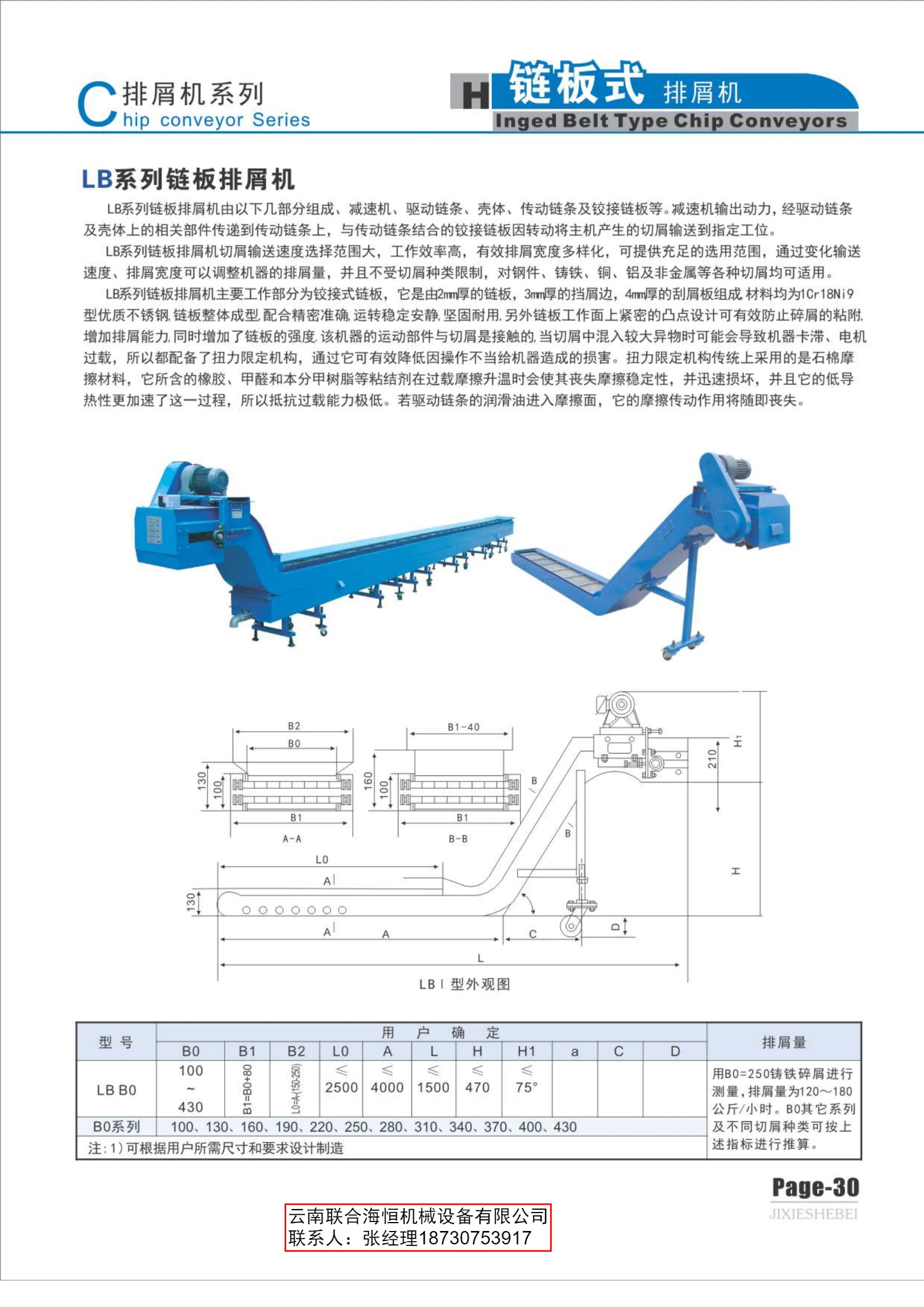
LB Series Hinged-Plate Chip Conveyor
The LB series hinged-plate chip conveyor consists of a geared motor, drive chain, housing, transmission chain, and hinged plates. The rotating plates carry chips to a designated station. It offers a wide range of chip-conveying speeds, high operating efficiency, and a variety of effective conveying widths, and is suitable for chips from steel, cast iron, copper, aluminum, and non-metallic materials. Its main working component is the hinged plate assembly, comprising 2 mm-thick plates, 3 mm-thick chip-retaining edges, and 4 mm-thick scraper plates, all made of 1Cr18Ni9 stainless steel. The plates are integrally formed and precisely fitted for stable, quiet operation. The conveyor is equipped with a torque-limiting mechanism and uses a new powder-metallurgy friction material with high heat resistance and excellent friction performance. After 800 overload cycles, linear wear is less than 0.04 mm. It is available in four basic types—Ⅰ, Ⅱ, Ⅲ, and Ⅳ—based on structural dimensions. Types Ⅰ and Ⅱ use C210AL transmission chains with a 31.75 mm pitch, while Types Ⅲ and Ⅳ use C216AL chains with a 50.80 mm pitch. Component dimensions can be flexibly designed.
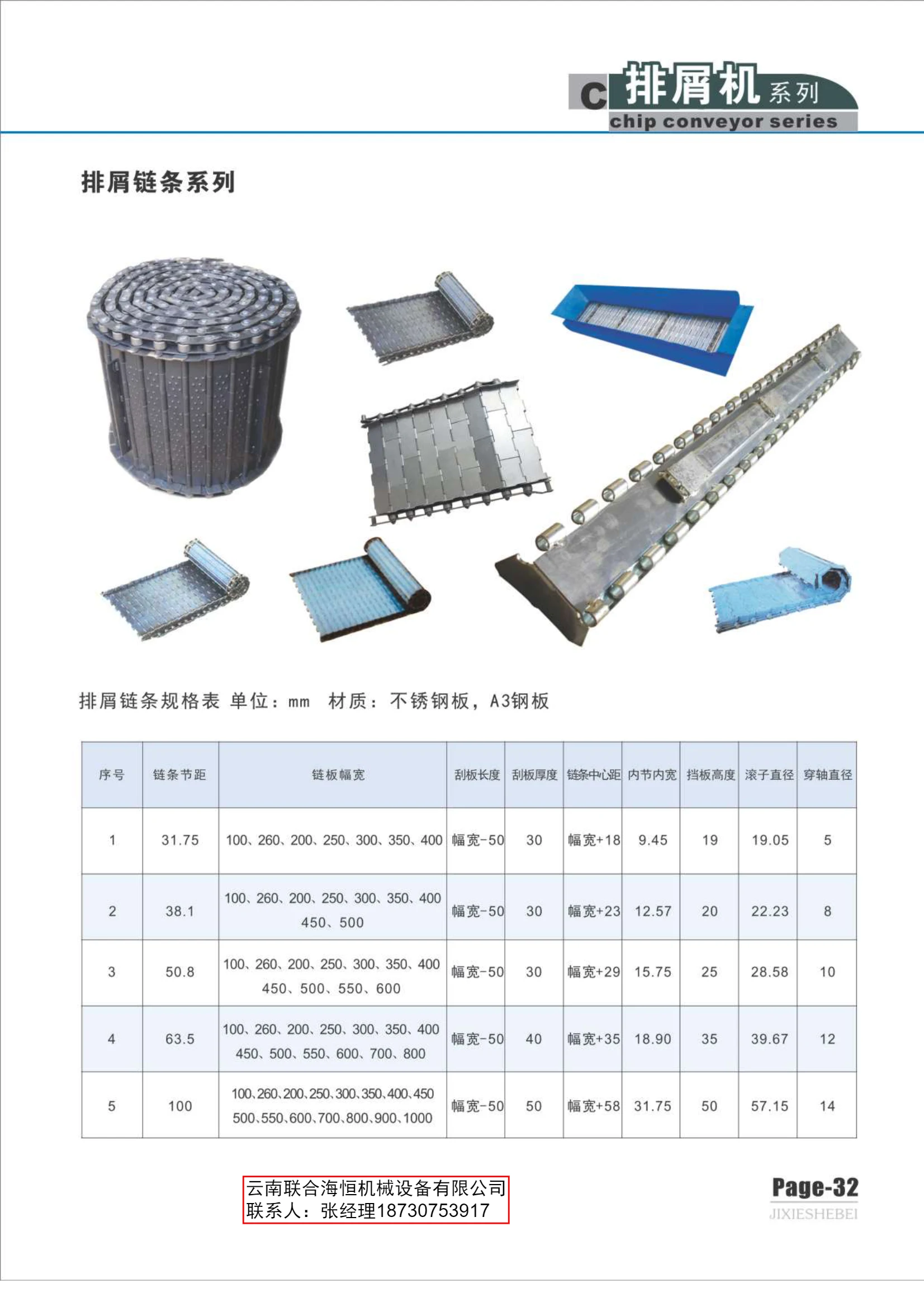
Chip Conveyor Chain Series
The chip conveyor chain series is primarily used to transport chips from machine tools, automated production lines, and other equipment. It is available in stainless steel plate or A3 steel plate, with chain pitches of 31.75 mm, 38.1 mm, 50.8 mm, 63.5 mm, and 100 mm. Chain plate widths range from 100 to 1,000 mm. The scraper length is the width minus 50 mm, and scraper thickness ranges from 30 to 50 mm. The chain center distance is the width plus the corresponding value. Inner link width, side plate height, roller diameter, and pin diameter vary with the pitch. Suitable for heavy-duty, long-distance chip removal, the chains are wear-resistant and corrosion-resistant.
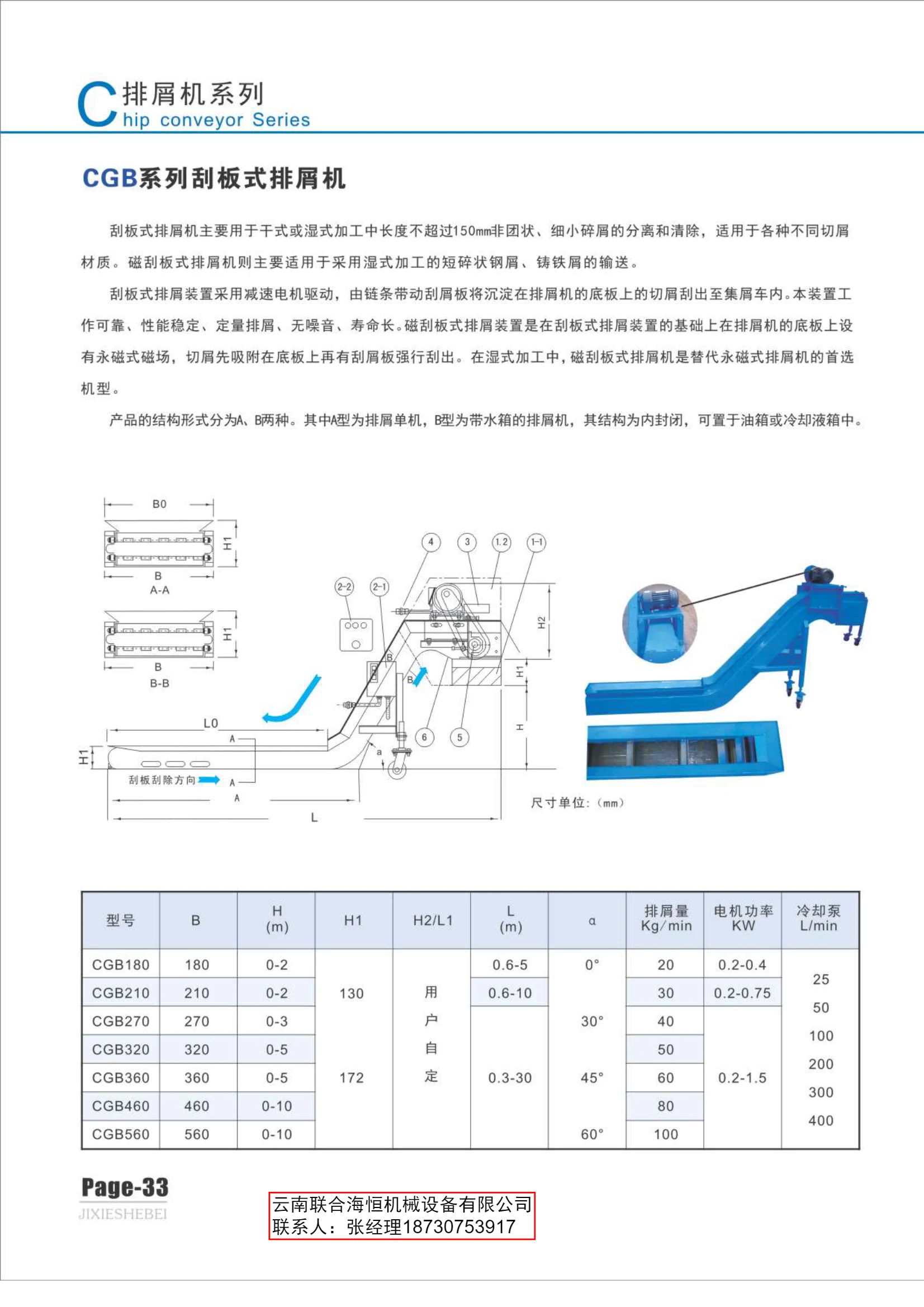
CGB Series Scraper-Type Chip Conveyor
The CGB series scraper-type chip conveyor is primarily used to separate and remove small, non-clumped chips no longer than 150 mm from dry or wet machining processes. It is suitable for chips made from a variety of materials. Magnetic scraper-type chip conveyors are mainly used to transport short, broken steel and cast-iron chips produced by wet machining. The scraper conveyor is driven by a geared motor, with a chain moving the scraper blades to clear chips that have settled on the conveyor’s bottom plate into a chip bin. It operates reliably and steadily, provides consistent chip removal, runs quietly and has a long service life. The magnetic scraper conveyor adds a permanent-magnet field to the bottom plate of the standard scraper design. Chips are first attracted to the plate and then forcibly scraped away, making this the preferred alternative to permanent-magnet chip conveyors for wet machining. The product is available in Type A (standalone chip conveyor) and Type B (an enclosed unit with a coolant tank, suitable for installation in an oil or coolant tank).
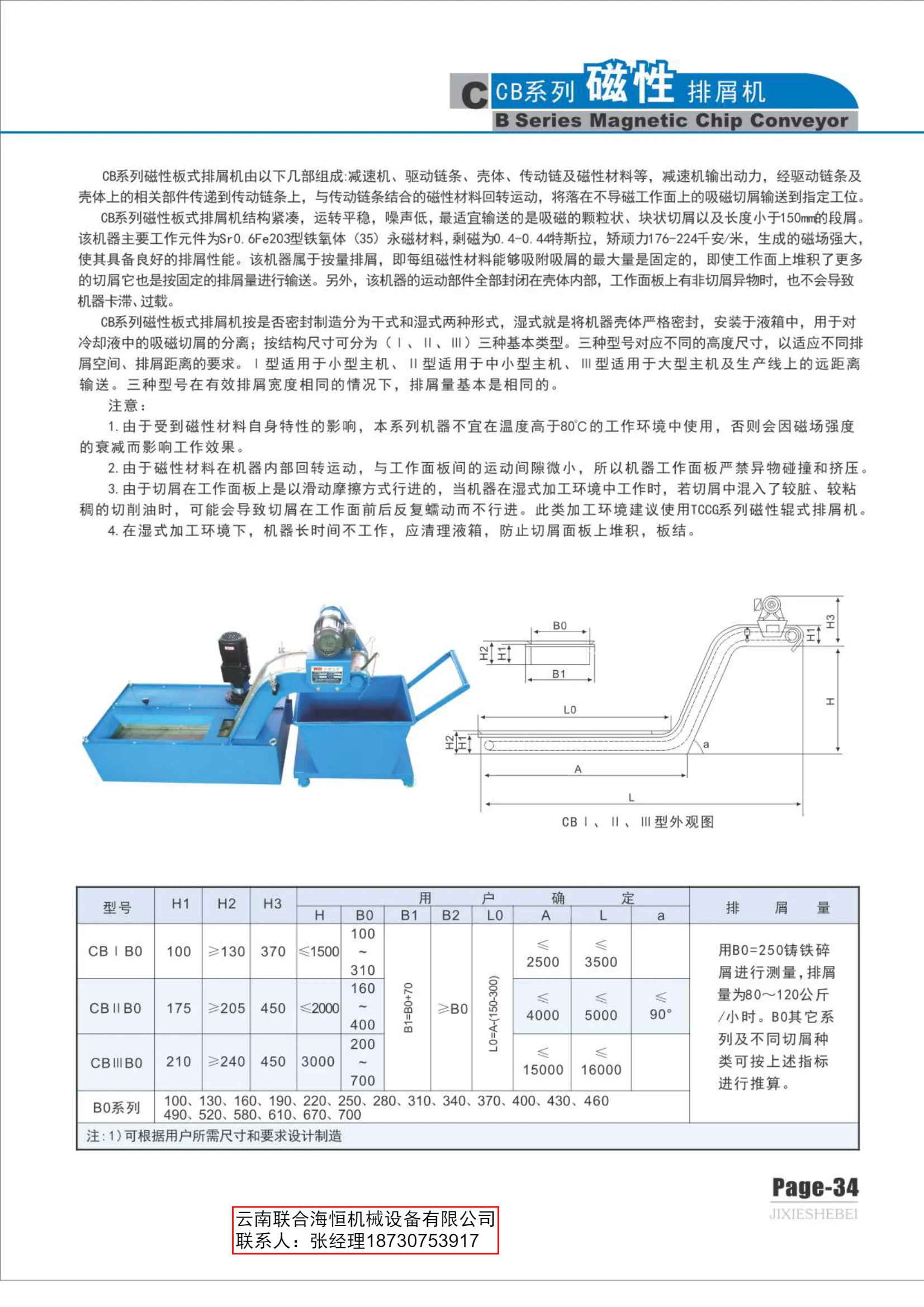
CB Series Magnetic Plate Chip Conveyor
The CB Series magnetic plate chip conveyor consists of a gear reducer, drive chain, housing, conveyor chain, and magnetic materials. It features a compact design, smooth operation, and low noise. It is best suited for conveying magnetically attracted granular and chunky chips, as well as chip segments less than 150 mm long. Its main working element is Sr0.6Fe2O3 ferrite permanent magnet material, which produces a strong magnetic field. Models are available in dry and wet versions, depending on whether they are sealed. There are three basic structural sizes—Types I, II, and III—with different heights to suit different chip-discharge spaces and distances. The operating temperature should not exceed 80°C. The TCCG Series is recommended for wet environments. Chip-handling capacity depends on the B0 width and chip type. Under standard test conditions (B0 = 250, cast-iron chips), capacity is 80–120 kg/h.
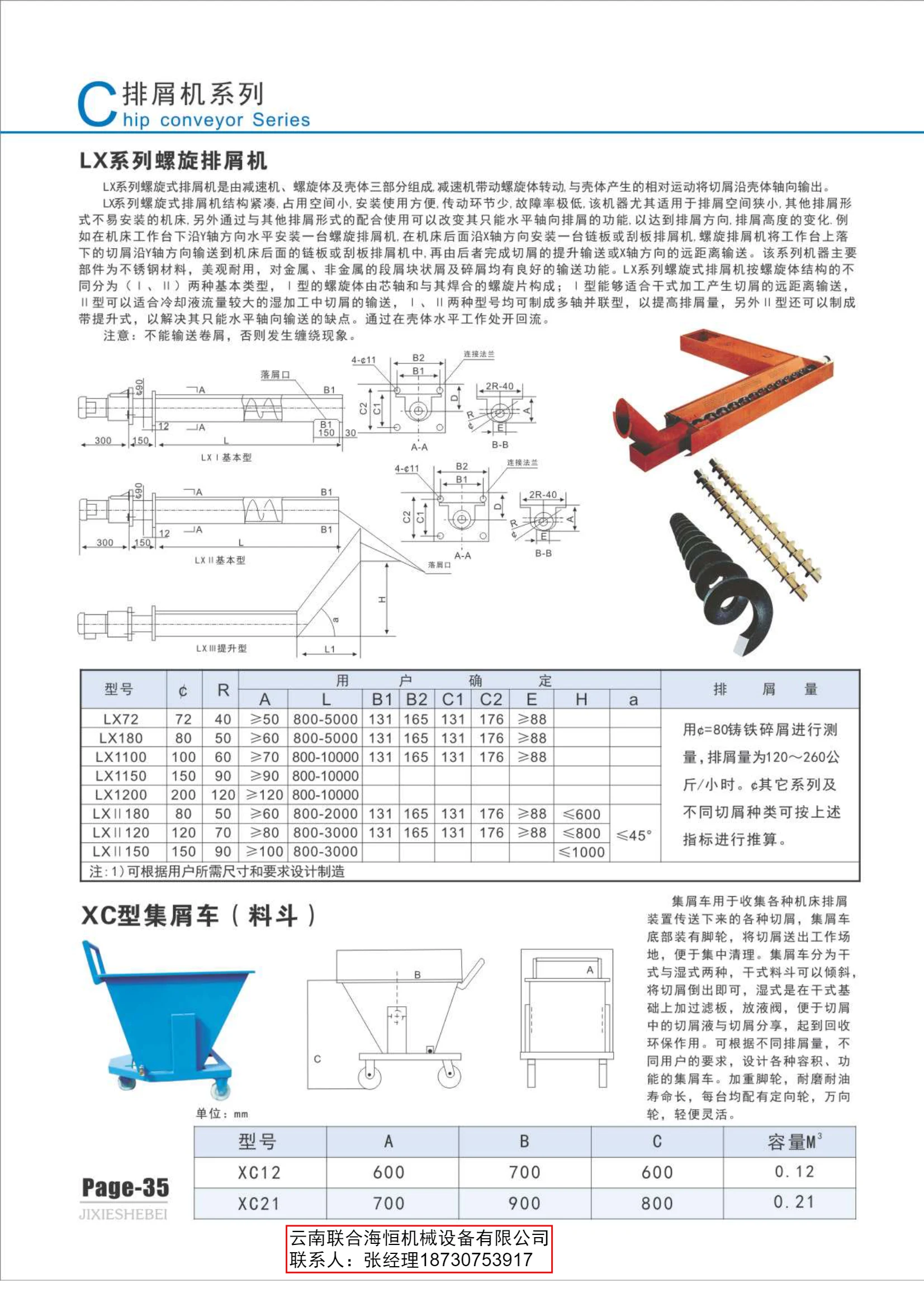
LX Series Screw Chip Conveyor
The LX Series Screw Chip Conveyor consists of three parts: a geared motor, a screw assembly, and a housing. The geared motor rotates the screw assembly, and the resulting relative motion between the screw and housing carries chips axially through the housing. Its compact design takes up little space and is easy to install and use. With few transmission components and an extremely low failure rate, it is especially suitable for machine tools with limited chip-removal space, where other types of chip conveyors are difficult to install. Combined with other chip-removal systems, it can extend horizontal axial chip removal to accommodate different discharge directions and heights. The main components are made of stainless steel, offering an attractive, durable finish and effective conveying of short, chunky, and fragmented metal and non-metal chips. It is available in two basic types, I and II, depending on the screw design. Type I has a central shaft and a helical flight. Type II is suitable for long-distance conveying in dry machining and can also be used for wet machining with high coolant flow rates. Both types can be configured with multiple parallel shafts to increase chip-removal capacity. Type II is also available with a lifting section, overcoming the limitation of horizontal axial conveying only. Note: Do not use it to convey stringy chips, as these may wrap around the screw.
XC-Type Chip Collection Cart
The chip collection cart collects chips discharged from various machine-tool chip removal systems. Casters are fitted to the bottom, making it easy to move the chips out of the work area for centralized disposal. The carts are available in dry and wet types. The dry-type hopper tilts to empty the chips. The wet type adds a filter plate and drain valve to the dry-type design, separating chips from cutting fluid for recovery and environmental protection. Carts with a range of capacities and functions can be designed to suit different chip volumes and user requirements. Heavy-duty casters offer long-lasting wear and oil resistance. Each cart is fitted with fixed and swivel casters for easy, flexible maneuvering.
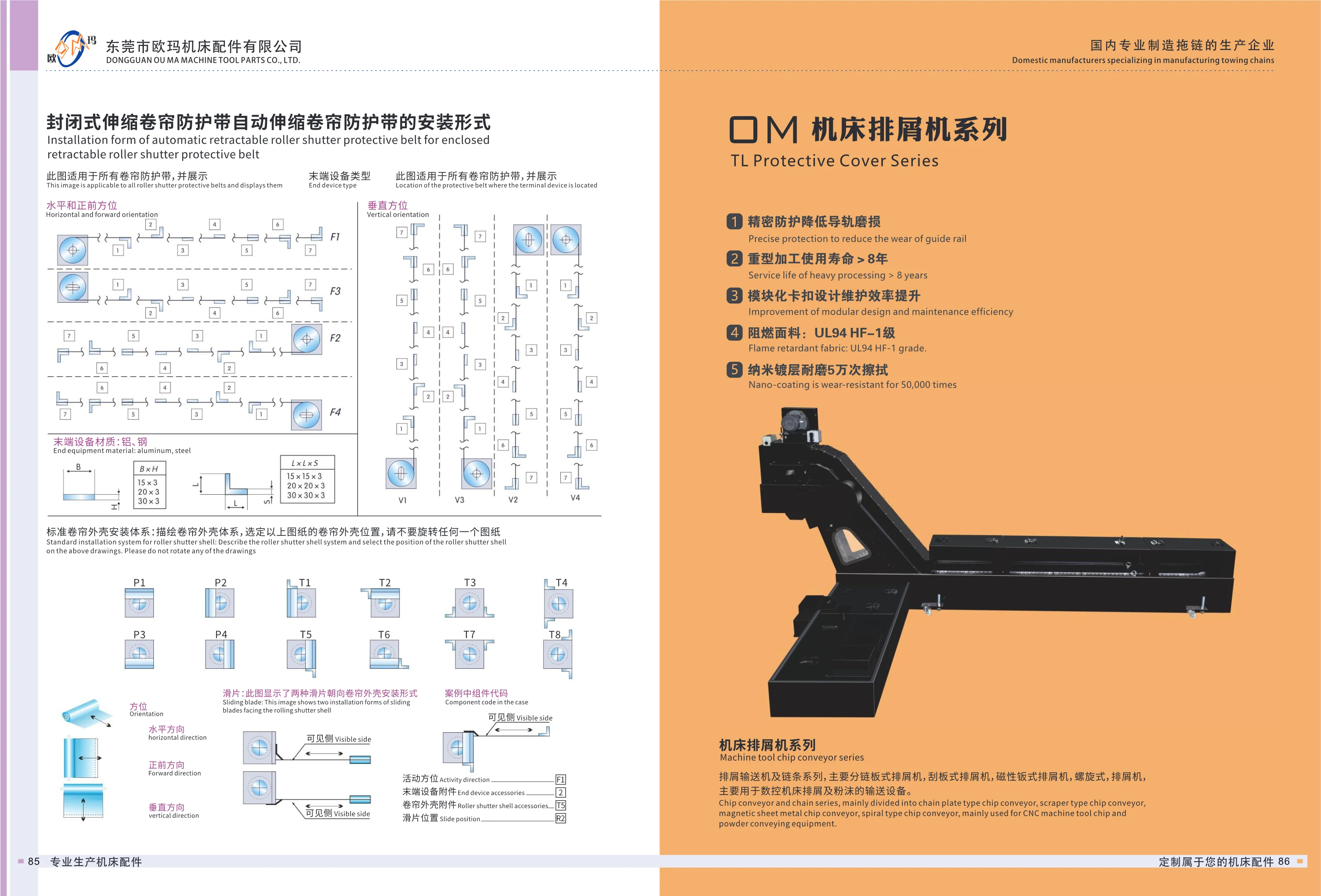
Machine Tool Chip Conveyor Series
The machine tool chip conveyor series transports chips and fines from CNC machine tools. Based on conveyor design, it comprises four types: hinged belt, scraper, magnetic plate and screw conveyors. Hinged belt conveyors use a continuous metal belt to remove large volumes of long, coiled or bundled chips. Scraper conveyors are suited to fine and oily chips. Magnetic plate conveyors use magnetic force to collect fine iron chips and powder, making them suitable for finishing and grinding. Compact screw conveyors are typically used for low-volume chip removal from individual machines. The conveyors can be connected to machine tool coolant tanks, chip collection bins and central chip removal systems to separate chips from cutting fluid and automate removal. A modular snap-fit design simplifies assembly, disassembly and maintenance. Precision guards at critical points reduce guideway wear, and heavy-duty models have a design service life of over 8 years. Optional wear-resistant features, including flame-retardant fabric (UL94 HF-1 grade) and nano-coatings, are available for different machining conditions.
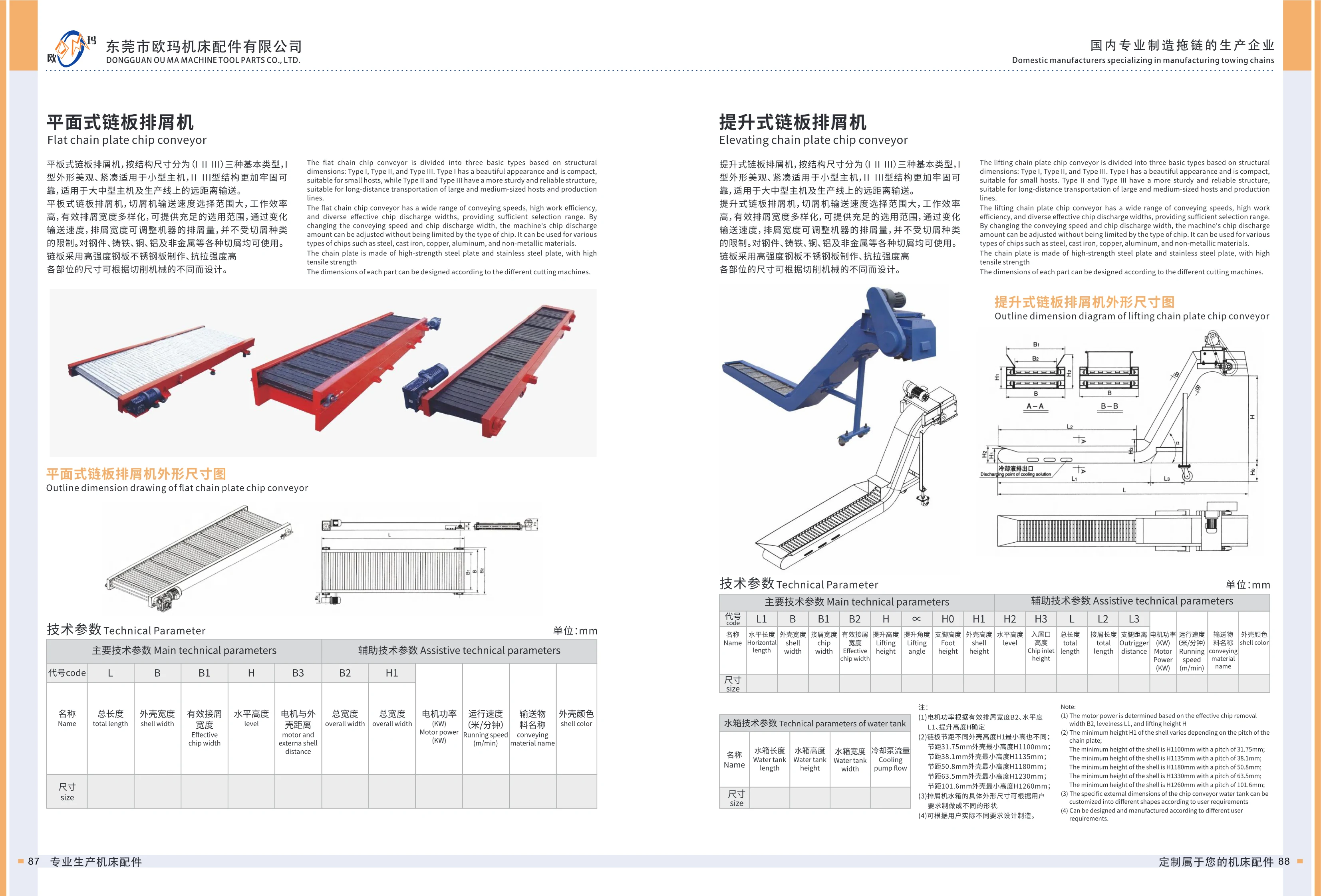
Flat-Plate Chain Chip Conveyor
The flat-plate chain chip conveyor is an auxiliary unit for machine tools and production lines, designed to continuously remove chips from steel, cast iron, copper, aluminum, nonmetals, and other materials. It comes in three basic types, I, II, and III, based on construction and dimensions. Type I has an attractive, compact design suited to small machines; types II and III offer a stronger, more reliable construction for medium and large machines and long-distance conveying on production lines. The conveyor offers a wide range of speeds, high operating efficiency, and a choice of effective chip removal widths. Capacity can be adjusted by changing the conveying speed and chip removal width, regardless of chip type. The chain plates are made from high-strength steel and stainless steel for high tensile strength. Selection is based primarily on overall dimensions: L overall length, B housing width, B1 effective chip removal width, H horizontal height, B2 overall width, B3 distance between motor and housing, and H1 height. Additional parameters include motor power (kW), operating speed (m/min), conveyed material, and housing color. Component dimensions can be designed to suit different chip-producing machines or customized to customer requirements.
Elevating Hinged-Belt Chip Conveyor
The elevating hinged-belt chip conveyor continuously transports and collects chips from machine tools and production lines for centralized discharge. It is available in three basic types based on structural dimensions: Type I has an attractive, compact design suited to small machines, while Types II and III have sturdier, more reliable construction for medium and large machines and long-distance transport on production lines. A wide range of conveying speeds and effective chip removal widths is available. Capacity can be adjusted by changing the speed and width, and the conveyor handles all types of chips, including steel, cast iron, copper, aluminum and nonmetallic materials. The hinged plates are made of high-strength steel or stainless steel and offer high tensile strength. Key dimensions include horizontal length L1, housing width B, chip removal width B1, effective chip removal width B2, lift height H, lift angle H0, housing height H1, overall length L, chip inlet L2 and chip discharge length L3. Motor power is determined by effective chip removal width B2, horizontal length L1 and lift height H. Belt pitches from 31.75~101.6mm are available, with each pitch corresponding to a different minimum housing height. The overall dimensions and structure can be designed and manufactured to customer requirements, making this a custom-built, nonstandard unit.