Pneumatic Vibrators
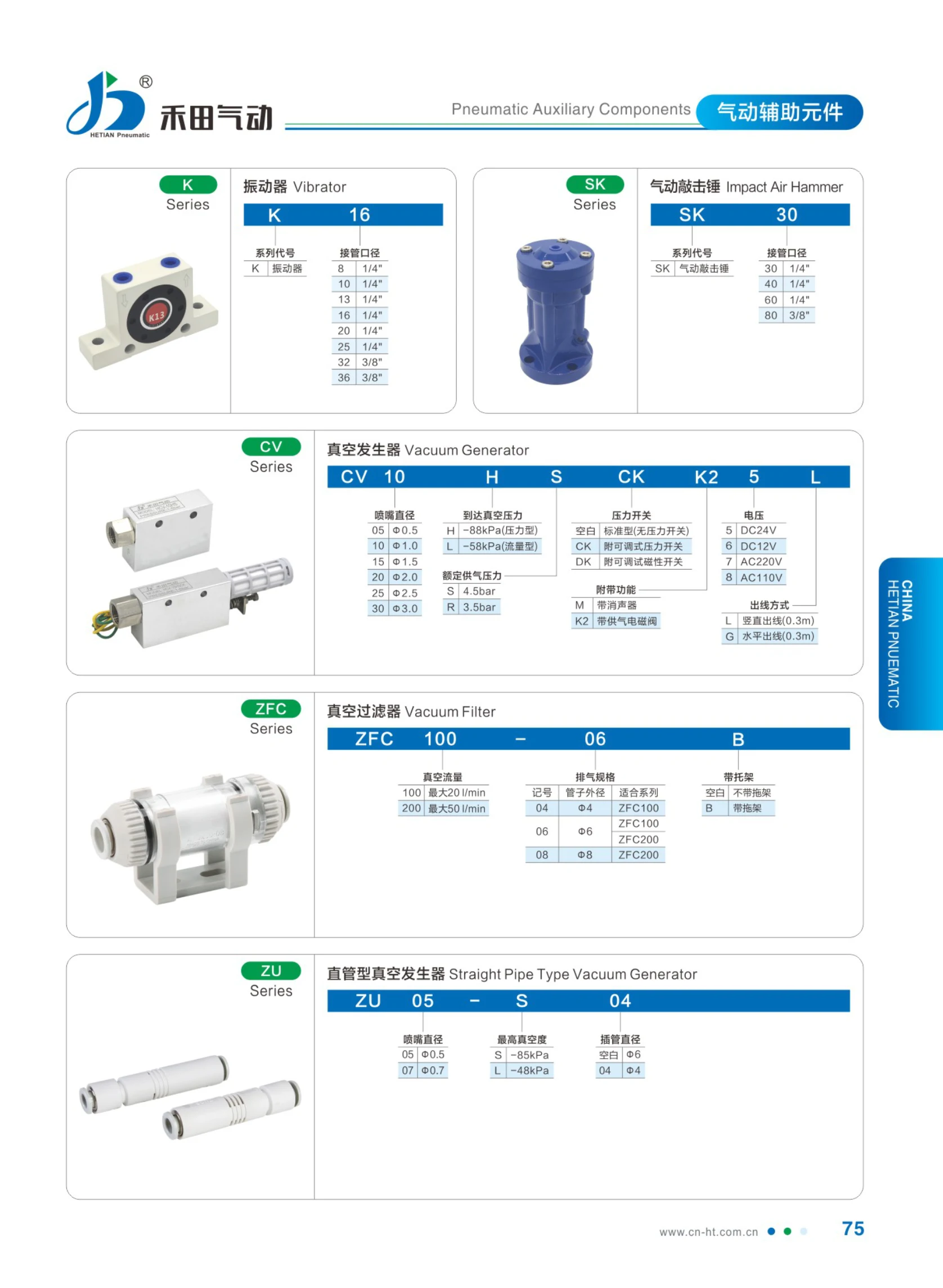
K Series Vibrators
K Series vibrators are pneumatic vibrators that use compressed air to drive an internal vibrating element and generate high-frequency vibration. Mounted on the exterior walls of bins, hoppers, chutes, pipes, and conveying equipment, they promote the flow of powders and granular materials, break up arches, prevent blockages, and compact material. The series is available in eight sizes, designated by the series code K followed directly by the size number: 8, 10, 13, 16, 20, 25, 32, and 36. Sizes 8~25 have 1/4" connection threads, while sizes 32 and 36 have 3/8" connection threads. They can be connected directly to a plant's compressed air lines. Compact and free of electrical components, these vibrators are safe for use in explosive environments and require little maintenance. Vibration force and frequency can be changed simply by adjusting the air pressure. They are widely used for material handling and storage in the food, chemical, plastics, and building materials industries.
SK Series Pneumatic Impact Hammers
SK series pneumatic impact hammers, also known as air hammers, are pneumatic vibration devices that use compressed air to drive a hammer head in repeated impacts. Like K series pneumatic vibrators, they belong to the broader vibrator category. Models are designated by the series code SK followed by the port size code, and are available in four sizes: SK30, SK40, SK60 and SK80. Port codes 30, 40 and 60 correspond to a 1/4" threaded connection, while port code 80 corresponds to a larger 3/8" threaded connection. Larger port codes indicate a larger hammer body and greater impact energy. These hammers are commonly used on bins, hoppers, chutes and pipes to break up bridging, prevent blockages and promote material flow. Compressed air is switched on and off at timed intervals or as needed, causing the hammer head to strike the wall repeatedly and dislodge adhering or bridged powders and granular materials. They can also provide vibration assistance for molds, castings and conveying troughs. For installation, the hammer is secured to the surface to be struck using a flange or threaded base. Automatic control can be achieved with a two-position, three-way solenoid valve and air preparation components. To select a model, first determine the required impact force based on bin capacity, wall thickness and material flowability, then select the port code and connection size, and confirm that the air supply pressure and flow rate meet the requirements.
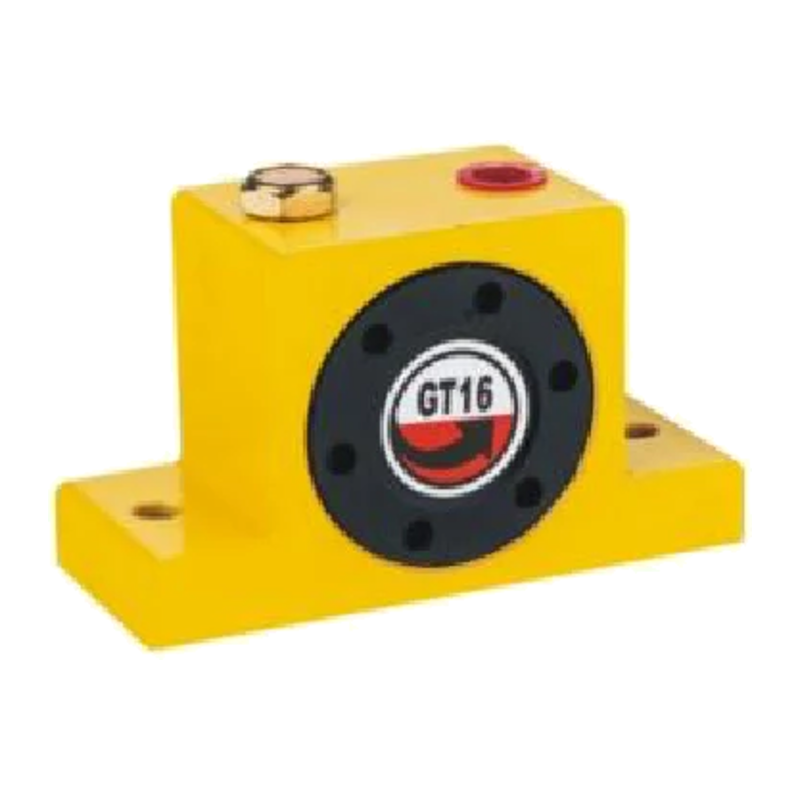
HWGT Series Pneumatic Vibrators
The HWGT series pneumatic vibrator (rotary pneumatic vibrator) is manufactured by SNS Automation (Ningbo) Group Co., Ltd. Compressed air enters through the inlet and impinges on the gear, which rotates on bearings. An eccentric steel counterweight inside the housing rotates with the gear, generating vibration through centrifugal force. Vibration force and frequency can be adjusted continuously by changing the air pressure (0.2/0.4/0.6MPa). The vibrator starts and stops instantly, responds quickly, operates quietly, delivers strong vibration, and is safe and reliable. The series includes 12 sizes (HWGT-4~HWGT-60), with a frequency range of 4750~45500 V.P.M (cycles/min), vibration force of 130~3100 N, air consumption of 30~480 l/min, air inlet size of 1/8~1/2, and weight of 260~5590 g. Typical applications include material conveying, vibratory screening, vibration-assisted discharge at material gates, package filling, and vibration of casting sand molds.

HWK Series Pneumatic Steel Ball Vibrators
HWK series pneumatic steel ball vibrators use compressed air to drive a precision steel ball around the inside of a steel sleeve. The ball's eccentric rotation generates centrifugal force, producing vibration. Vibration force and frequency can be adjusted through the air supply pressure. The sealed aluminum alloy housing is suitable for wet, dusty and hazardous environments. Applications include material conveying, hopper and gate vibration, packaging and filling assistance, and vibration of foundry sand molds. Standard models range from HWK-8 to HWK-32, with operating pressures of 0.2, 0.4 and 0.6 MPa, frequencies of approximately 7500 to 34100 V.P.M, vibration forces of 245 to 4000 N, and air consumption of 90 to 680 L/min.

R Series Roller Vibrators
R Series roller vibrators use compressed air to drive a steel ball or roller around inside a sleeve, producing centrifugal vibration. Vibration frequency and force can be adjusted by changing the air pressure. Their simple, safe design offers a long service life and is suitable for damp, dusty and explosion-hazard environments. Standard models include R-50, R-65, R-80 and R-100, with an operating pressure of 0.2–0.6 MPa, a frequency of approximately 11,050–36,150 V.P.M, a vibration force of 1,175–8,955 N and air consumption of 1,450–7,350 L/min. Applications include material conveying, hopper and material gate vibration, assisting with package filling and vibrating foundry sand molds.

NTP Series Reciprocating Piston Vibrators
NTP series pneumatic reciprocating piston vibrators use compressed air to drive a piston back and forth, generating vibration. They offer high power, low noise, and continuously adjustable vibration force and frequency. The nominal frequency is approximately 43~146 cycles/minute, with a vibration force of approximately 150~2039 N. The maximum operating temperature is 150℃, with a 200℃ version available on request. Applications include hopper vibration, material conveying, emptying, impact, and tapping. They are suitable for wet, dusty, and potentially explosive environments. Standard models include NTP25, NTP32, and NTP48, with dimensional and mounting interface details available.

SK Series Pneumatic Knocker
The SK Series pneumatic knocker uses compressed air to drive a reciprocating piston, producing impact and vibration. It offers high power, strong impact force, and quiet operation. Its nominal frequency is 43~146 impacts/minute, with an excitation force of 150~2039 N. Frequency and amplitude can be continuously adjusted through air pressure. The maximum operating temperature is 150℃, with custom 200℃ versions available. It is suitable for vibratory emptying, conveying, impact, and tapping applications involving bins, pipes, and hoppers, and can be controlled manually or electrically.