Sensors — Page 2

3-Axis Force Sensor
The 3-axis force sensor features an integrated construction, high accuracy, strong resistance to off-axis loads, low interference, and easy installation. Custom specifications are available. It is suitable for robotic arms and multidirectional force control, and is widely used in machine-tool cutting, drilling and milling force measurement, rehabilitation medical equipment, aircraft testing, robotic force-controlled grinding, assembly, hand-guided teaching, and scientific research. Sensor coordinate system: The X-axis is perpendicular to the signal cable connector direction; the Y-axis is perpendicular to the X-axis, with its positive direction pointing toward the tool-side pin hole; and the Z-axis runs along the sensor's axial centerline. Positive torque follows the right-hand rule. Key specifications include rated capacity (X/Y/Z:1000KG), output sensitivity (approximately 1.5mV/V), combined accuracy (≤0.1%F.S.), excitation voltage (5~15V), operating temperature range (-20~80℃), safe overload (150%F.S.), and material (alloy steel/stainless steel).

Three-Axis Force Sensor
Made from aluminum alloy, this compact three-axis force sensor is easy to install and features independent internal bridges for each axis. Designed primarily for three-axis force measurement systems, it measures forces along the X, Y and Z axes simultaneously. Rated capacities are 50/100/200/300/500N for X/Y and 50/100/200/300/500/1000N for Z. Zero output is ±2%F.S., output resistance is 350±5Ω, insulation resistance is ≥5000MΩ/50VDC, safe overload is 150%F.S. and ultimate overload is 300%F.S. It is suitable for force feedback and force measurement applications where space is limited.

Cylindrical 3-Axis Force Sensor
The cylindrical 3-axis force sensor features a one-piece stainless steel construction and simultaneously measures force along the X, Y, and Z axes. It offers high accuracy, strong resistance to off-axis loading, low cross-axis interference, and easy installation. Rated capacities are available in several ranges, including 10~100N, 500N, and 50~5000N for the X/Y/Z axes. Specifications include approximately 1.0mV/V output sensitivity, ±2%F.S. zero output, 350±10Ω or 750±10Ω output resistance, ≥5000MΩ/100VDC insulation resistance, 150%F.S. safe overload, -10~40℃ temperature compensation range, -20~75℃ operating temperature range, and 15VDC excitation voltage. A Φ3.2×3000mm cable is included as standard. The sensor is primarily used to detect and control multidirectional forces at robotic arm end effectors and in various automated equipment. Custom capacities and mounting dimensions are available.
Two-Axis Force Sensor
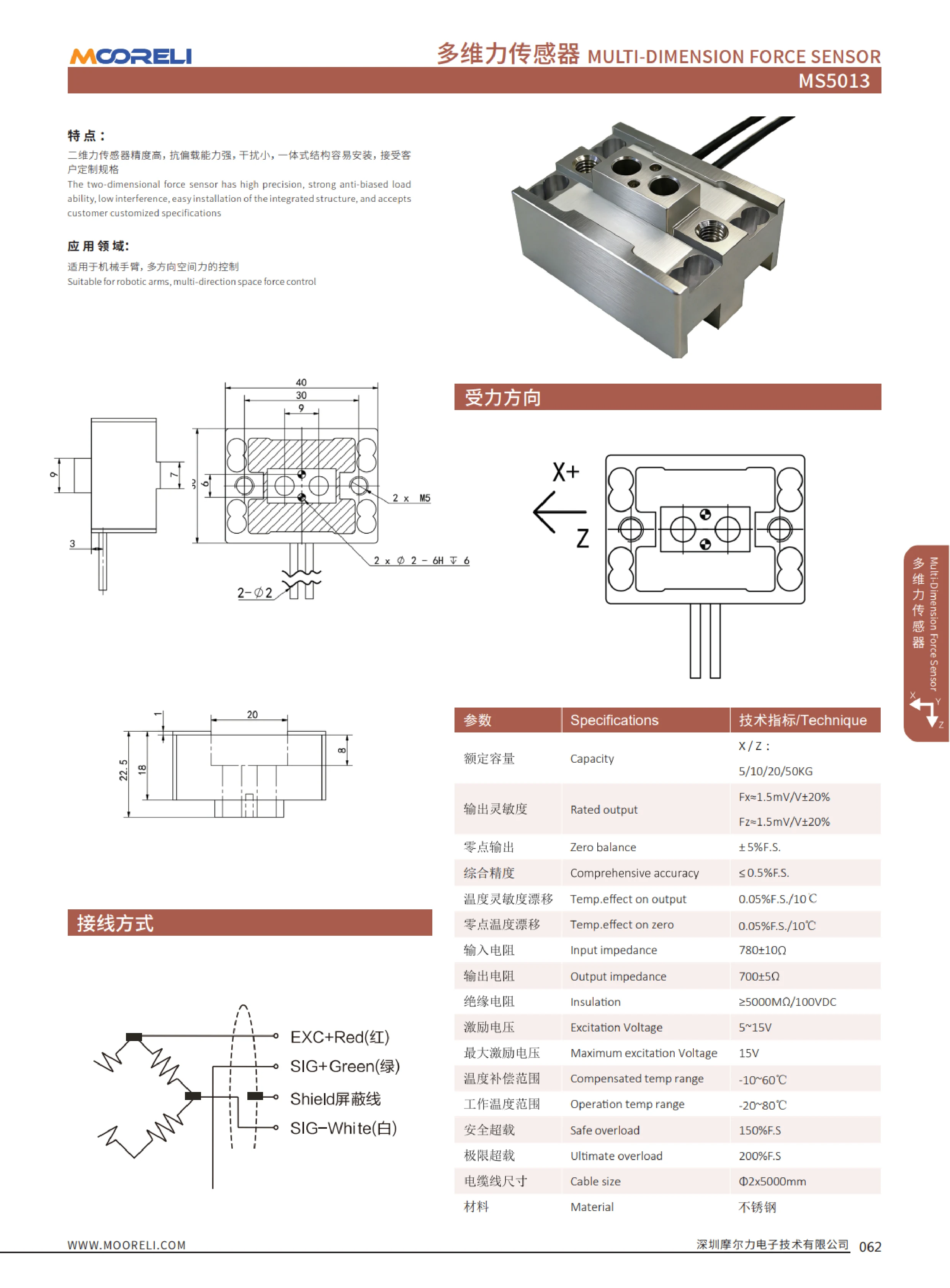
This two-axis force sensor features a one-piece stainless steel construction, high accuracy, strong resistance to off-center loads, low interference, and easy installation. Specifications can be customized to meet customer requirements. It measures forces in the X and Z directions simultaneously, with rated capacities of 5/10/20/50KG. Output sensitivity is approximately 1.5mV/V±20%, combined accuracy is ≤0.5%F.S., zero output is ±5%F.S., input resistance is 780±10Ω, output resistance is 700±5Ω, insulation resistance is ≥5000MΩ/100VDC, excitation voltage is 5~15V, operating temperature is -20~80℃, safe overload is 150%F.S., and ultimate overload is 200%F.S. A Φ2×5000mm cable is supplied as standard. It is suitable for robotic arms and multidirectional force control applications.

Multi-Axis Force Sensor
This multi-axis force sensor (two-axis force sensor) simultaneously measures rotational torque and pressure. It offers high accuracy, strong resistance to off-center loads, low interference, a compact design, and easy installation. It is suitable for robotic arms and applications requiring multidirectional force control, and can be customized to customer specifications. Rated capacity: Fz:50N, Mx:0.5N·m; output sensitivity: approximately 1.0~1.5mV/V; combined accuracy: ≤0.1%F.S.; input/output resistance: 780kΩ/700kΩ; insulation resistance: ≥5000MΩ/100VDC; excitation voltage: 5~15V; operating temperature: -20~80℃; safe overload: 150%F.S.; ultimate overload: 200%F.S.; cable: 2-Φ2×3000mm; material: aluminum alloy.
Cylindrical 3-Axis Force Sensor
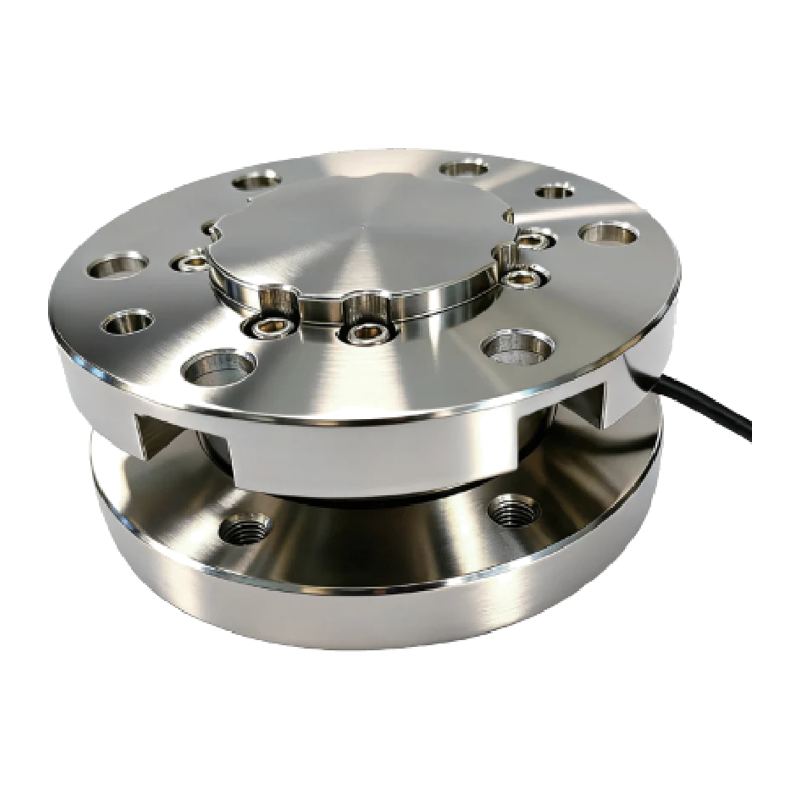
The cylindrical 3-axis force sensor features a one-piece stainless steel elastic element and can simultaneously measure forces in three directions. It offers high accuracy, strong resistance to off-axis loads, and low cross-channel interference. Its integrated design simplifies installation, and specifications can be customized to meet customer requirements. It is suitable for force sensing at the end of robotic arms and for multidirectional force control and feedback. Key specifications: rated capacity options of 100KG and 200KG; output sensitivity of 1.8mV/V±20%; temperature sensitivity drift and zero temperature drift both 0.05%F.S./10℃; input resistance 780±10Ω, output resistance 700±5Ω, insulation resistance ≥5000MΩ/100VDC; excitation voltage 5~15V, maximum excitation voltage 15V; compensated temperature range -10~60℃, operating temperature range -20~80℃; safe overload 150%F.S., ultimate overload 200%F.S.; cable dimensions Φ5×3000mm.

High-Precision Cantilever Tension Sensor
The high-precision cantilever tension sensor is made of all-steel stainless steel, 17-4 stainless steel, or aluminum alloy. It has an IP66 protection rating, a compact design, and is easy to install. Paired with an idler roller shaft, or fitted with a split clamp, movable pulley, and shaft, it provides stable tension measurement for fabrics, tapes, wires, strips, and similar materials. The measurement range is 1N~10N, with an accuracy class of 0.1%F.S. Rated output, zero output, hysteresis, and the effects of temperature on zero and sensitivity are all controlled within ±2%F.S. The sensor offers strong overload resistance, withstanding loads up to 5 times its rated range. It is widely used in automated tension measurement equipment, the weaving industry, and wire tension monitoring and control systems. It is also suitable for precision force measurement applications such as medical machinery and electronic component lead bending tests.

Tension Sensors
Resistance strain gauge tension sensors are used in automated tension measurement and control systems for in-line monitoring in industries such as medical machinery, presses, weaving, wire, and fabric tapes. Designs include cantilever, double-nut ring, and three-pulley types. Housing materials include aluminum alloy, 1/4 stainless steel, and alloy steel. Aluminum alloy models are compact, highly accurate, and easy to install. Stainless steel and alloy steel models offer compact construction, high overall accuracy, corrosion and oil resistance, and good long-term stability. Measuring ranges span 10N~2000N, with an accuracy class of approximately ±0.1%F.S. and a rated output of 2.0±0.2mV/V (2.0mV/V±20% for some models). Nonlinearity, repeatability, and hysteresis can reach ±0.05%F.S. Input/output resistance is approximately 410Ω, operating temperature is 20~80℃, and protection rating is IP65 or IP66.

Double-Nut Ring Tension Sensor
Made of 17-4 stainless steel, the double-nut ring tension sensor is compact and highly accurate. Its double-nut ring design makes it easy to install and use, and it has an IP56 protection rating. It is suitable for automated medical machinery, textile manufacturing, and tension measurement and control systems for wire, fabric tape, and similar materials. Its measurement range is 10N-100N, with an accuracy of 0.05%F.S., a rated output of 2.0±0.2mV/V, and a zero output of ±2%F.S. It is ideal for space-constrained applications requiring stable tension feedback.

Tension Measurement Sensor
This tension measurement sensor features a modular, highly integrated design with high accuracy, fast response, and a full range of interfaces. It includes built-in overload protection and a 5-digit display for convenient on-site readings and setup. Available measurement ranges are 200G, 500G, 1KG, 2KG, and 5KG, accommodating tension measurement for different wire diameters and materials. Overall accuracy is 0.1%F.S., nonlinearity is ≤0.2%mV/V, repeatability is ±0.2%mV/V, and safe overload is 150%F.S. The sensor operates on a 12~30DCV power supply and supports 0~5V / 0~10V / ±5V / ±10V analog outputs and RS485 communication. Its 100~14kHz acquisition frequency provides high-speed sampling for winding applications. Operating temperature is -10~60℃, and the protection rating is IP65. It is widely used in automated tension measurement equipment, copper wire and fiber tension control on high-speed cable machines, cable manufacturing for electronic components, and tension measurement and control systems in the textile industry.

Flat-Plate Force Sensor
The flat-plate force sensor is made of alloy steel, with stainless steel used for certain models. Its thin, flat design is compact and visually appealing. With an overall IP65 protection rating, it provides reliable long-term operation in dusty, oily, and humid industrial environments. It monitors process force in equipment such as press-fit machines for new energy applications and electric vehicle motor assembly. It is also suitable for force analysis on industrial presses and press-fit force measurement in precision assembly equipment for electronic components. Key specifications include rated capacity, zero output, output linearity and nonlinearity (±0.2%F.S.), repeatability, maximum excitation voltage (15V), input impedance, output impedance, insulation resistance, cable specifications, and operating temperature range. Models can be selected to suit different press-fit tonnages and installation spaces.

Grip Force Sensor
This compact, low-profile sensor features an attractive design and stainless steel construction. It is available in five rated ranges: 0-50N, 0-100N, 0-300N, 0-500N, and 0-1000N. It offers an output sensitivity of 2.0mV/V±20%, nonlinearity of ±0.2%F.S., a safe overload rating of 150%F.S., IP65 protection, a compensated temperature range of -10~60℃, and an operating temperature range of -20~80℃. It is suitable for force analysis in industrial presses and precision electronic component assembly equipment, as well as grip and clamping force analysis in medical rehabilitation equipment and robotic motion systems.

MS1001 Compression Load Cell
The MS1001 is a stainless steel compression load cell with a low profile, minimal deformation, compact dimensions, and high dynamic response frequency. It is suited to force measurement applications where installation space is limited and rapid response is required. Typical applications include automotive press fitting, automated assembly, consumer electronics testing, new energy product assembly, medical testing, mold assembly in robotics, and other industrial testing, measurement, and control systems. Key specifications for the series include rated capacity, output sensitivity, zero output, output resistance, insulation resistance, safe overload, ultimate overload, operating temperature range, zero temperature drift, sensitivity temperature drift, and temperature coefficient. The specification table on this page lists parameter names only; refer to the complete catalog or selection documentation for specific values. Select a model based on the rated load, installation dimensions, temperature drift requirements, and dynamic response needs of the press-fitting or assembly station.

MS1005 Series Compression Load Cells
The MS1005 series consists of stainless steel compression load cells featuring a low profile, minimal deformation, compact dimensions, and high dynamic response frequency. They can be customized to suit application requirements. They are suitable for industrial testing, measurement, and control systems used in automotive press fitting, automated assembly, 3C product testing, new energy product assembly, medical testing, robotics, and mold assembly. The catalog page lists rated capacity, output sensitivity, zero output, output resistance, insulation resistance, safe overload, ultimate overload, operating temperature range, zero temperature drift, and sensitivity temperature drift, but does not provide specific values.

MS1009-16 Compression Load Cell
The MS1009-16 is a compression load cell with a compact annular hollow, spoke-type, or disc-type elastic element. Its central through-hole or internal thread connects directly to a lead screw or load rod, making it suitable for force measurement and control in equipment with limited installation space. It has a rated range of 100~1000N, an output sensitivity of 1.5±20%mV/V, a zero output of ±5%F.S., a safe overload of 150%F.S., an ultimate overload of 200%F.S., a dynamic response frequency below 300Hz, and an IP65 protection rating. It is supplied with a Φ4×300mm cable. Typical applications include press-fit force monitoring in automated assembly, precision force measurement platforms, and lead screw thrust measurement. The main selection parameters are rated range, mounting interface (central through-hole or internal thread), and lead cable length.

MS1074 Series Compression Load Cells
The MS1074 series consists of stainless steel compression load cells characterized by low deformation and high dynamic response frequency. With an IP65 protection rating, they operate reliably in typical industrial environments exposed to dust and moisture. Their compact design makes them suitable for installation in confined spaces. They are widely used for force measurement and control in industrial manufacturing, research and testing, including static and dynamic measurement of pressure and weight. Key selection parameters include rated capacity, output sensitivity, insulation resistance, rated voltage, rated current, rated frequency, operating temperature and humidity. Refer to the manufacturer's official datasheet for specific values.

MS2003 Series Tension and Compression Sensors
The MS2003 is a miniature tension and compression force/load cell made of stainless steel. Its compact size makes it easy to install, and it measures loads in both tension and compression. It has a rated range of 50~2000N, an output sensitivity of 1.0±10%mV/V, an output resistance of approximately 800~11000Ω, and an insulation resistance of ≥5000MΩ/100VDC. It is suitable for industrial automation applications such as automotive press-fitting, automated assembly, 3C product testing, new energy product assembly, medical testing, robotics, and mold assembly. The sensor can be used with various weighing and force measurement instruments and data acquisition systems. During installation, the force axis must be aligned with the loading direction to prevent lateral forces and bending moments from affecting measurement accuracy. Selection is based primarily on the rated load range, output sensitivity and resistance compatibility, available installation space, and cable exit configuration.

MS2008/MS2009 Series Miniature Tension and Compression Sensors
The MS2008/MS2009 series consists of miniature bidirectional tension and compression sensors made of stainless steel or aluminum alloy. They offer high accuracy, compression overload protection, and high-frequency dynamic response. The rated range is 10~500N, with an output sensitivity of approximately 2.0±10%mN/V, output resistance of 350±30Ω, safe overload of 150%F.S., ultimate overload of 300%F.S., excitation voltage of 5~15V, and maximum excitation voltage of 15V. Applications include button force testing for 3C products such as computers, switch and button testing, insertion and extraction force testing, medical testing, and other industrial testing, measurement, and control systems.

MS2009 Series Miniature Tension and Compression Load Cells
The MS2009 series consists of miniature bidirectional tension and compression load cells with stainless steel or aluminum alloy sensing elements. They offer high accuracy, compression overload protection, and high-frequency dynamic response. With rated capacities from 10-500N, they are suitable for key force testing on computers and 3C products, testing various switch buttons, insertion and extraction force testing, medical testing, and industrial testing, measurement, and control systems. The load cells withstand a safe overload of 150%F.S. and an ultimate overload of 300%F.S. The recommended excitation voltage is 5-15V, with a maximum of 15V. Output sensitivity is approximately 2.0±10%mV/V, and output resistance is approximately 350±30Ω. Their miniature design makes them easy to integrate into space-constrained force measurement fixtures for dynamic force acquisition and bidirectional tension and compression measurement.
MS2019 Spoke-Type Tension and Compression Sensor
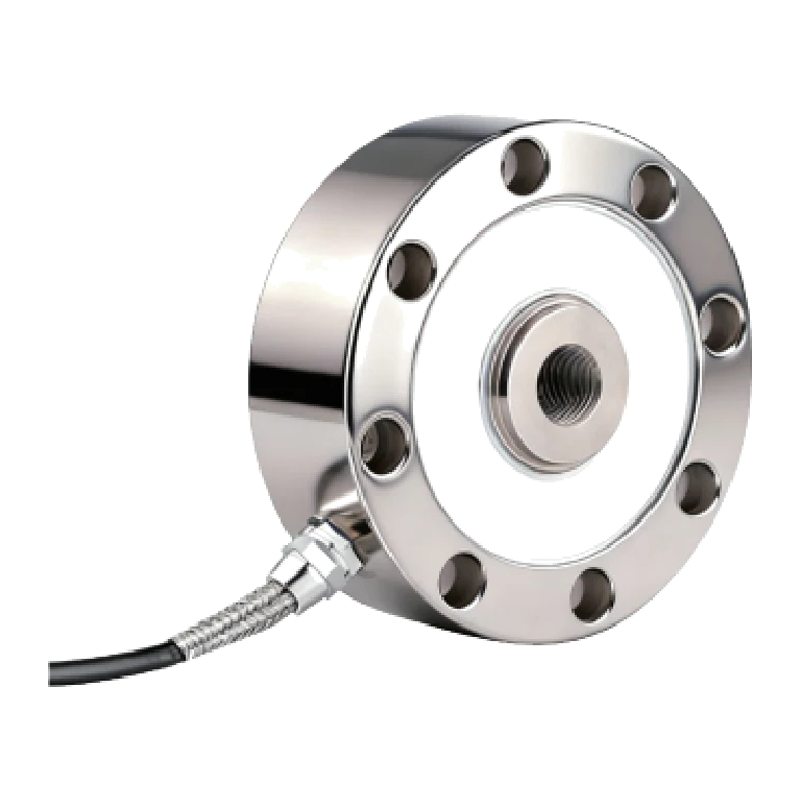
The MS2019 is a spoke-type load cell for bidirectional tension and compression measurement. Its elastic element is made of alloy steel or stainless steel, allowing it to withstand both tensile and compressive forces for applications requiring bidirectional force measurement. Rated capacities range from 0.1~300T, with output sensitivity calibrated to 2.0±1%mV/V for both the 0.1~5t and 0.1~300t ranges. It offers a combined error as low as 0.03%F.S., an output sensitivity of ±1%F.S., and good insulation resistance. The capacity can be customized to suit operating conditions. Its low profile, rigid structure, strong resistance to off-center loading, and fast dynamic response make it suitable for materials testing machines, truck scales, hopper scales, and various industrial weighing and batching systems. It can also monitor press-fitting and gripping forces during production. The load is typically applied to the center of the spokes, and the sensor is secured using threaded holes on the bottom or side. It can be connected to a standard weighing indicator or transmitter to provide a standard signal output.

MS2029 Tension and Compression Load Cell
The MS2029 is a miniature tension and compression load cell made of aluminum alloy. It offers high accuracy, strong overload protection, and a high dynamic response frequency. The sensor measures both tension and compression with minimal deformation, making it suitable for high-frequency dynamic force measurement. Applications include button force testing on computers and other consumer electronics, switch and button testing, insertion and extraction force testing, medical testing, and other industrial testing, measurement, and control systems. The series also includes the MS2025 tension and compression load cell, available in stainless steel or aluminum alloy. It features minimal deformation and a high dynamic response frequency, and is primarily used in force gauges, automated assembly testing, medical testing, robotics, and a variety of industrial automation force measurement applications. Series specifications include rated capacity, output sensitivity, insulation resistance, safe overload, ultimate overload, compensated temperature range, operating temperature range, zero temperature drift, and sensitivity temperature drift. TEDS functionality is optional.

MS3003 Series Single-Point Load Cells
The MS3003 series consists of aluminum alloy single-point (single-point parallel beam) load cells, including the MS3002 and MS3003 models. Their aluminum alloy sensing element provides high accuracy, strong resistance to off-center loading, and stable return to zero. They are easy to install and can be screwed directly onto a scale body or mechanism. With an IP65 protection rating, they are suitable for environments with light moisture and dust, such as those found around dispensing and liquid filling machines. Typical applications include in-line weighing during dispensing and liquid filling, electronic scales, counting scales, electronic balances, and various industrial weighing and batching systems. Selection is based primarily on rated capacity (range), accuracy class, output sensitivity, excitation voltage, wiring configuration, and mounting hole dimensions. Models within the series have different capacities and dimensions; refer to the relevant model's catalog datasheet for these specifications.
MS3006/MS3007 Series Single-Point Sensors
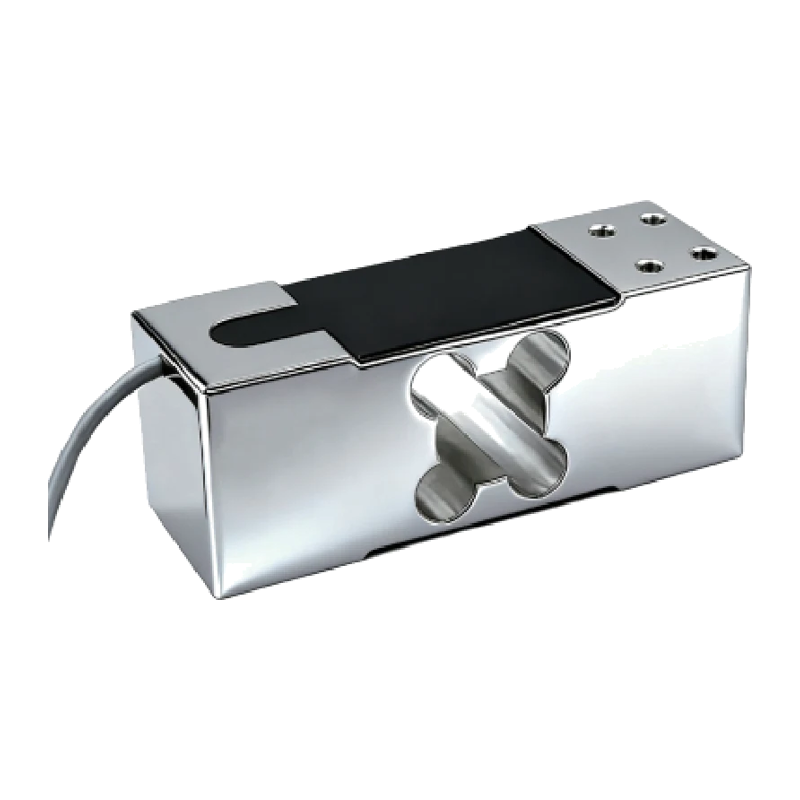
The MS3006/MS3007 series comprises single-point load cells made of aluminum alloy, offering excellent stability, high accuracy, strong resistance to off-center loading, easy installation, and an IP65 protection rating. They are suitable for electronic scales, counting scales, electronic balances, and various industrial weighing systems, providing stable and reliable weight signal acquisition in common industrial weighing applications. The catalog does not specify electrical parameters such as rated capacity, sensitivity, or nonlinearity. Confirm these details against physical samples or the manufacturer's technical documentation when selecting a model.
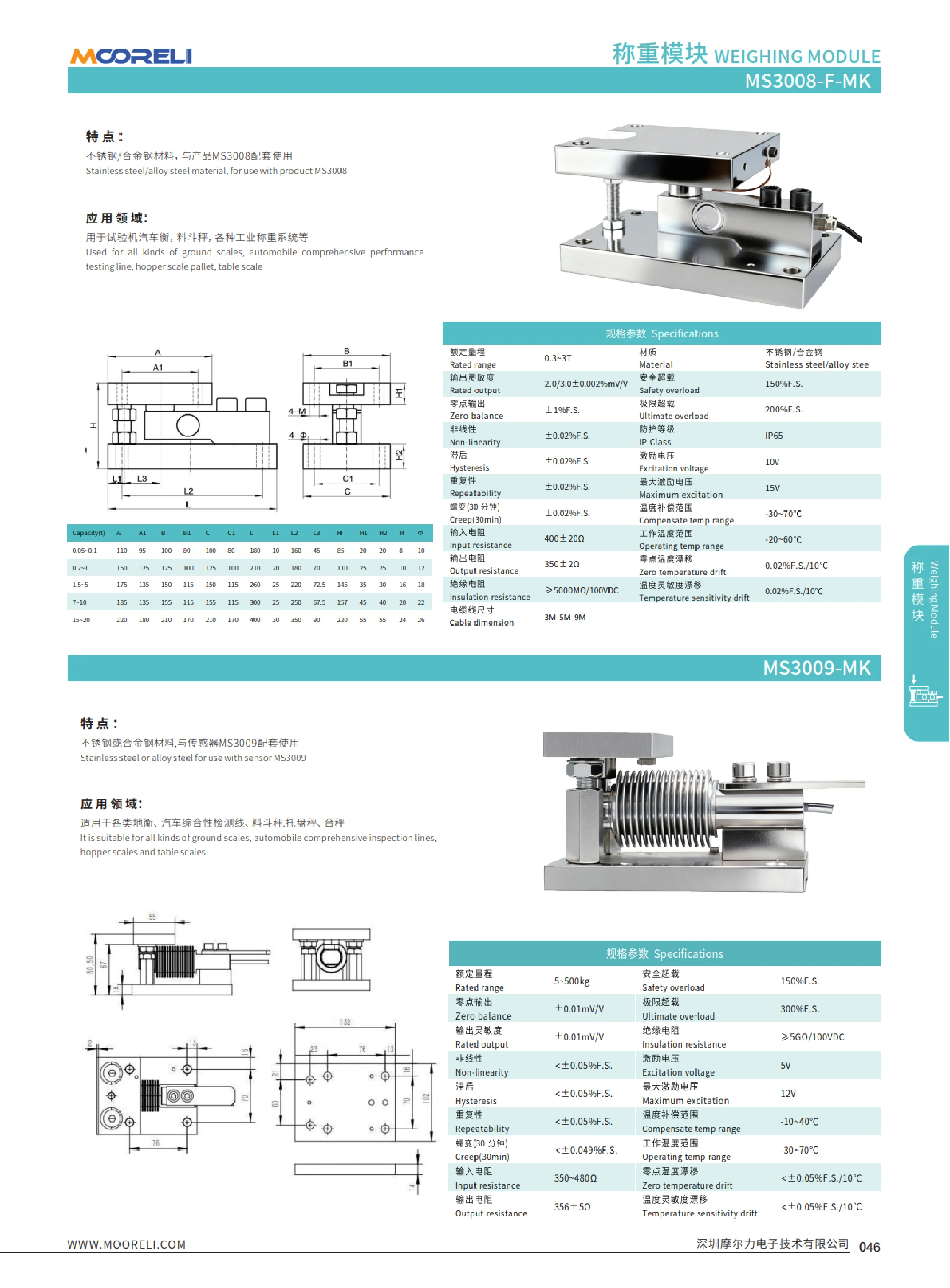
Load Cells for MS3008
This series of load cells is designed for use with MS3008 products. The sensing elements are made of stainless steel or alloy steel, providing good corrosion resistance and structural rigidity. They can be installed directly in testing machines, truck scales, hopper scales, platform scales, and various industrial weighing systems to convert weight signals into electrical outputs. Key specifications include a safe overload capacity of 150%F.S., a compensated temperature range of -30~70°C, an operating temperature range of -20~60°C, and both zero temperature drift and sensitivity temperature drift of 0.02%F.S./10°C. These characteristics ensure stable zero and sensitivity outputs over a wide range of ambient temperatures. Select a model based on rated capacity (measuring range), material (stainless steel or alloy steel), compatible instrumentation, and mounting interface. During installation, ensure that the direction of the applied load matches the sensor's calibration direction, and avoid off-center and lateral loads that could affect measurement accuracy.

MS3011/MS3029 Single-Point Load Cells
The MS3011/MS3029 series consists of single-point load cells made of aluminum alloy with an IP65 protection rating. They offer high accuracy, a low center of gravity, easy installation, and good interchangeability. They are suitable for weighing equipment such as electronic scales, truck scales, and platform scales. The catalog lists two specific models, MS3011 and MS3029. The specifications table covers rated capacity, output sensitivity, nonlinearity, hysteresis, insulation resistance, maximum platform size, material, safe overload, compensated temperature range, and maximum excitation voltage. However, repeated OCR text in the supplied page prevented extraction of the specific values for each model. Refer to the specifications table in the original catalog when selecting a model.

MS3012/MS3015 Single-Point Load Cells
The MS3012/MS3015 are single-point load cells with stainless steel or aluminum alloy sensing elements. They offer high accuracy, a low center of gravity, strong resistance to off-center loading, easy installation, and good interchangeability. The MS3012 has an IP65 protection rating and a maximum platform size of 50×50mm. It is widely used in price-computing scales, counting scales, and platform scales. The MS3015 is made of aluminum alloy and has an IP66 protection rating (the source also lists IP65). It is suitable for truck scales, counting scales, platform scales, and similar applications. Rated capacity ranges are 44~220kg and 50~1000kg. Nonlinearity, hysteresis, and repeatability are each 0.017%F.S.; 30-minute error is ±0.015%F.S.; zero output is ±2%F.S.; input resistance is 450±15Ω; output resistance is 350±3Ω; insulation resistance is ≥5000MΩ/100VDC; safe overload is 150%F.S.; ultimate overload is 200%F.S.; recommended excitation voltage is 5V, with a maximum of 12V; compensated temperature range is -10~40℃; operating temperature is -20~50℃; and temperature sensitivity drift is 0.03%F.S.

MS3040 Single-Point Sensor
The MS3040 is an aluminum alloy single-point load cell offering high accuracy, easy installation, and good interchangeability. It is suitable for weighing equipment such as price-computing scales, counting scales, and platform scales, with a maximum platform size of 800×800 mm. The catalog lists parameters including rated capacity, accuracy class, output sensitivity, input/output resistance, insulation resistance, safe overload, ultimate overload, operating temperature range, temperature sensitivity drift, temperature coefficient, and excitation voltage/current/frequency/power. Refer to the product label or complete catalog for specific values.
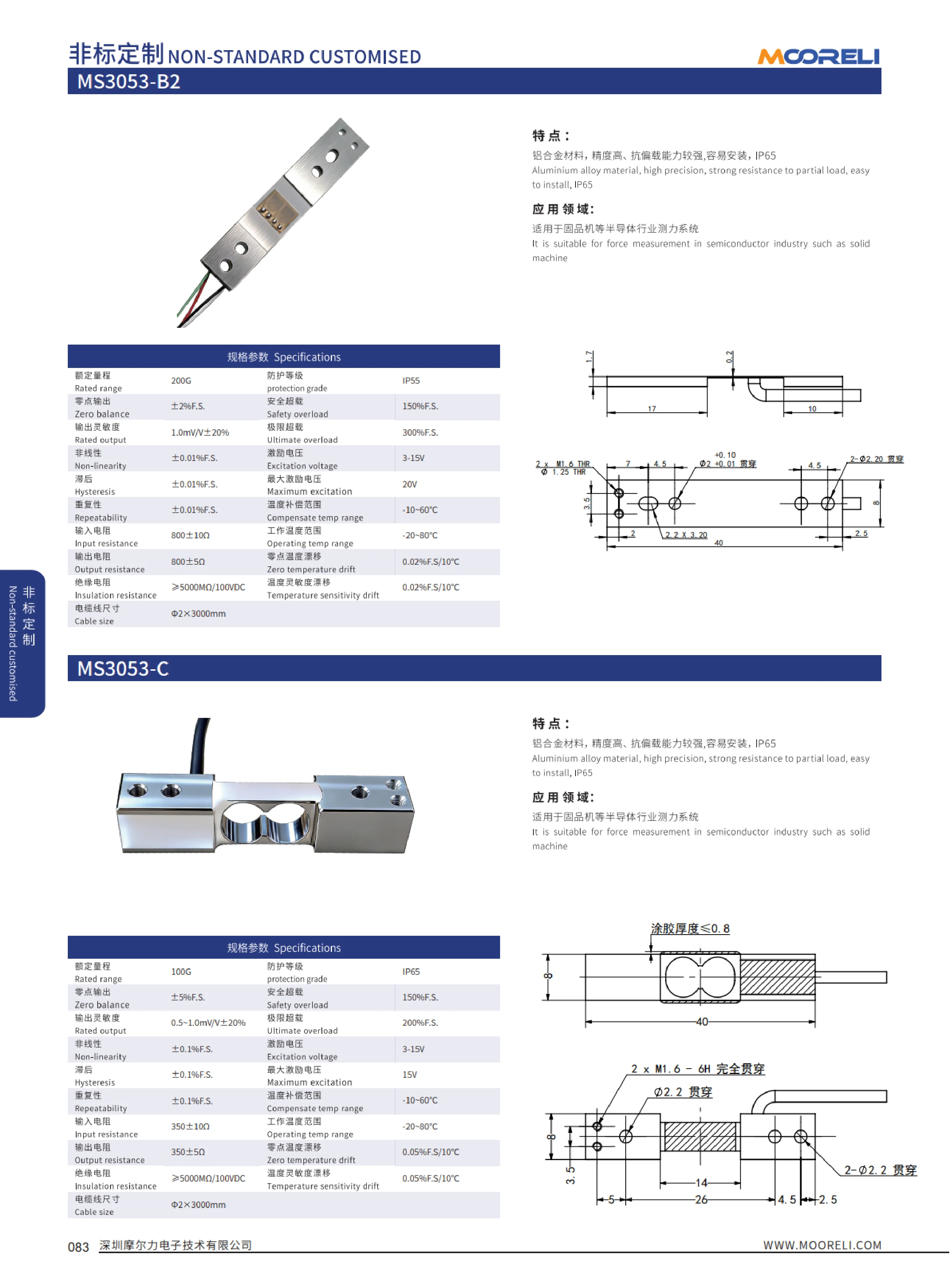
MS3053 Series Force Sensors
The MS3053 series consists of custom force sensors made from aluminum alloy. They offer high accuracy, strong resistance to off-center loading, easy installation, and an IP65 protection rating. Designed for force measurement systems in semiconductor equipment such as die bonders, they provide stable measurement of small forces. The rated range is 100G, zero balance is ±5%F.S., output sensitivity is approximately 0.5-1.0mW/Ω±20%, and cable size is 2.5mm². The series includes structural variants such as MS3053-B2 and MS3053-C, which can be selected according to the available mounting space and direction of force.

MS6023 Tension Sensor
The MS6023 tension sensor is designed for a wide range of web tension control equipment and accurately measures the tension of materials such as metal sheet, paper, film, metal foil, and wire. Its compact design is easy to install, with measurement ranges from 100N to 1000N and matched-pair accuracy of 0.025%. Sensors are sold in pairs and require no individual compensation. Made from aluminum alloy or stainless steel, they offer excellent resistance to torsion and protection up to IP67 for use in demanding environments. Built-in mechanical stops provide overload protection of more than three times the rated capacity. Specifications include a rated range of 15~200kg, combined error of ±0.05%, power input of 10VDC/AC, output of 0~20mV, safe overload of 150%F.S., ultimate overload of 300%F.S., insulation resistance of ≥5000Ω, and operating temperature range of -30~100℃. Typical applications include rolling mills, looms, coaters, rewinders, slitters, laminators, printing presses, plastic film production lines, steel sheet processing lines, and wire and cable machinery. The sensor is also widely used in batch processing industries such as pharmaceuticals, chemicals, and food.

MS9007 Strain Sensor
The MS9007 strain sensor uses the resistance strain gauge principle and is easy to install with screws. It has an IP66 protection rating and is suitable for monitoring strain under dynamic and static loads on equipment such as cranes and presses. It has a rated strain range of 50μm/m, zero balance of ±2%F.S., output sensitivity of 1.5±10%V/V, non-linearity of 0.25%F.S., hysteresis and repeatability of 0.1%F.S. each, input/output resistance of 1000±10Ω, insulation resistance of ≥5000MΩ/100VDC, operating temperature of -20~60℃, and maximum excitation voltage of 15V.