Manual Valves

3H Series Hand-Operated Valve
The 3H series hand-operated valve is a manually operated, direct-acting, two-port, two-position pneumatic valve. Its spool is driven directly by hand to switch airflow on and off. The working medium is air filtered through a screen rated at approximately 40μm or above; no lubrication is required. Port sizes include G1/8, G1/4, G3/8 and G1/2, with effective flow areas of 14.0~50.0mm² (Cv 0.78~2.79) to suit different flow requirements. The operating pressure range is 0~0.8MPa (0~114psi), proof pressure is 1.2MPa (170psi), and operating temperature is -50~60℃. The body is made of aluminum alloy. G and NPT port threads are available. The valve is suitable for manual switching, exhaust and commissioning in various pneumatic control circuits.

4R Series Hand-Operated Valves
The 4R series hand-operated valve is a five-port, two-position pneumatic directional control valve with manual control and automatic operation, suitable for pneumatic circuits requiring manual intervention. The working medium is air filtered through a 40μm or larger filter screen. No lubrication is required. The operating pressure range is 0~1.0MPa, the proof pressure is 1.5MPa, and the operating temperature range is -50~70℃. The valve body is made of aluminum alloy. The series includes models 4R110-06, 4R210-06, 4R310-06, and 4R310-10, with port sizes PT1/8, PT1/4, and PT3/8. G or NPT threads are also available. Its compact design is suitable for directional control, commissioning, and manual operation of pneumatic systems.
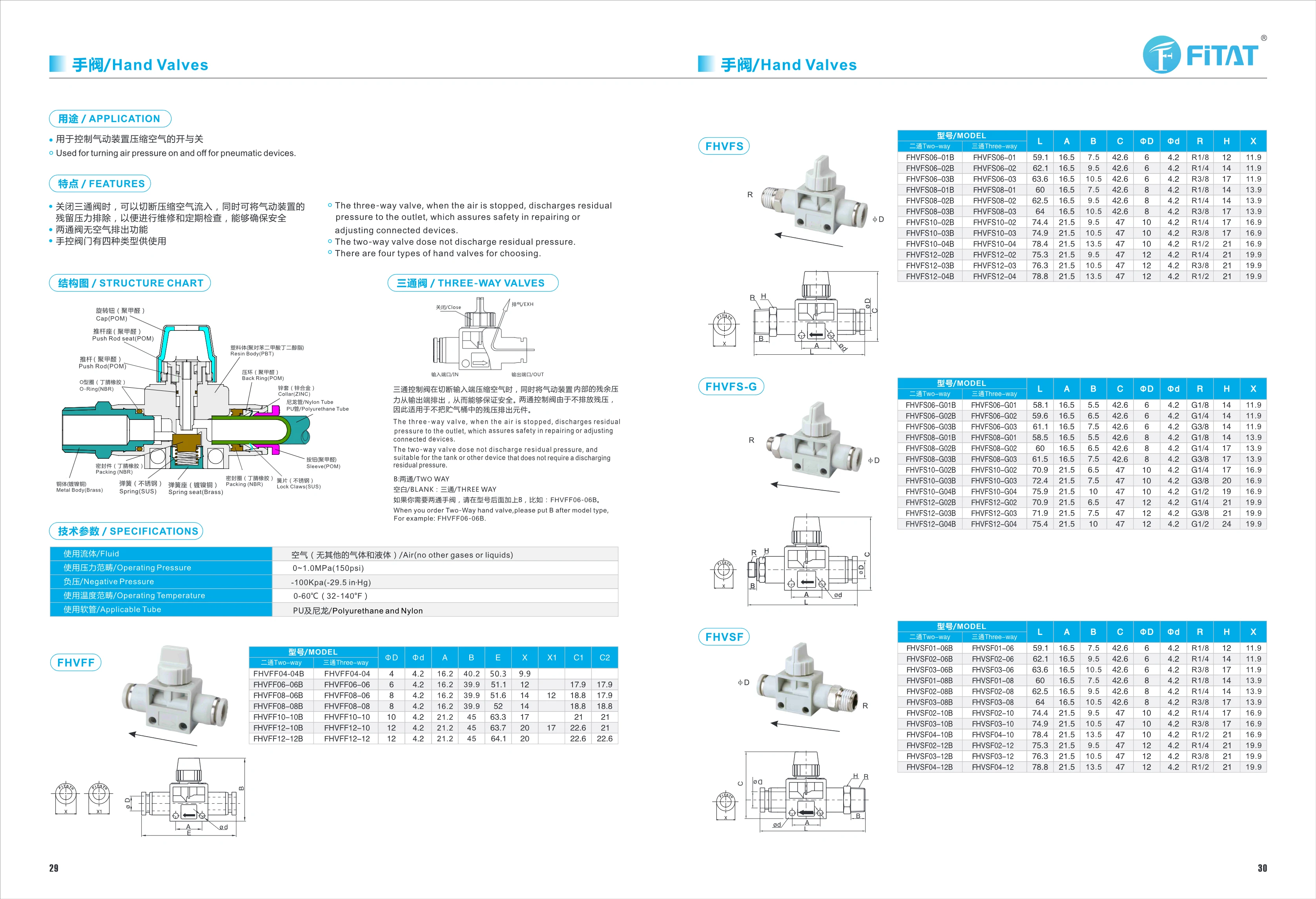
FHVFS Series Hand Valves
The FHVFS series consists of manually operated pneumatic shutoff valves (hand valves) used to turn the compressed air supply to pneumatic equipment on or off. When a three-way hand valve is closed, it shuts off the air supply and vents residual downstream pressure, allowing safe maintenance and periodic inspection. Two-way hand valves do not have an exhaust function and are suitable for applications such as air tanks where pressure relief is not required. The permitted medium is air only; do not use other gases or liquids. Valve body connections are available in two types: threaded ports (R1/8, R1/4, R3/8, R1/2, G1/2) and push-in hose connections (for Φ6~Φ12 hoses). Nominal bore sizes include Φ6, Φ8, Φ10 and Φ12. The overall valve body length L is approximately 58~76 mm, and the body height C is 42.6 mm or 47 mm. The model suffix B indicates a two-way valve. An FHVFS-G handle configuration is also available with the same connection codes and slightly different overall dimensions.
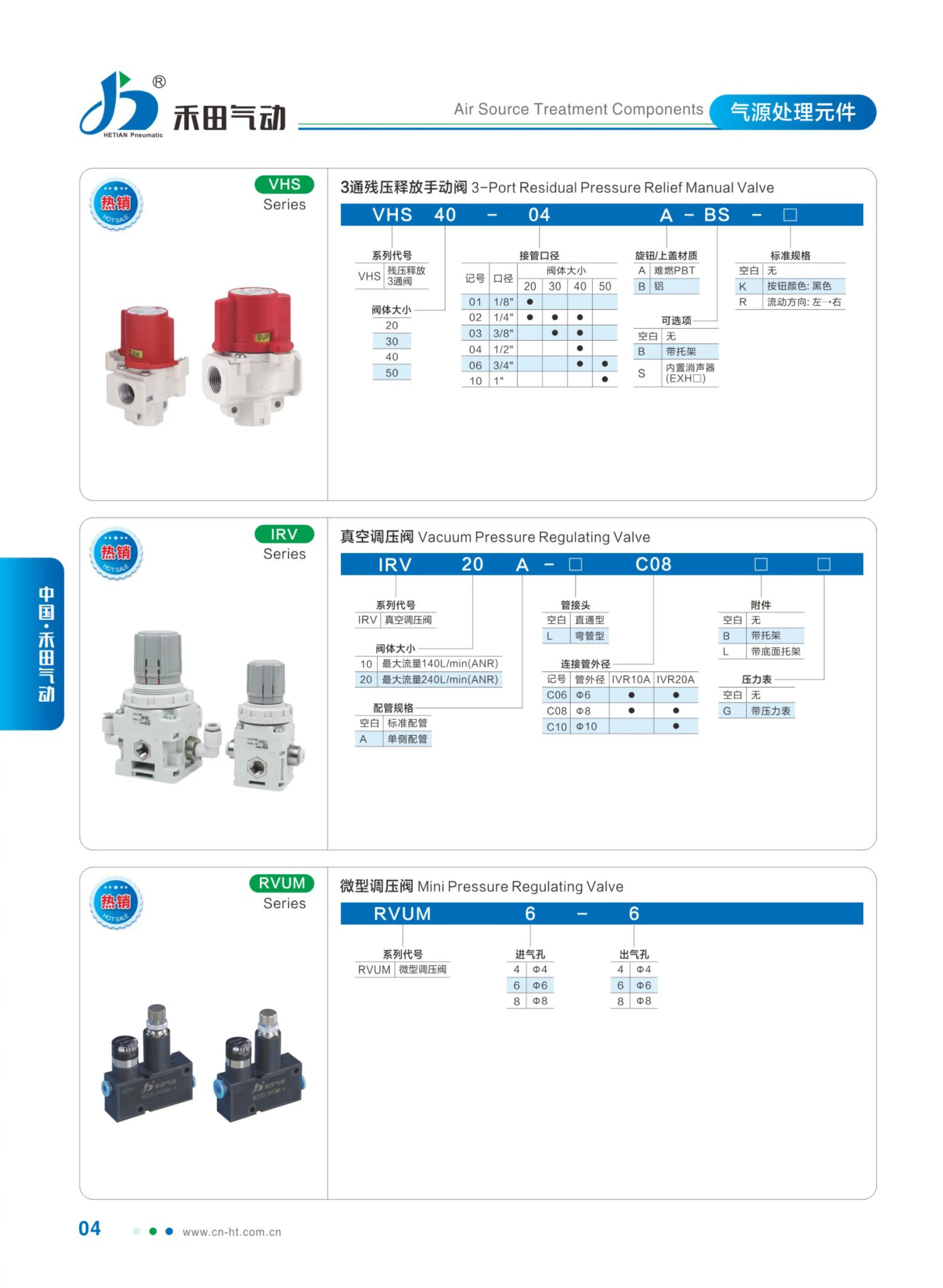
VHS Series 3-Port Manual Residual Pressure Relief Valve
The VHS series is a 3-port manual residual pressure relief valve used as a safety and maintenance component in pneumatic systems. It is typically installed downstream of the air preparation circuit and upstream of the actuators. Before inspection or maintenance, it manually shuts off the air supply while venting residual compressed air from downstream piping through the exhaust port. This quickly depressurizes the piping and actuators, such as cylinders and pneumatic grippers, to zero pressure, preventing injury from unexpected actuator movement caused by residual pressure and supporting safe work procedures such as lockout/tagout (LOTO). A typical design consists of a three-port valve body with a manual knob or a handle with a lock hole, an air inlet (P), an outlet (A), and an exhaust port (R). When turned to the closed position, the valve shuts off the inlet and connects the outlet side to the exhaust port. Common selection criteria include port thread size (such as 1/4, 3/8, 1/2, or 3/4), effective flow area and flow rate, operating pressure range, operating temperature range, and mounting style (in-line or panel-mounted). The source text on this page provides only the series name and product name in Chinese and English; it does not list specific model codes, dimension tables, or ordering codes.