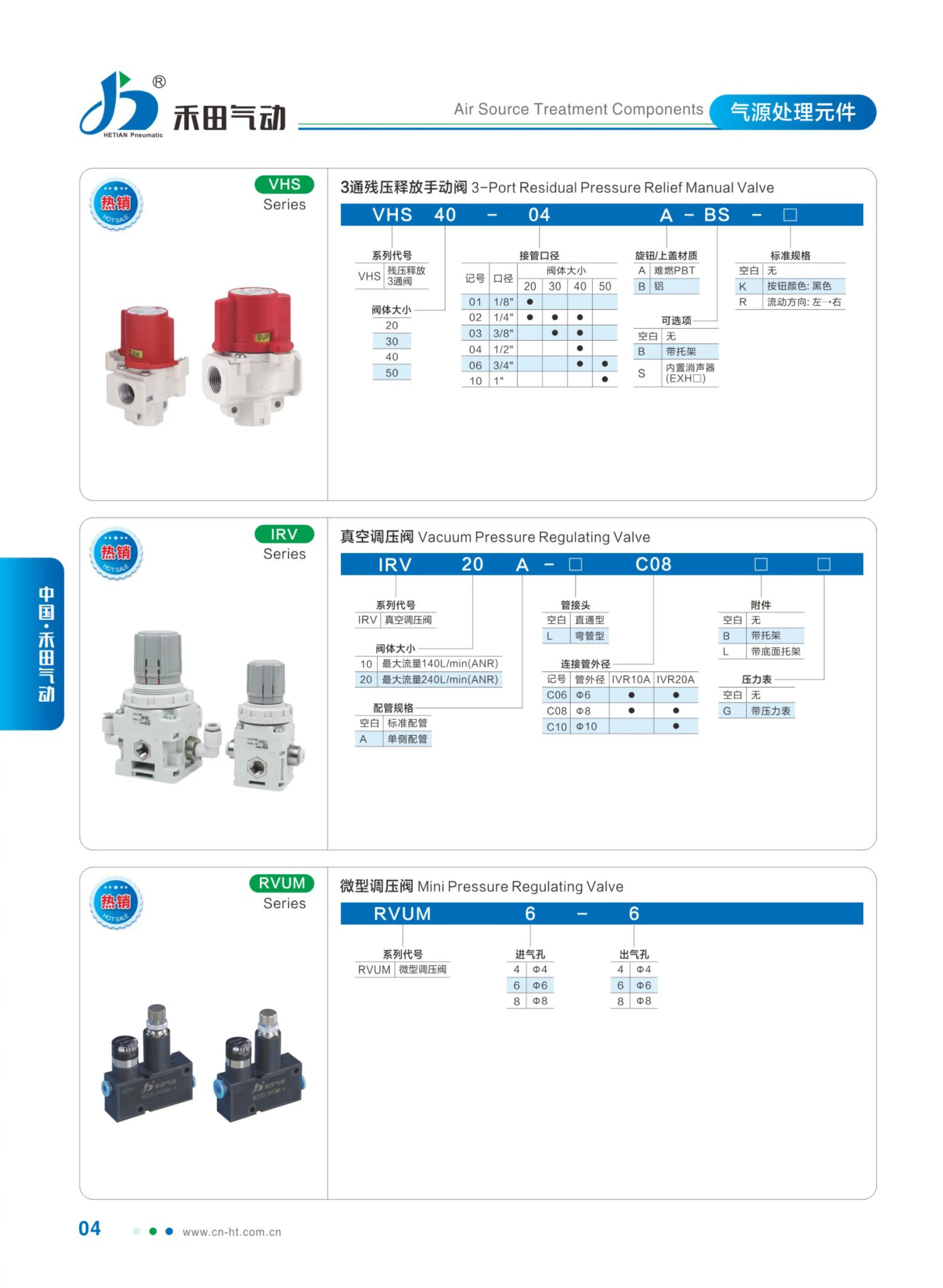
Model · VHS Series 3-Port Manual Residual Pressure Relief Valve
VHS Series 3-Port Manual Residual Pressure Relief Valve
The VHS series is a 3-port manual residual pressure relief valve used as a safety and maintenance component in pneumatic systems. It is typically installed downstream of the air preparation circuit and upstream of the actuators. Before inspection or maintenance, it manually shuts off the air supply while venting residual compressed air from downstream piping through the exhaust port. This quickly depressurizes the piping and actuators, such as cylinders and pneumatic grippers, to zero pressure, preventing injury from unexpected actuator movement caused by residual pressure and supporting safe work procedures such as lockout/tagout (LOTO). A typical design consists of a three-port valve body with a manual knob or a handle with a lock hole, an air inlet (P), an outlet (A), and an exhaust port (R). When turned to the closed position, the valve shuts off the inlet and connects the outlet side to the exhaust port. Common selection criteria include port thread size (such as 1/4, 3/8, 1/2, or 3/4), effective flow area and flow rate, operating pressure range, operating temperature range, and mounting style (in-line or panel-mounted). The source text on this page provides only the series name and product name in Chinese and English; it does not list specific model codes, dimension tables, or ordering codes.
Overview
The VHS series is a 3-port manual residual pressure relief valve used as a safety and maintenance component in pneumatic systems. It is typically installed downstream of the air preparation circuit and upstream of the actuators. Before inspection or maintenance, it manually shuts off the air supply while venting residual compressed air from downstream piping through the exhaust port. This quickly depressurizes the piping and actuators, such as cylinders and pneumatic grippers, to zero pressure, preventing injury from unexpected actuator movement caused by residual pressure and supporting safe work procedures such as lockout/tagout (LOTO). A typical design consists of a three-port valve body with a manual knob or a handle with a lock hole, an air inlet (P), an outlet (A), and an exhaust port (R). When turned to the closed position, the valve shuts off the inlet and connects the outlet side to the exhaust port. Common selection criteria include port thread size (such as 1/4, 3/8, 1/2, or 3/4), effective flow area and flow rate, operating pressure range, operating temperature range, and mounting style (in-line or panel-mounted). The source text on this page provides only the series name and product name in Chinese and English; it does not list specific model codes, dimension tables, or ordering codes.
Product category: Pneumatic components/Manual valves/Hand valves
Original catalogs