Transmission Accessories — Page 14
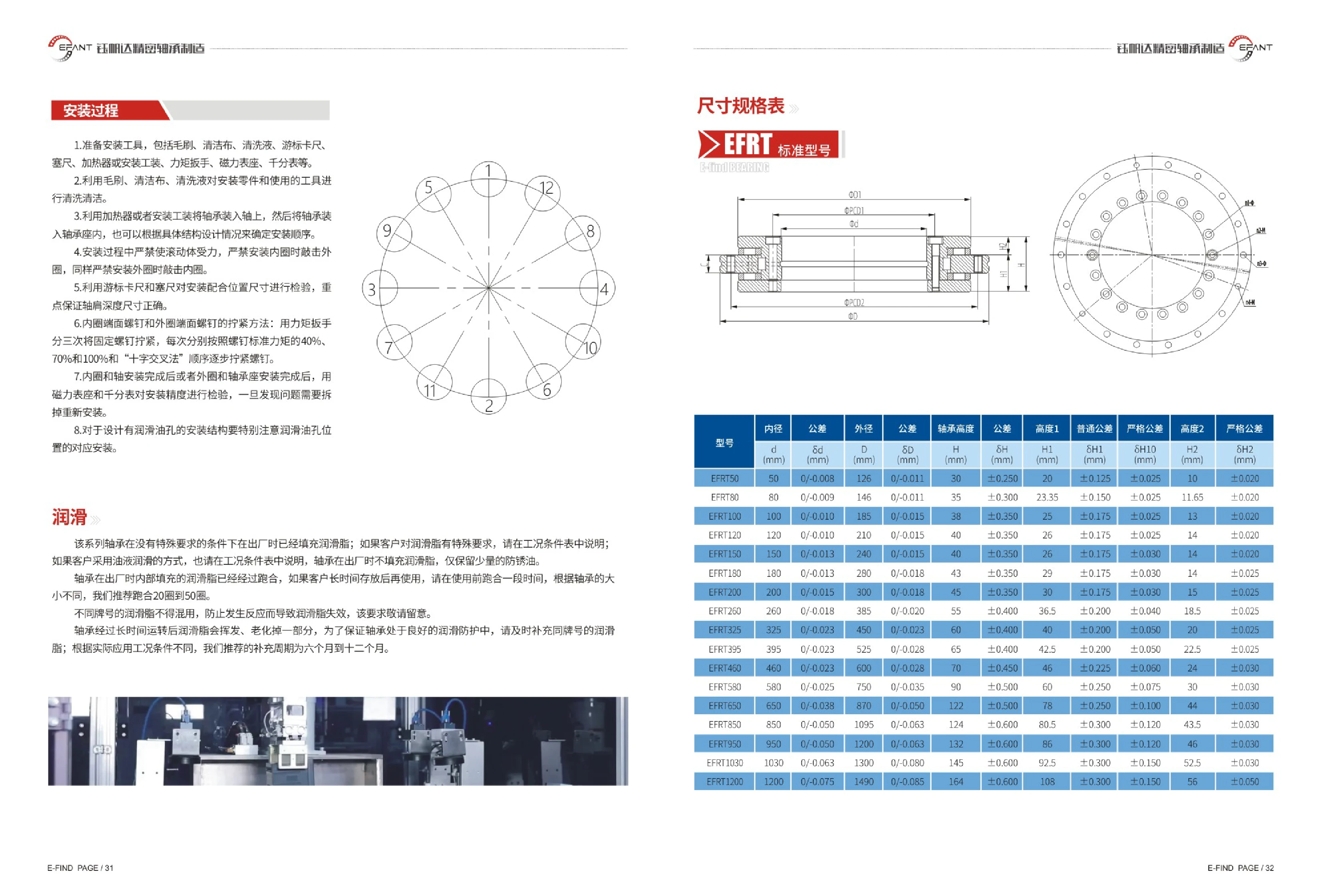
EFRT Series Bearings
EFRT series bearings are medium- to large-sized bearings with mounting screw holes in the end faces of the inner and outer rings. The 17 sizes cover bore diameters of 50~1200mm, outside diameters of 126~1490mm and bearing heights of 30~164mm. The catalog specifies five dimensions: bore diameter, outside diameter, bearing height, height 1 and height 2. It lists unilateral negative tolerances for bore and outside diameters (e.g., 0/-0.008 for a 50mm bore and 0/-0.075 for a 1200mm bore), symmetric height tolerances (±0.250~±0.600), and normal and strict tolerance options for heights 1 and 2, allowing selection according to equipment accuracy requirements. Before installation, clean the parts and tools, then fit the bearing using a heater or dedicated mounting tool. Never apply force through the rolling elements or strike the non-fitted ring. Use a torque wrench to tighten the inner and outer ring end-face screws in a crosswise sequence, in three stages at 40%, 70% and 100% of the standard torque. Check installation accuracy with a dial indicator on a magnetic base, paying particular attention to the shoulder depth dimension. Bearings are supplied prefilled with grease according to the fit requirements. Oil lubrication can be used instead to suit the customer's operating conditions, in which case only rust-preventive oil is retained; different grades of
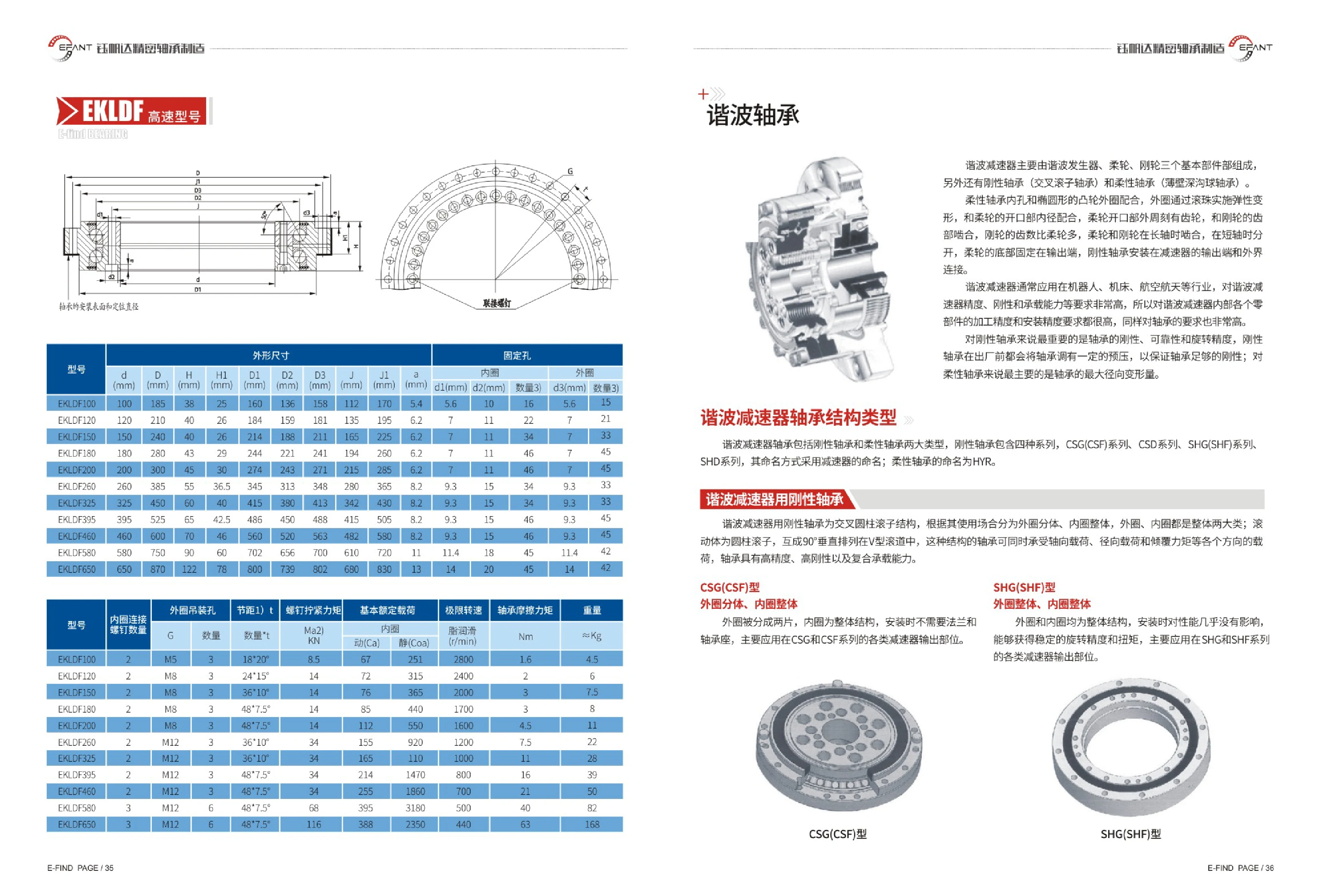
EKLDF Series Rigid Bearings for Harmonic Drive Reducers
EKLDF series rigid bearings for harmonic drive reducers feature crossed cylindrical rollers arranged perpendicular to each other at 90° in a V-shaped raceway. They can simultaneously accommodate axial loads, radial loads, and overturning moments. Depending on the application, they are available in two configurations: a split outer ring with an integral inner ring, or integral outer and inner rings. They offer high precision, high rigidity, and combined load capacity. The range covers d=100~650 mm in 11 sizes and is suitable for harmonic drive reducers, robot joints, and precision rotary mechanisms.

CSG(CSF) Series Rigid Bearings for Harmonic Reducers
CSG/CSF series rigid bearings for harmonic reducers feature a crossed cylindrical roller design, with rollers arranged perpendicular to each other at 90° in a V-shaped raceway. They simultaneously accommodate axial loads, radial loads, and overturning moments, providing high precision, high rigidity, and combined load capacity. Depending on the application, they are available in two main configurations: a split outer ring with an integral inner ring, or integral outer and inner rings. Rigid bearing series include CSG(CSF), CSD, and SHG(SHF). This page lists 11 sizes with bore diameters d=100~650mm, along with overall and mounting dimensions including d, H, H1, D1, D2, D3, J, J1, and a, as well as mounting hole specifications for the inner and outer rings. These bearings are suitable for harmonic reducer output support and precision rotary applications.
CSD Series Rigid Bearings for Harmonic Drives
Rigid bearings for harmonic drives feature crossed cylindrical rollers arranged at 90° to one another in a V-shaped raceway. They simultaneously accommodate axial loads, radial loads, and overturning moments, offering high precision, high rigidity, and strong combined-load capacity. Depending on the application, they are available in two main designs: a split outer ring with an integral inner ring, or integral inner and outer rings. Rigid bearing series include CSG(CSF), CSD, and SHG(SHF), and are commonly used in precision drive applications such as harmonic drives, robot joints, and precision rotary tables. This page lists EKLDF specifications with bore diameters d=100~650 mm, outer diameters of 185~870 mm, and heights of 38~122 mm. Mounting hole and raceway dimensions are also provided to support selection and installation design.

SHG(SHF) Series Rigid Bearings for Harmonic Reducers
Rigid bearings for harmonic reducers use a crossed cylindrical roller design, with cylindrical rollers arranged at 90° to one another in V-shaped raceways. They can simultaneously support axial loads, radial loads, and tilting moments, providing high precision, high rigidity, and combined load capacity. Depending on the application, they are divided into two main types: split outer ring with integral inner ring, and integral inner and outer rings. The rigid bearing range comprises four series: CSG(CSF), CSD, SHG(SHF), and SHG(CSF). The catalog lists 11 sizes from EKLDF100 to EKLDF650, with bore diameter d ranging from 100mm to 650mm. Overall height, mounting hole dimensions, and other dimensions increase with bore diameter. These bearings are widely used in precision transmission applications such as industrial robot joints and harmonic reducers.

CSD Flexible Bearings for Harmonic Drive Reducers
Flexible bearings for harmonic drive reducers are available in CSD, SHD and other configurations. The CSD type has one-piece inner and outer rings and the same outside diameter as the CSG type, but offers greater rigidity. It is used at the output of CSD series reducers. The SHD type has a one-piece toothed inner ring that meshes directly with the flexspline teeth. It is lower in height than the SHG and is used at the output of SHD series reducers. These thin-walled bearings deform elastically when fitted to a cam and are subjected to alternating stress. The inner and outer rings and rolling elements are made of high-carbon chromium bearing steel, and the cage is a one-piece nylon design. The catalog lists the dimensions of CSG(CSF)-14~-65 bearings (d, D, H, C, B, H2, D1, D2, d1, d2). The operating temperature range is -20℃~+80℃. The bearings are filled with lithium complex grease and preloaded before shipment.
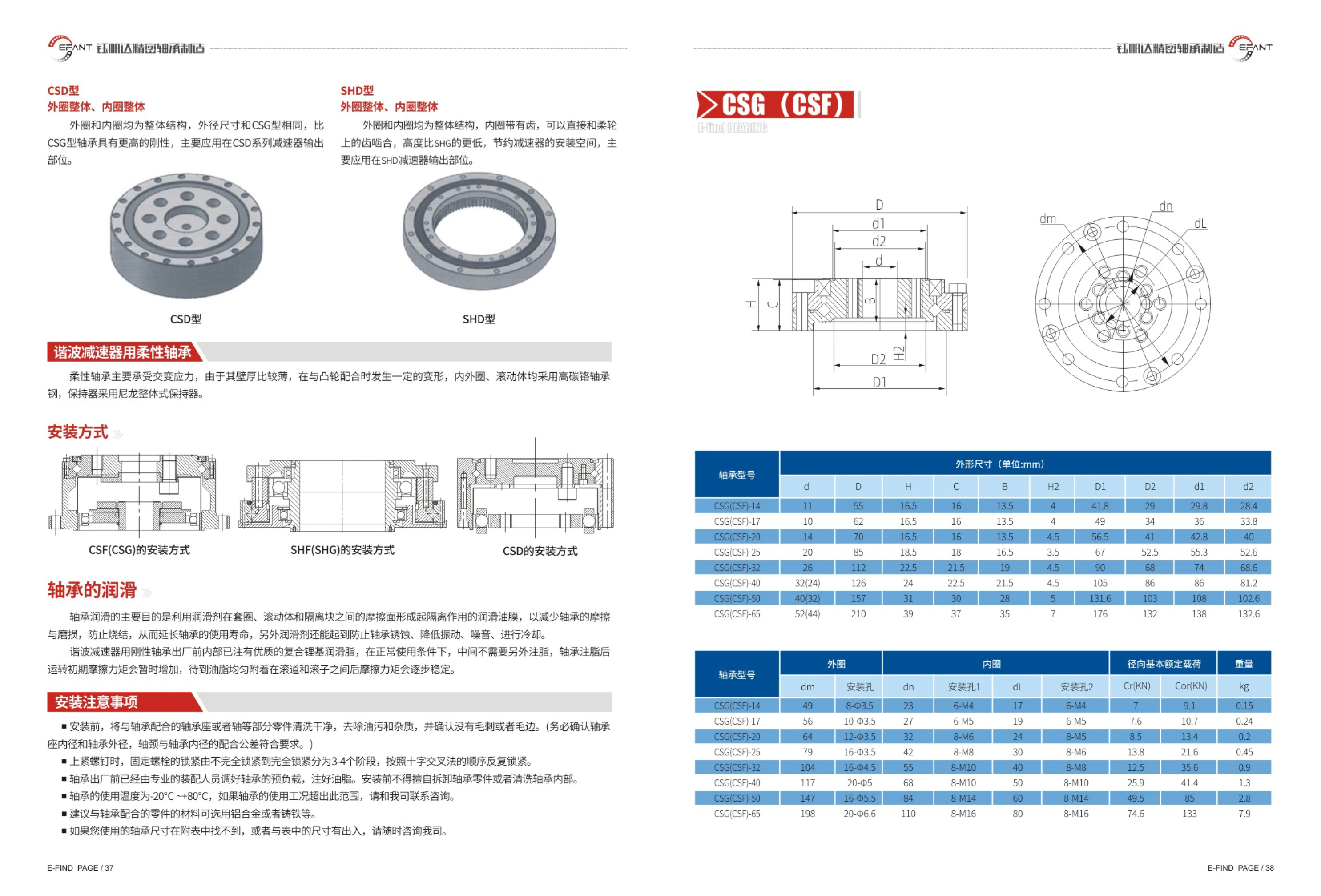
Flexible Bearings for SHD Harmonic Reducers
Flexible bearings for SHD harmonic reducers feature one-piece outer and inner rings. The inner ring has teeth that mesh directly with the teeth on the flexspline. Their lower profile compared with the SHG type saves installation space, and they are primarily used at the output of SHD series reducers. The thin-walled flexible bearing is subject to alternating stress and deforms to a degree when fitted to the cam. The inner and outer rings and rolling elements are made of high-carbon chromium bearing steel, and the cage is a one-piece nylon design. The bearings are filled with high-quality lithium complex grease and preloaded before leaving the factory; no relubrication is required under normal operating conditions. The operating temperature is -20℃~+80℃, and aluminum alloy or cast iron is recommended for mating components. Consult the manufacturer if the required dimensions are not listed in the accompanying table or differ from those shown.
CSG(CSF) Flexible Bearings for Harmonic Reducers
Flexible bearings for harmonic reducers are thin-walled flexible ball bearings designed primarily to withstand alternating stresses. Their thin walls undergo controlled elastic deformation when paired with an elliptical cam, driving the flexspline into periodic meshing engagement. They are core components of harmonic reducers. The inner and outer rings and rolling elements are made of high-carbon chromium bearing steel, while the cage is a one-piece nylon structure. Before shipment, trained assembly personnel adjust the preload and fill the bearing with high-quality lithium complex grease. No relubrication is required under normal operating conditions. Both the outer and inner rings are one-piece structures, and the outer diameter matches that of the CSG type. These bearings are mainly used at the output of CSD series reducers. The same series also includes variants such as the CSD type, which has one-piece inner and outer rings and a toothed inner ring that can mesh directly with the flexspline teeth. It has a lower height and is used at the output of SHD reducers. The bearing operating temperature range is -20℃~+80℃. Aluminum alloy or cast iron is recommended for mating components. Models are classified by reducer frame size (14, 17, 20, 25, 32, 40, 50, 65), with each frame size corresponding to specific dimensions such as d, D and H, and mounting hole positions.
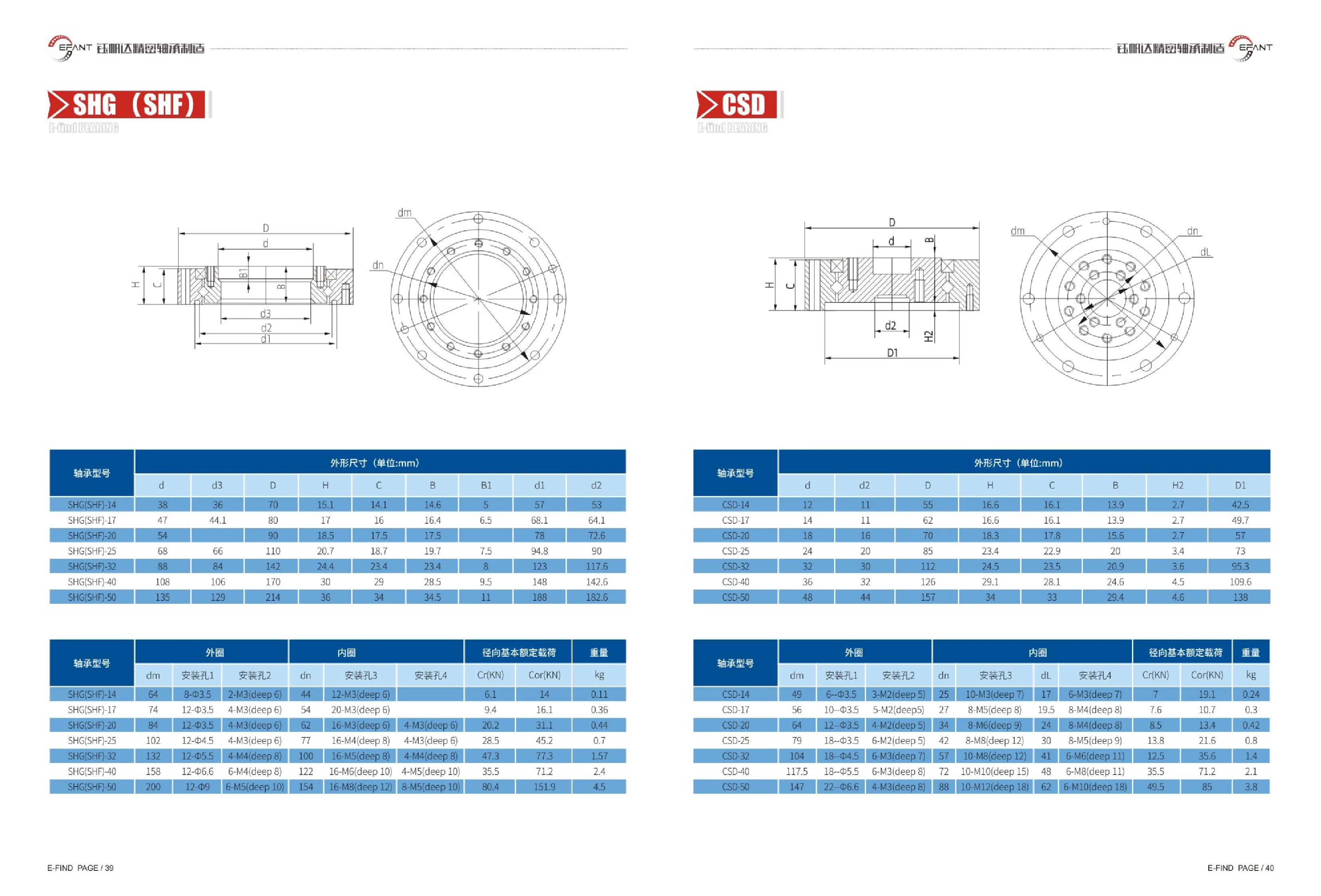
SHG(SHF) Series Crossed Roller Bearings
The SHG(SHF) series comprises thin-section crossed roller bearings in seven sizes: 14, 17, 20, 25, 32, 40, and 50. SHG and SHF models in the same size share the same overall dimensions. The bearing bore diameter d is 38~135mm, the outer diameter D is 70~214mm, and the assembled height H is 15.1~36mm. Mounting and mating dimensions including d3, C, B, B1, d1, and d2 are also provided. The series features a single row of rollers arranged crosswise at 90°, allowing it to support radial, axial, and tilting moment loads simultaneously. It offers high rigidity, high rotational accuracy, and a compact design, and is commonly used for rotary support at harmonic drive outputs, industrial robot joints, precision rotary tables, and semiconductor equipment. When selecting a model, use the size code (14~50) to determine the inner and outer diameters and mounting hole positions. During installation, ensure that the inner- and outer-ring bolts are preloaded evenly.
CSD Series Crossed Roller Bearings
CSD series crossed roller bearings have a thin-walled structure with rollers arranged at 90° to one another and mounting holes integrated into both the inner and outer rings. They offer high rigidity and precision in a space-saving design and can simultaneously support radial loads, axial loads, and overturning moments. The catalog covers 7 sizes from CSD-14 to CSD-50, with inner diameters of 12~48 mm, outer diameters of 55~157 mm, overall heights of 16.6~34 mm, basic dynamic radial load ratings of 7~49.5 kN, static load ratings of 10.7~85 kN, and weights of 0.24~3.8 kg. Applications include industrial robot joints, precision rotary tables, measuring instruments, medical equipment, and semiconductor manufacturing equipment.

XR/JXR Series Crossed Tapered Roller Bearings
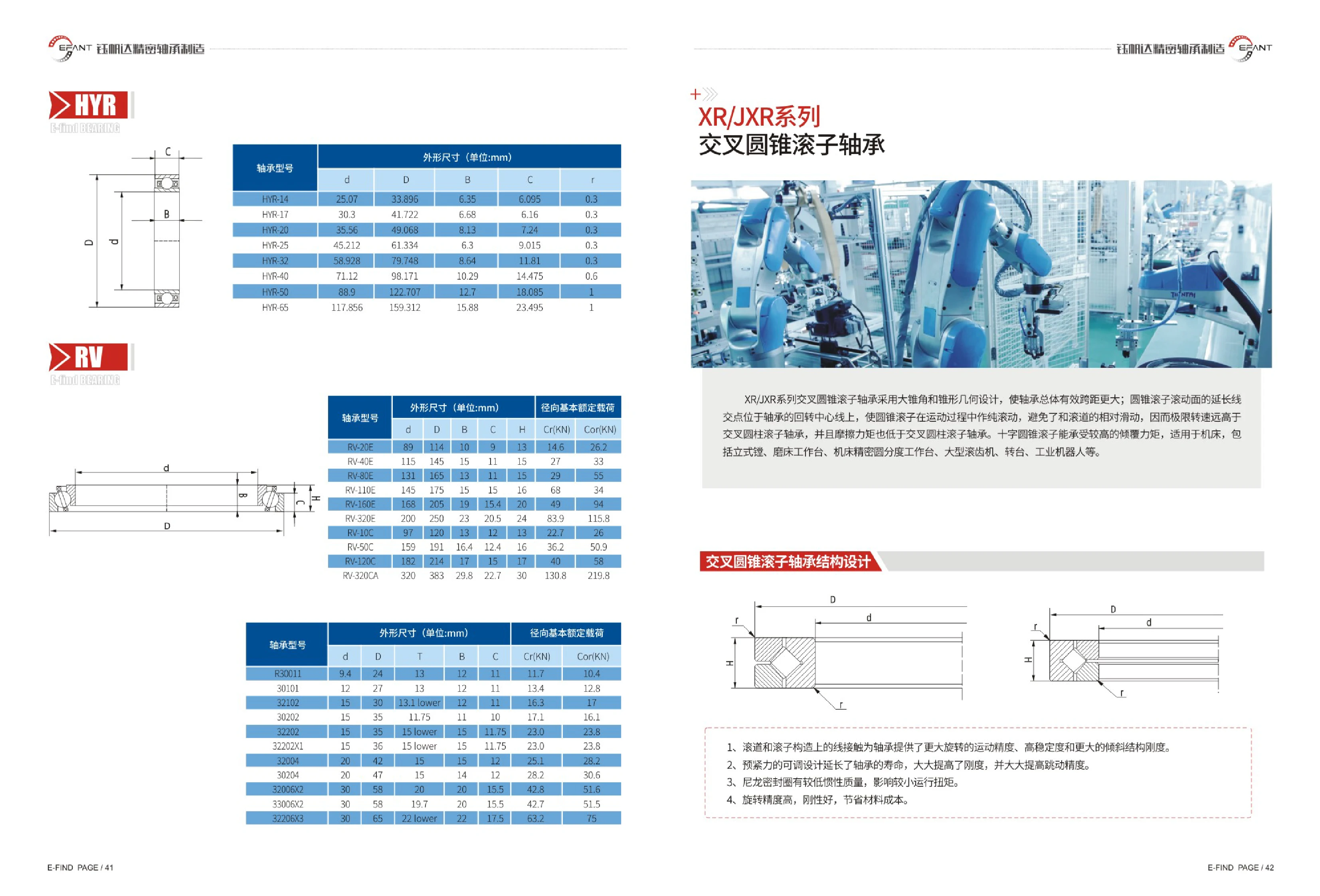
XR/JXR series crossed tapered roller bearings use a steep contact angle and tapered geometry to increase the overall effective bearing span. The extended lines of the tapered roller rolling surfaces intersect on the bearing's axis of rotation. The rollers roll without sliding relative to the raceways, resulting in a much higher limiting speed and lower frictional torque than crossed cylindrical roller bearings. Each bearing consists of one outer ring, two split inner rings, crossed tapered rollers and nylon spacers. Line contact between the rollers and raceways allows the bearing to support radial loads, axial loads and high overturning moments simultaneously. A single bearing can replace a conventional bearing assembly, offering a compact cross-section and high rigidity. Adjustable preload extends bearing life and improves rigidity and runout accuracy. The nylon sealing ring has low inertial mass and little effect on operating torque. The finished components are supplied unassembled and installed by the user through alignment and preloading. The gap between the inner rings provides lubrication, and lifting holes in the outer ring simplify installation. Bore diameter: 203.2~1549.4mm; outside diameter: 279.4~1828.8mm; height: 31.75~114.3mm; basic radial dynamic load rating: 51.2~516kN; axial dynamic load rating: 61.4~698kN; limiting speed (oil): 80~800r/mi
RV Series Crossed Roller Bearings
The RV series of crossed roller bearings is available in three configurations: RV-E, RV-C and RV-CA. Model designations consist of RV followed by a size code, with ten sizes ranging from 20 to 320. These thin-section bearings have rollers arranged at 90° to one another in V-shaped raceways. A single bearing can simultaneously support radial loads, axial loads in both directions and overturning moments. Features include a compact design, high rigidity, high rotational accuracy, low starting friction torque and long service life. The catalog lists the bore diameter d and outer diameter D (in mm) for each model to assist with selection based on available mounting space and the design of mating components. The series is widely used in applications requiring high rigidity and rotational accuracy, including machine tool rotary tables, vertical boring and grinding machine tables, precision indexing tables, large gear hobbing machines, turntables and industrial robot joints. To select a bearing, first determine the size code based on mounting space and load requirements, then choose the final model according to preload, lubrication and sealing conditions.
ERBS Series Crossed Roller Bearings
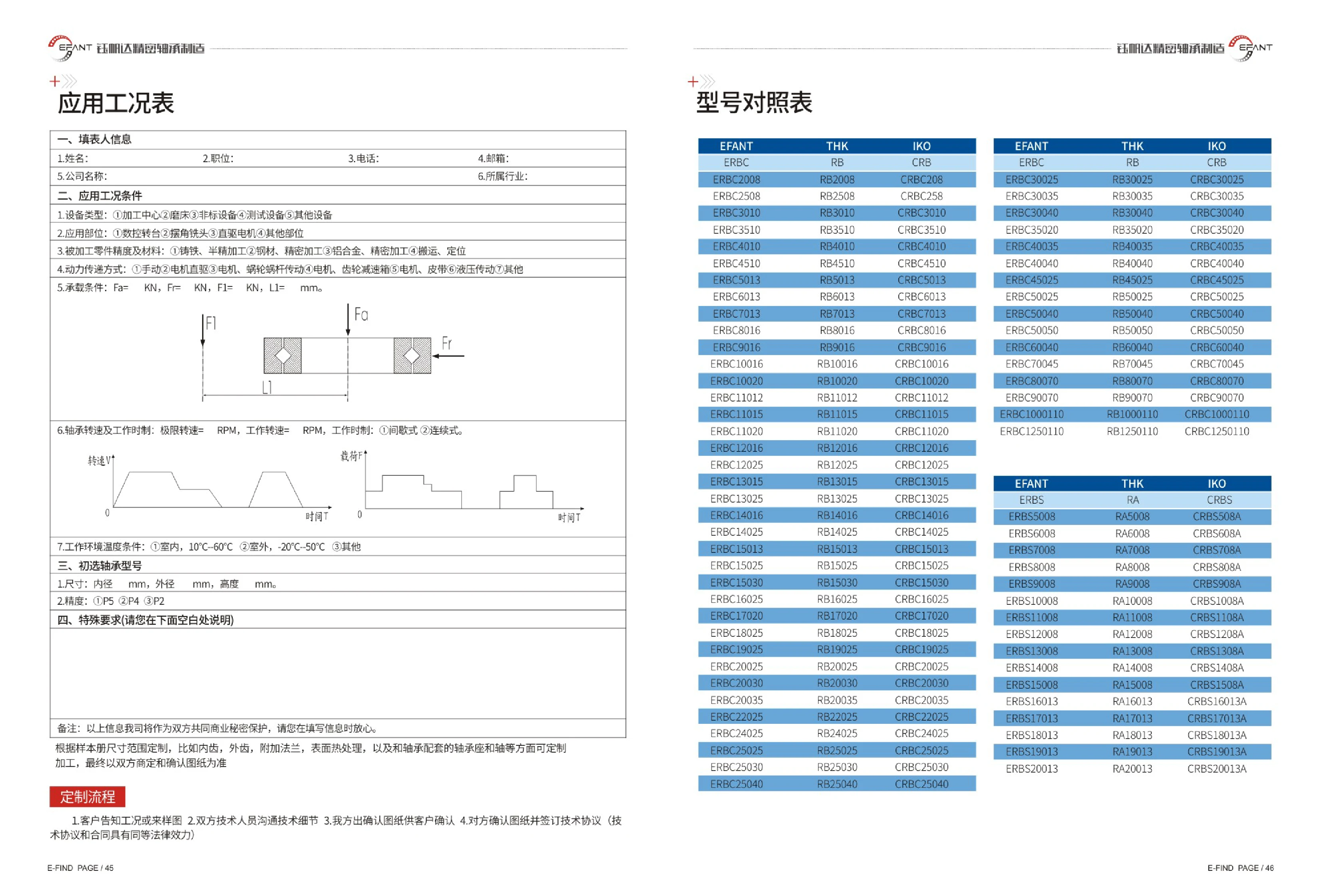
The ERBS series consists of thin-section crossed roller bearings with a single row of rollers arranged alternately at 90°. They can simultaneously support radial loads, axial loads in both directions, and overturning moments, while offering a thin cross-section, high rigidity, and high rotational accuracy. Catalog models are designated as “ERBS+bore diameter+width” and cover bore diameters of 50~200mm. They are available in two width ranges: 8mm (ERBS5008~ERBS15008) and 13mm (ERBS16013~ERBS20013). They correspond to and are interchangeable with the THK RA series and IKO CRBS series. Available accuracy grades are P5, P4, and P2. Typical applications requiring high rigidity and rotational accuracy include CNC rotary tables on machining centers, swiveling milling heads, direct-drive motors, robot joints, and test equipment. In addition to standard models, internal or external gear teeth, additional flanges, surface heat treatment, and matching bearing housings and shafts can be customized to suit operating conditions. Final specifications are subject to drawings approved by both parties.
ERBH Series Crossed Roller Bearings
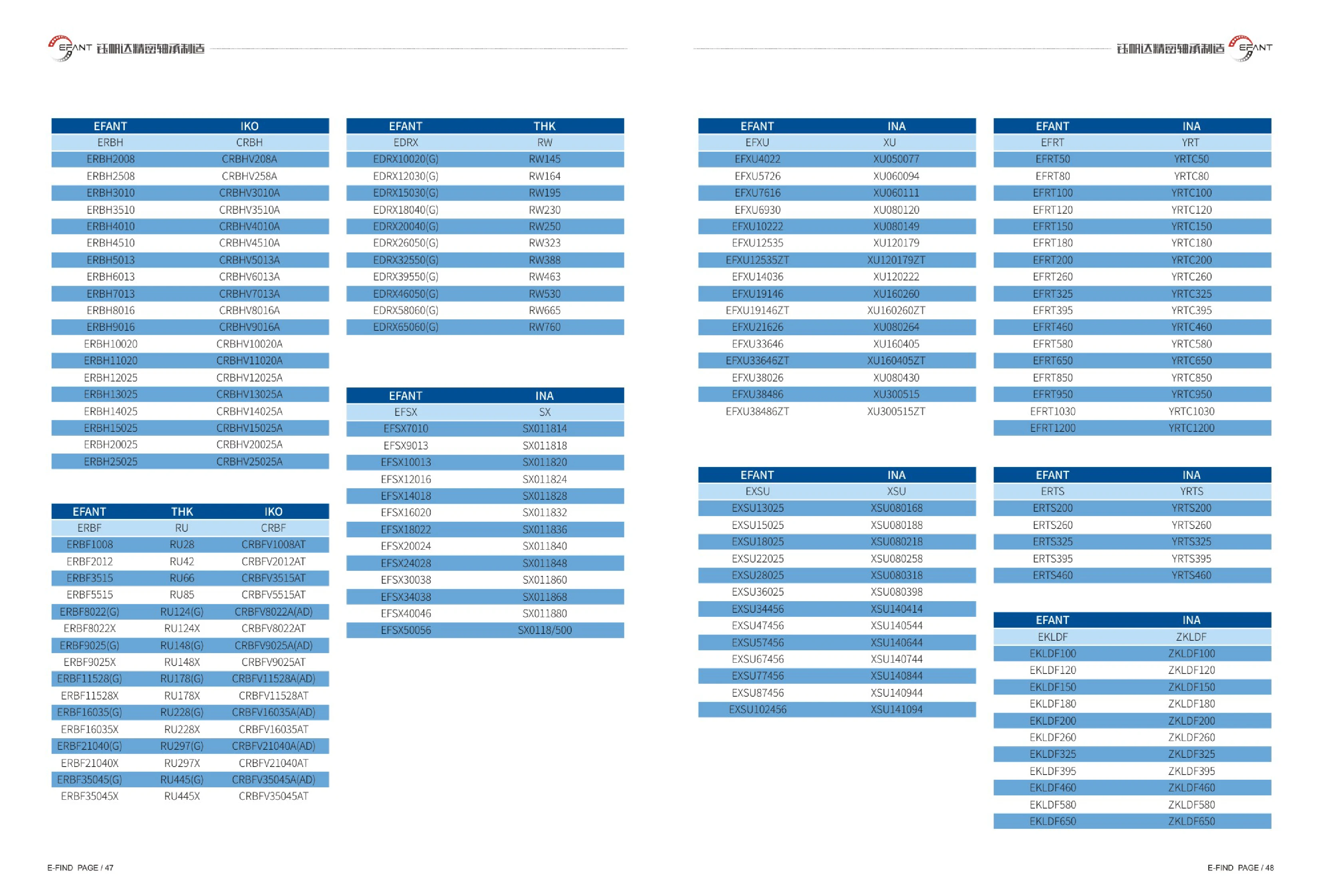
ERBH series crossed roller bearings feature rollers arranged at 90° to one another between the inner and outer rings. A single bearing can simultaneously support radial loads, axial loads in both directions, and overturning moments. They offer a compact design, high rigidity, and high rotational accuracy. The series has an integral inner or outer ring (corresponding to the IKO CRBH/CRBHV series) and requires no additional adjustment shims during installation. It enables highly rigid, precise rotary motion in applications such as robot joints, CNC indexing tables, rotary worktables, precision rotary tables, medical equipment, and semiconductor equipment. The catalog lists models from ERBH2008 to ERBH25025 by bore diameter and width, with bore diameters of approximately 20~250 mm and widths of 8~25 mm. Users can select a model based on available mounting space and load requirements. Corresponding sizes are directly interchangeable with IKO CRBHV bearings.
ERBF Series Crossed Roller Bearings
ERBF series crossed roller bearings feature a compact design with rollers arranged at 90° to one another. They simultaneously support radial, axial and moment loads, offering high rigidity, high rotational accuracy and space-saving installation. They are suitable for robot joints, rotary tables, machine tool indexing tables and precision rotary mechanisms. Model numbers consist of ERBF followed by the bore diameter and width; for example, ERBF1008 has a bore diameter of 10 mm and a width of 8 mm. Some sizes are available in (G) and X variants. The catalog provides a model-by-model correspondence with the THK RU series to simplify selection and replacement.
EFXU Series Crossed Roller Bearings
The EFXU series consists of full-complement crossed roller bearings with rollers arranged alternately at 90° to one another in a 90° V-shaped raceway. They accommodate radial loads, axial loads in both directions, and tilting moments simultaneously. Their high rigidity, high rotational accuracy, and compact axial dimensions make them suitable for rotary positioning applications such as robot joints, CNC indexing tables, machine tool rotary tables, radar, and medical equipment. Corresponding to the INA XU series, these bearings have integral inner and outer rings. Model numbers consist of EFXU followed by a size code, with sizes ranging from small and medium-light models to large models with outside diameters exceeding 400 mm. Some models have a ZT suffix denoting a structural variant. Select the appropriate size based on bore diameter, outside diameter, width, dynamic and static load ratings, and tilting moment. During installation, ensure the mounting surfaces are sufficiently flat and rigid to take full advantage of the bearing's high rigidity.
EXSU Series Crossed Roller Bearings
EFANT EXSU series crossed roller bearings are equivalent to the INA XSU series. Their cylindrical rollers are arranged crosswise at 90°, allowing them to simultaneously withstand radial loads, axial loads in both directions, and tilting moments. They offer high rigidity, high rotational accuracy, and a compact cross-section. The series is suitable for precision rotation applications such as industrial robot joints, machine tool rotary tables, indexing tables, radar, and medical equipment. The catalog lists 13 sizes, from EXSU13025 to EXSU102456, with the corresponding INA XSU model for each to facilitate selection and replacement. During installation, ensure the mating surfaces are accurate and clean, and apply lubrication and preload appropriate to the operating conditions.
EKLD Series Crossed Roller Bearings
EKLD series crossed roller bearings are EFANT bearings designed specifically for rotary tables. The catalog provides a model cross-reference showing the corresponding INA ZKLDF series specification for each model. Featuring a crossed-roller/multi-row rolling element design, these bearings can simultaneously support axial loads, radial loads, and tilting moments. They are suitable for applications requiring high rigidity and rotational accuracy, including CNC rotary tables, indexing tables, rotary tables in vertical and horizontal machining centers, and rotary joints in radar and medical equipment. The number in each model designation indicates the bearing bore diameter. The range covers bore diameters from 100 mm to 650 mm in 11 sizes: EKLD100, EKLD120, EKLD150, EKLD180, EKLD200, EKLD260, EKLD325, EKLD395, EKLD460, EKLD580, and EKLD650. Select a model according to the rotary table bore diameter, load capacity, and speed requirements. During installation, ensure the mounting surfaces meet flatness and fit accuracy requirements. For dimensions, load ratings, and limiting speeds, refer to the dimension table for the corresponding INA ZKLDF size.
LBCR Series Crossed Roller Bearing Roller Assemblies
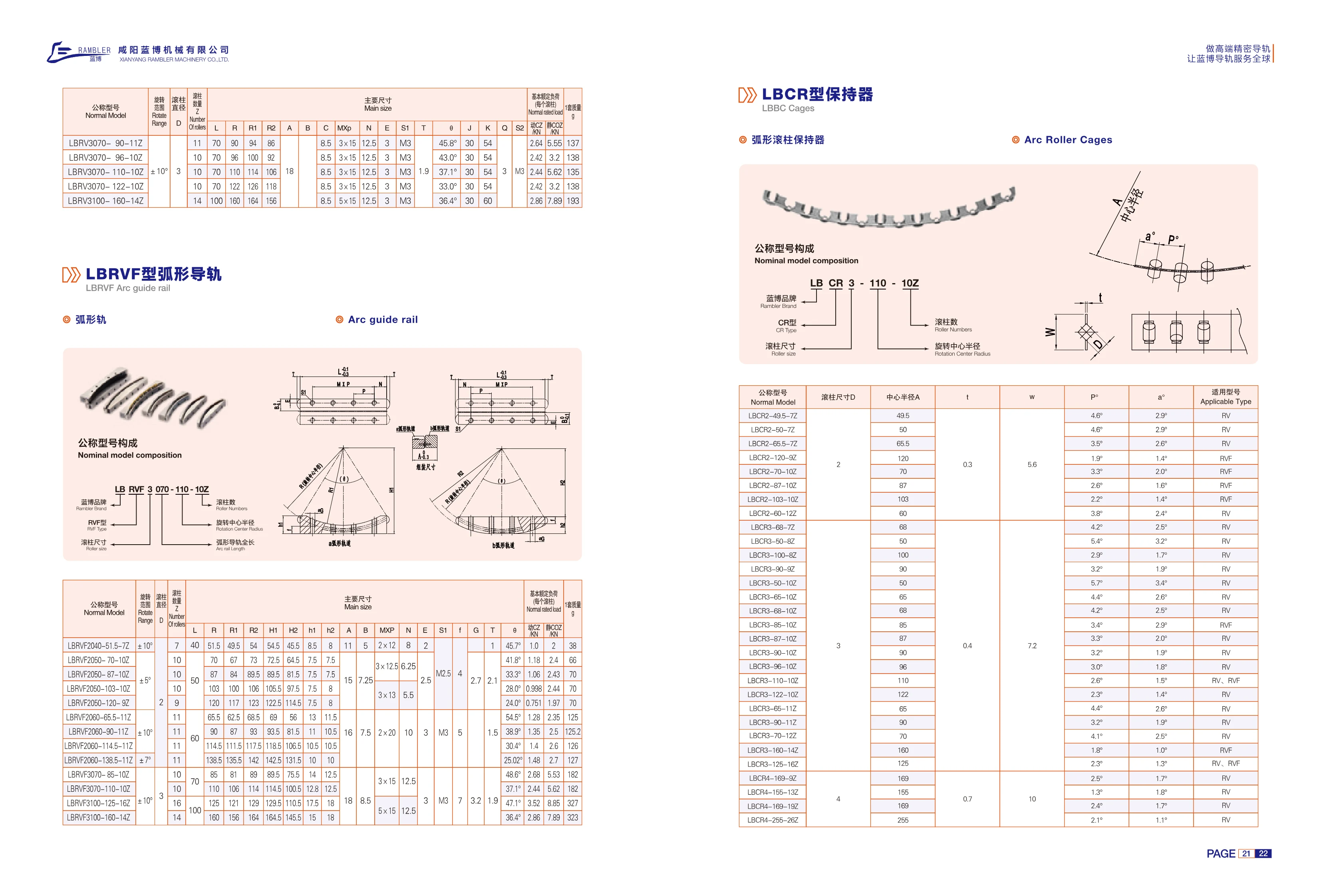
The LBCR series consists of roller assemblies for crossed roller bearings (RV and RVF types). Cylindrical rollers and a cage are supplied as a set and installed between the inner and outer ring raceways to retain the rolling elements. The series is divided into D2, D3 and D4 sizes by roller diameter D, with corresponding structural dimensions t of 0.3, 0.4 and 0.7, and w of 5.6, 7.2 and 10, respectively. Center radius A ranges from 49.5~255 mm. The roller count is indicated by a suffix from 7Z to 26Z (7~26 rollers). P° and a° are angular parameters describing the circumferential arrangement of the rollers. They vary with center radius and roller count, ranging from approximately 1.3°~5.7°. The catalog also provides the basic load rating per roller for load calculations. Select the assembly according to the mating bearing's center radius A, required roller count and applicable model (RV or RVF). The same nominal model may have multiple sets of angular parameters; final fit depends on the mating bearing's raceway dimensions.
LBCR Series Rollers
LBCR series rollers are cylindrical rollers designed specifically for RV and RVF series cycloidal pinwheel reducers. They are available in three diameters—2mm, 3mm and 4mm—with center radii ranging from 49.5mm to 255mm and roller counts of 7, 8, 9, 10, 11, 12, 13, 14, 16, 19 or 26. Each model specifies the P° and a° angle parameters and the compatible reducer type (RV or RVF). As essential rolling elements in a reducer, the rollers' precision and material directly affect transmission efficiency and service life. Made from high-quality bearing steel and precision-machined and heat-treated, these rollers offer high hardness, excellent wear resistance and a long service life. They are suitable for manufacturing and repairing RV/RVF reducers used in industrial robots, machine tools, packaging machinery and other applications.
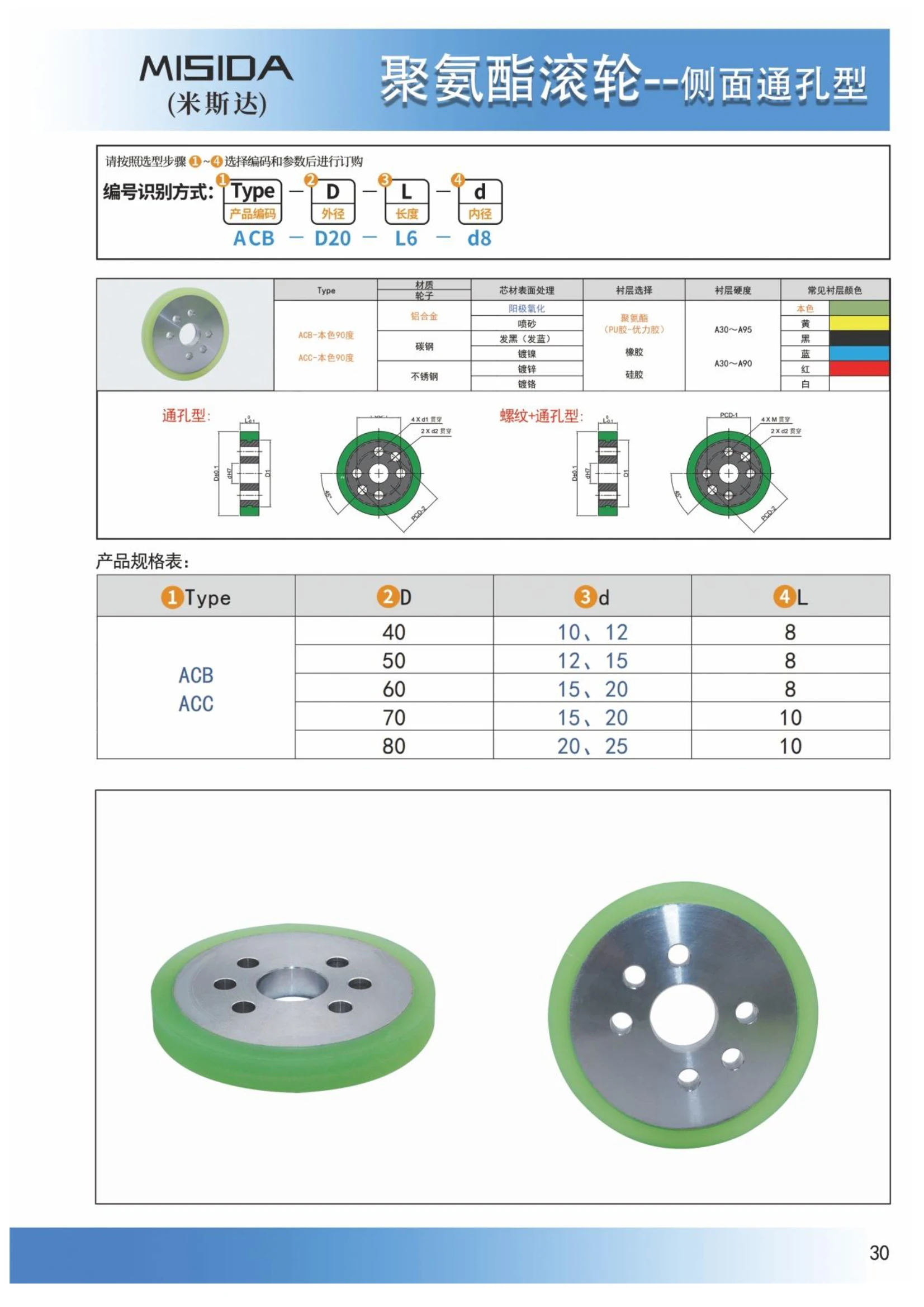
MISIDA Polyurethane Wheel, Side Through-Hole Type
The MISIDA side through-hole polyurethane wheel is made of polyurethane (PU), offering excellent wear resistance, elasticity, and load capacity. The core is available with various surface treatments, including anodizing, sandblasting, blackening (blueing), nickel plating, and chrome plating, to suit different operating environments. The outer diameter D is available in sizes from 40 to 80 mm, and the inner diameter d from 10 to 25 mm. Length L is 8 or 10 mm, depending on the outer diameter. Polyurethane hardness ranges from A30 to A95. Suitable for conveyor lines, automation equipment, industrial machinery, and other applications. The product code consists of Type (ACB/ACC), D, d, and L.
ACC Series Rollers
MISIDA polyurethane wheels — through-hole type with side access, suitable for light-duty conveying and positioning applications. The wheel is made of polyurethane (PU), with a hardness range of A30–A95. The core surface can be anodized, sandblasted, blackened, nickel-plated, or chrome-plated. The model code is Type-D-L-d. Type is available as ACB or ACC. Detailed specifications are available for ACB: diameters (D) of 40, 50, 60, 70, or 80 mm; corresponding lengths (L) of 8 or 10 mm; and bore diameters (d) of 10, 12, 15, 20, or 25 mm, depending on the wheel diameter. Specific dimensions for the ACC model are not listed; custom sizes are available on request. The compact design is easy to install and offers good wear resistance.
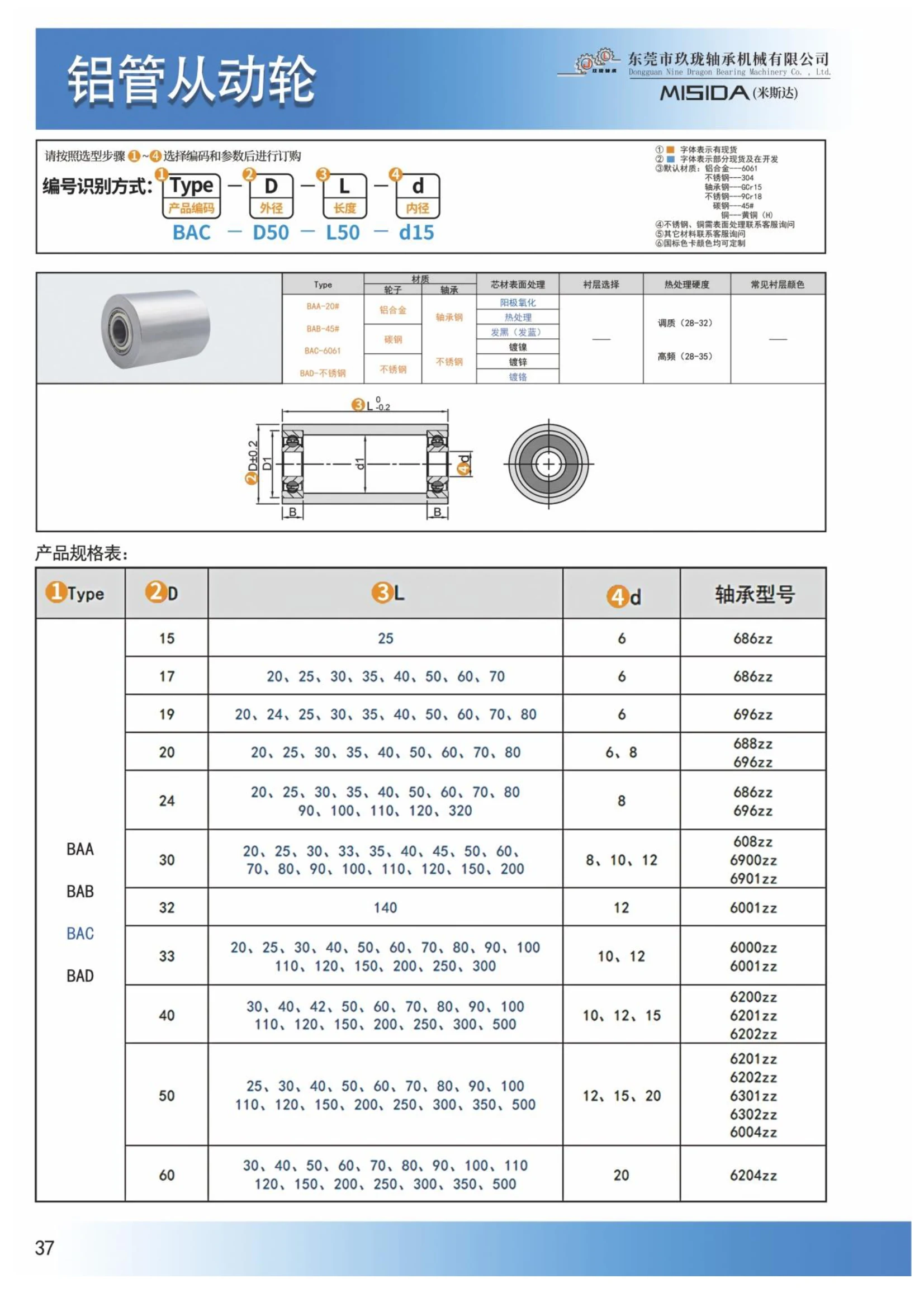
Aluminum Tube Idler Pulley
The aluminum tube idler pulley is a key component in synchronous belt drive systems. It is typically used as an idler or tensioner to maintain proper belt tension and transmission accuracy. Made from aluminum alloy tubing and anodized on the surface, it is lightweight, corrosion-resistant, and has low rotational inertia. It features a built-in high-precision rolling bearing (such as 686ZZ or 696ZZ) that supports radial loads and enables low-friction rotation. The series is available in a range of types, including 15, 17, 19, and 20, as well as letter-coded variants such as BAA, BAB, BAC, and BAD. These correspond to various outer diameters D (from 20 mm to 320 mm), lengths L (from 6 mm to 500 mm), and inner diameters d (from 6 mm to 20 mm). Users can select a suitable combination from the specifications table based on the available installation space and load requirements. These pulleys are widely used in packaging machinery, printing equipment, electronics assembly lines, and automated conveyor systems, where they help reduce synchronous belt wear and noise.
BAA Series Timing Pulleys
BAA aluminum tube idler roller, 20 mm outer diameter, with customizable lengths from 20 to 200 mm in adjustable increments. Available with 8, 10, or 12 mm inner diameters and supplied with standard 608ZZ bearings. Suitable for light-duty conveying, linear modules, and other applications. Its compact design makes installation easy.
Aluminum Tube Idler Pulley
Aluminum tube idler pulleys are key components in synchronous belt drive systems. Made from aluminum tubing and fitted with precision bearings, they are lightweight, corrosion-resistant, and quiet in operation. The range includes multiple models, such as BAA, BAB, BAC, and BAD, with outer diameters of 20–60 mm, lengths of 6–500 mm, and inner diameters of 6–20 mm. Choose from a range of sizes and bearing models to suit your needs (686zz, 696zz, 608zz, 6901zz, 6001zz, 6200zz, 6201zz, and 6204zz). Suitable for automation equipment, material handling and conveying systems, printing machinery, and more.
Aluminum Tube Idler Pulley
This aluminum tube idler pulley features an aluminum body and a fitted bearing. Designed for use as an idler in synchronous belt drive systems, it is available in a range of configurations combining different outer diameters, lengths, and bore diameters. This series is suitable for light-duty applications and offers low weight and smooth rotation. The bearing model is fixed for each type; outer diameter D, length L, and bore diameter d can be selected to suit your requirements. Product codes combine the type, outer diameter, length, and bore diameter.
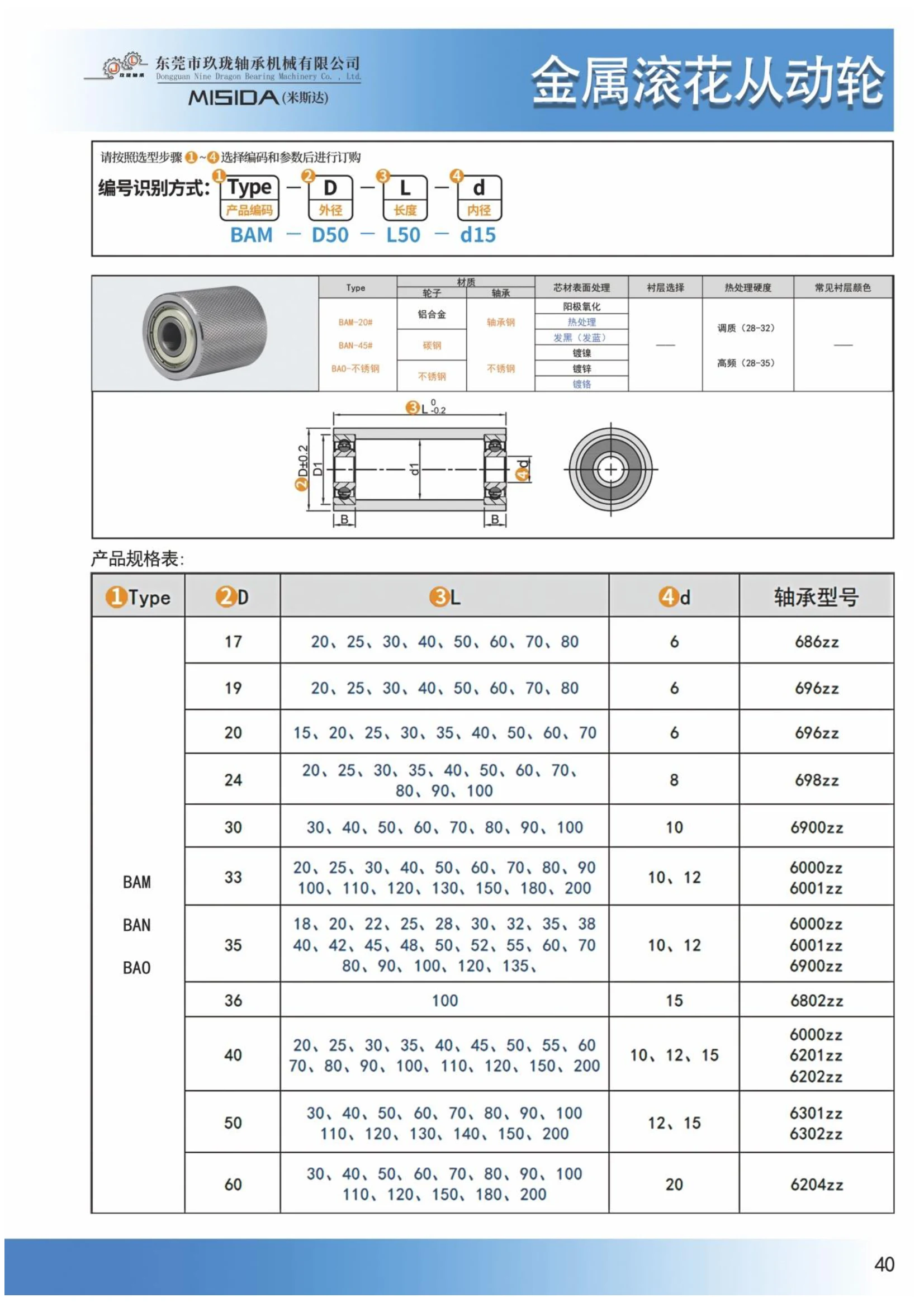
Metal Knurled Idler Pulley
Made of metal with a knurled surface, this idler pulley is designed for conveying, guiding, and similar applications. It is used with miniature bearings such as 686zz, 696zz, 698zz, 6900zz, 6000zz, 6802zz, 6301zz, and 6204zz. Available in a range of outer diameters (D), lengths (L), and inner diameters (d), with Type options from 17 to 60 to suit common sizes, load requirements, and installation needs. The knurled surface increases friction, making it suitable for belt drives and guide-rail applications. To order, follow selection steps ①–④ to choose the Type, D, L, d, and bearing model.
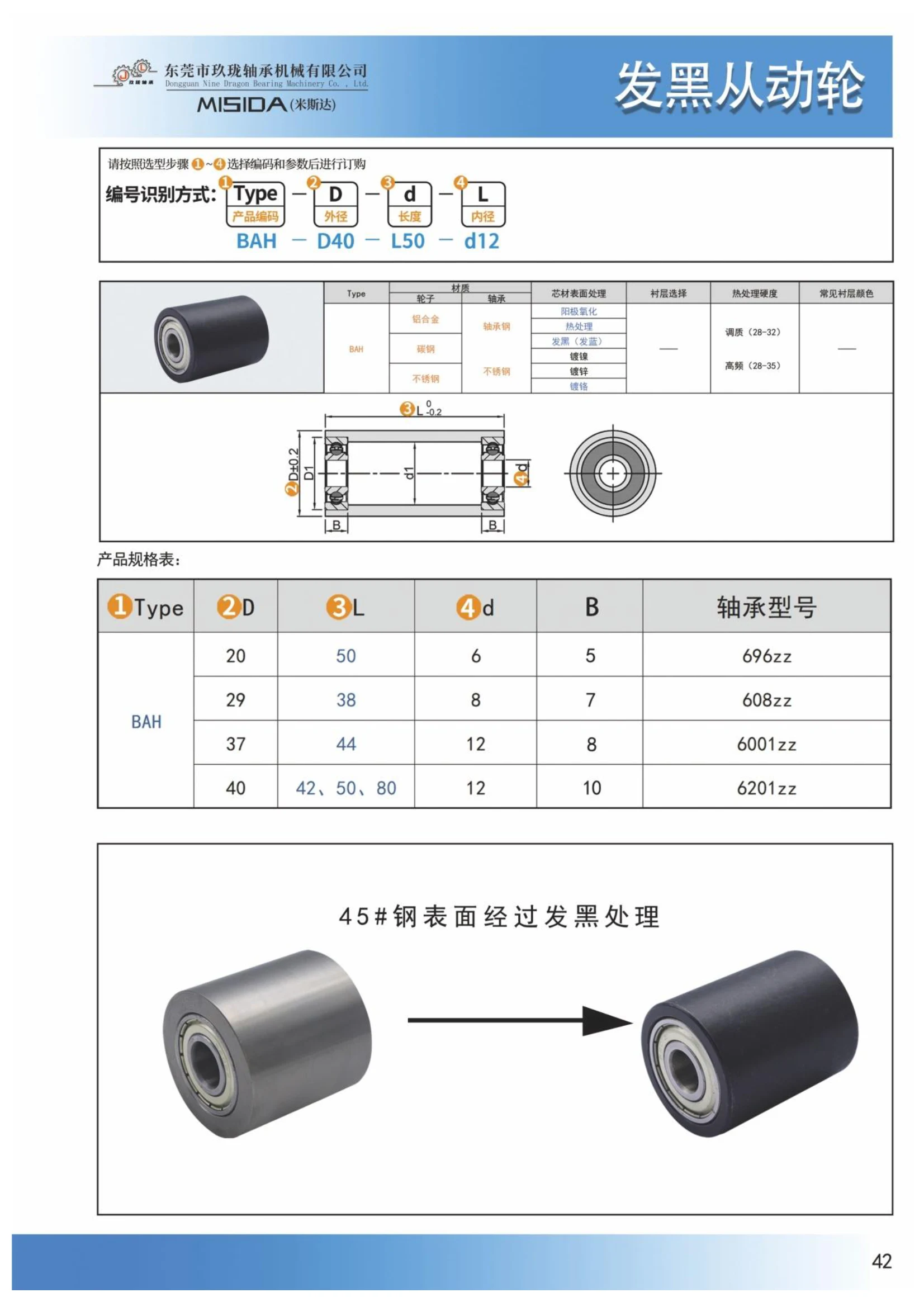
BAH Series Mounted Bearings
BAH series mounted bearings are made of 45# steel and feature a blackened surface for good rust resistance. Available in a range of sizes, they accommodate various deep-groove ball bearings, including 696zz, 608zz, 6001zz, and 6201zz. Designed for light-duty rotary support, these compact bearings are easy to install and widely used in automation equipment, conveyor machinery, and other applications.
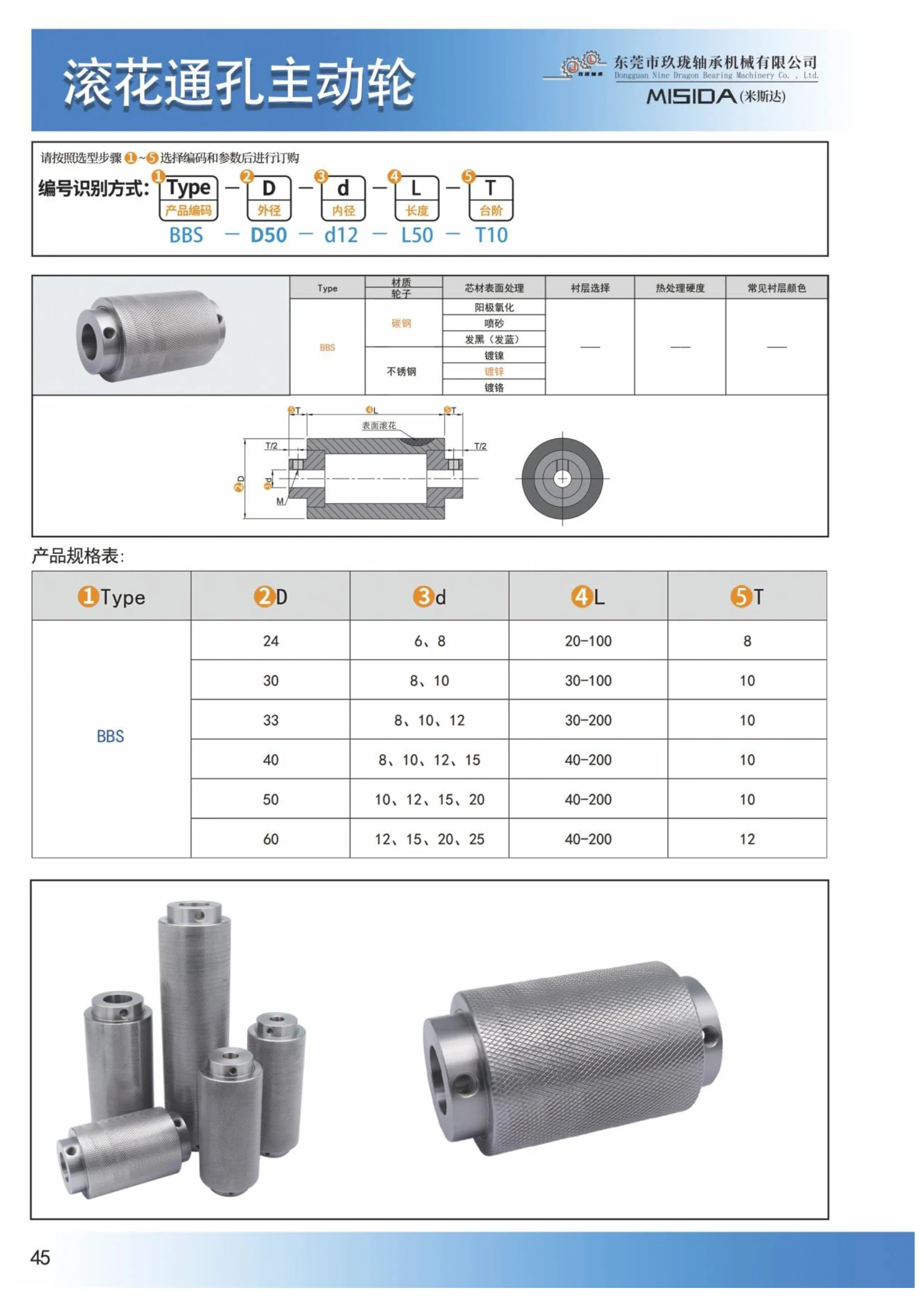
BBS Series Rollers
This series of knurled, through-bore drive wheels is manufactured by Dongguan Jiulong Bearing Machinery Co., Ltd. under the MISIDA brand. Products are identified by a five-part code: Type, outer diameter D, inner diameter d, length L, and step T. The outer diameter ranges from 24 to 60 mm, the inner diameter from 6 to 25 mm, the length from 20 to 200 mm, and the step from 8 to 12 mm. These wheels are used as drive wheels in transmission systems, and the knurled surface increases friction. To select a product, choose the Type (fixed as BBS), outer diameter, inner diameter, length, and step in that order.
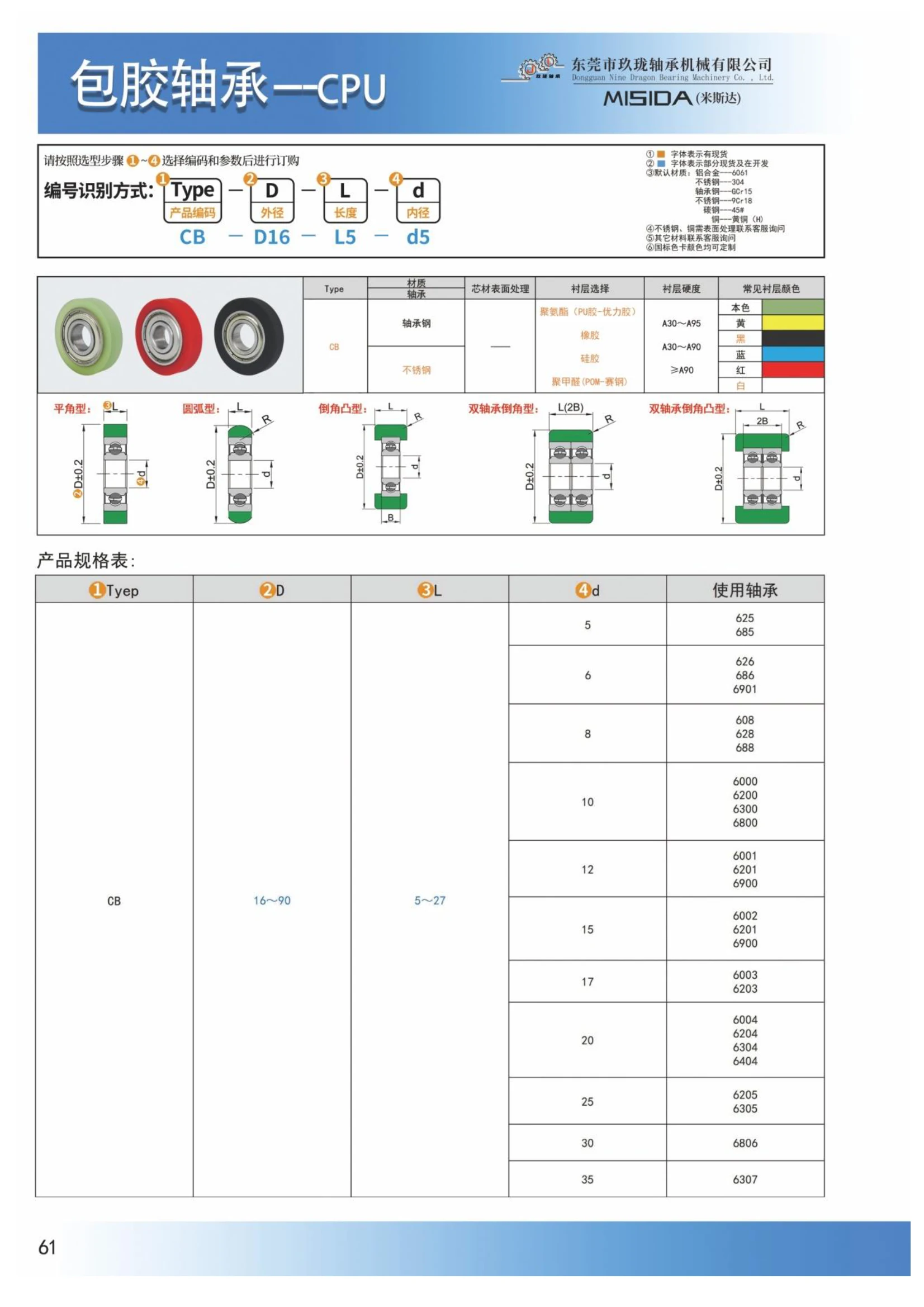
CB Series Pillow Block Bearings
CB series bearing housings are designed to accommodate a range of deep-groove ball bearings. They have an outer diameter (D) of 16–90 mm and a length (L) of 5–27 mm, and fit bearing models with bore diameters (d) from 5 to 35 mm, including 625, 626, 608, 6000, 6001, 6002, 6003, 6004, 6205, 6806, and 6307. This provides flexible shaft-diameter compatibility. Their compact design makes installation easy, and they are widely used to support mechanical drives in a variety of applications.
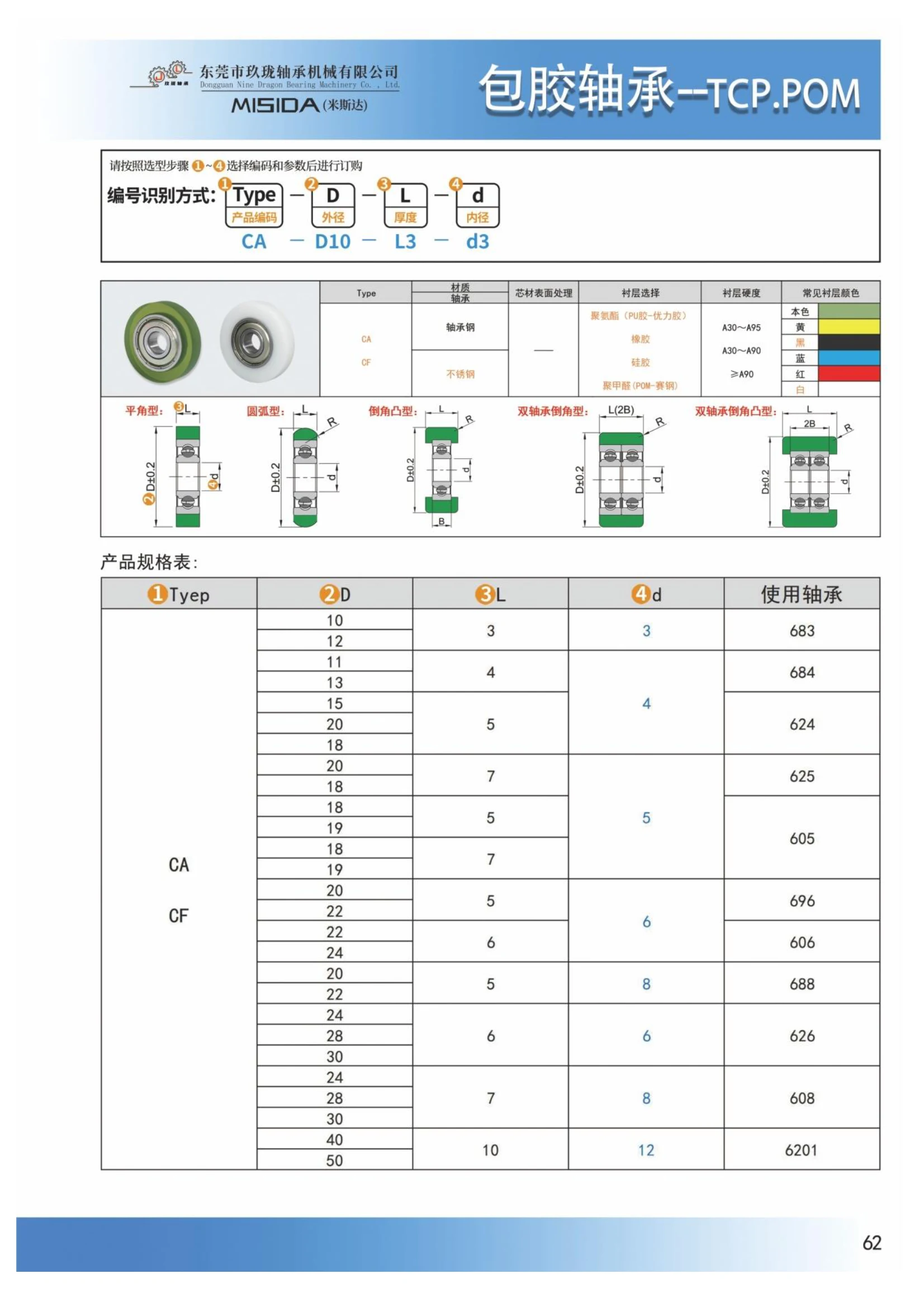
TCP.POM Rubber-Coated Bearings
Rubber-coated bearing series with a bearing-steel core that has undergone surface treatment, overmolded with polyurethane (PU, also known as urethane) or rubber. Available in hardness ratings from A30 to A95 and a range of popular colors. Suitable for light-duty applications such as conveying, these bearings offer wear resistance, shock absorption, and quiet operation. Select and order by combining the Type, D, L, and d parameters.
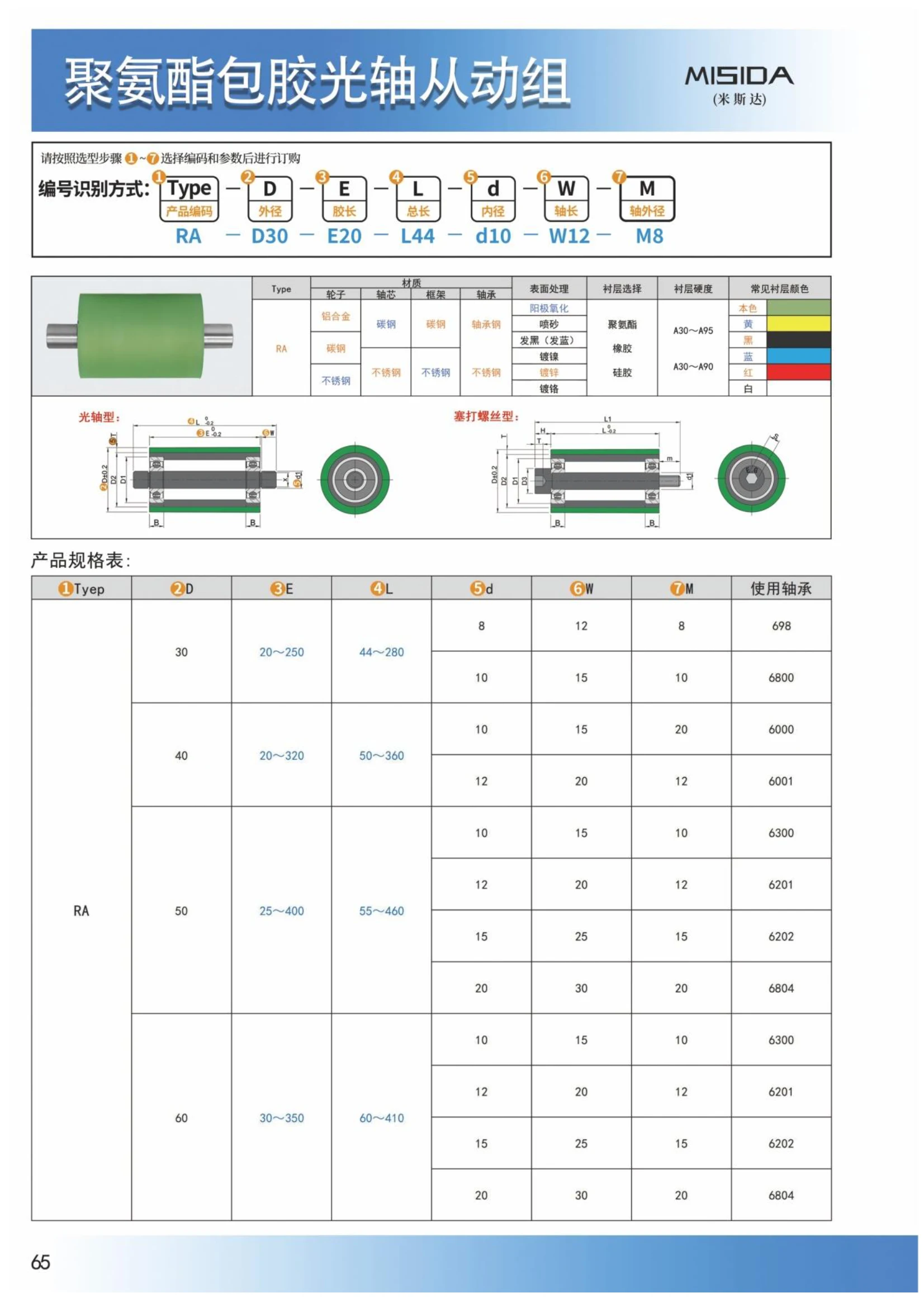
RA Series Polyurethane-Coated Smooth Shaft Follower Assembly
This polyurethane-coated smooth shaft follower assembly is designed to provide follower support in linear guide systems. Its polyurethane coating offers good wear resistance and shock absorption. The model code consists of the RA base model, outer diameter (D), lengths (E) and (L), inner diameter (d), width (W), and thread specification (M). The outer diameter is fixed at 50 mm. Length E is available from 25 to 400 mm, and length L from 55 to 460 mm. The inner diameter d is available in 10, 12, 15, or 20 mm; the corresponding width W and thread specification M are determined accordingly. Built-in bearings ensure smooth rotation. It is widely used in automation equipment, conveyor lines, and similar applications.
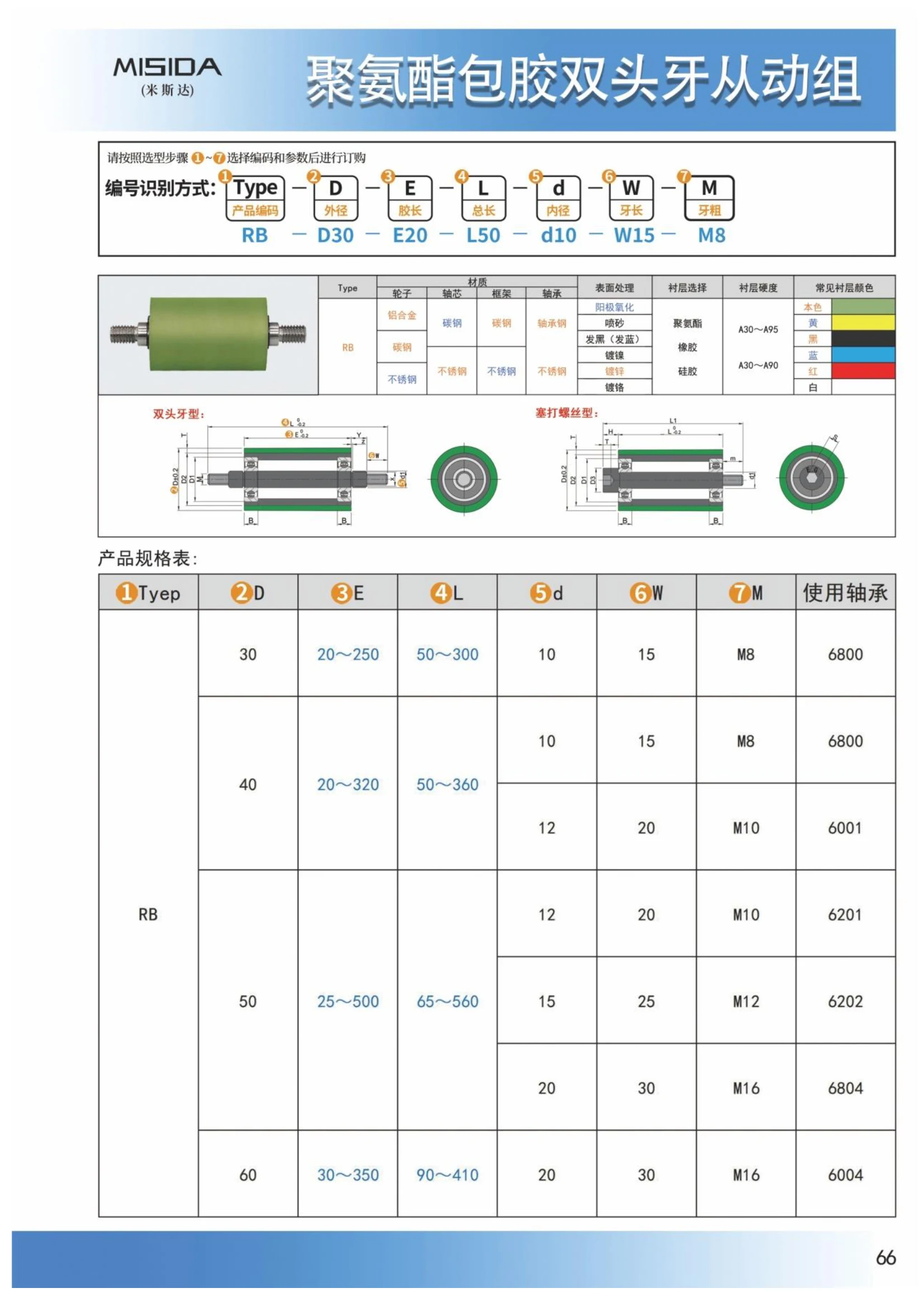
Polyurethane-coated double-ended threaded idler assembly
The polyurethane-coated double-ended threaded idler assembly is an idler wheel component for conveyor systems. Its polyurethane-coated surface offers wear resistance, shock absorption, and quiet operation. The product code consists of Type (RB), D (wheel diameter), E (width), L (length), d (shaft diameter), W (key width), and M (thread). Example dimensions are D30, E20, L50, d10, W15, and M8. Available materials include bearing steel, carbon steel, and stainless steel. Surface finishes include anodizing, powder coating, blackening, nickel plating, and chrome plating. Suitable for light- to medium-duty conveying applications.
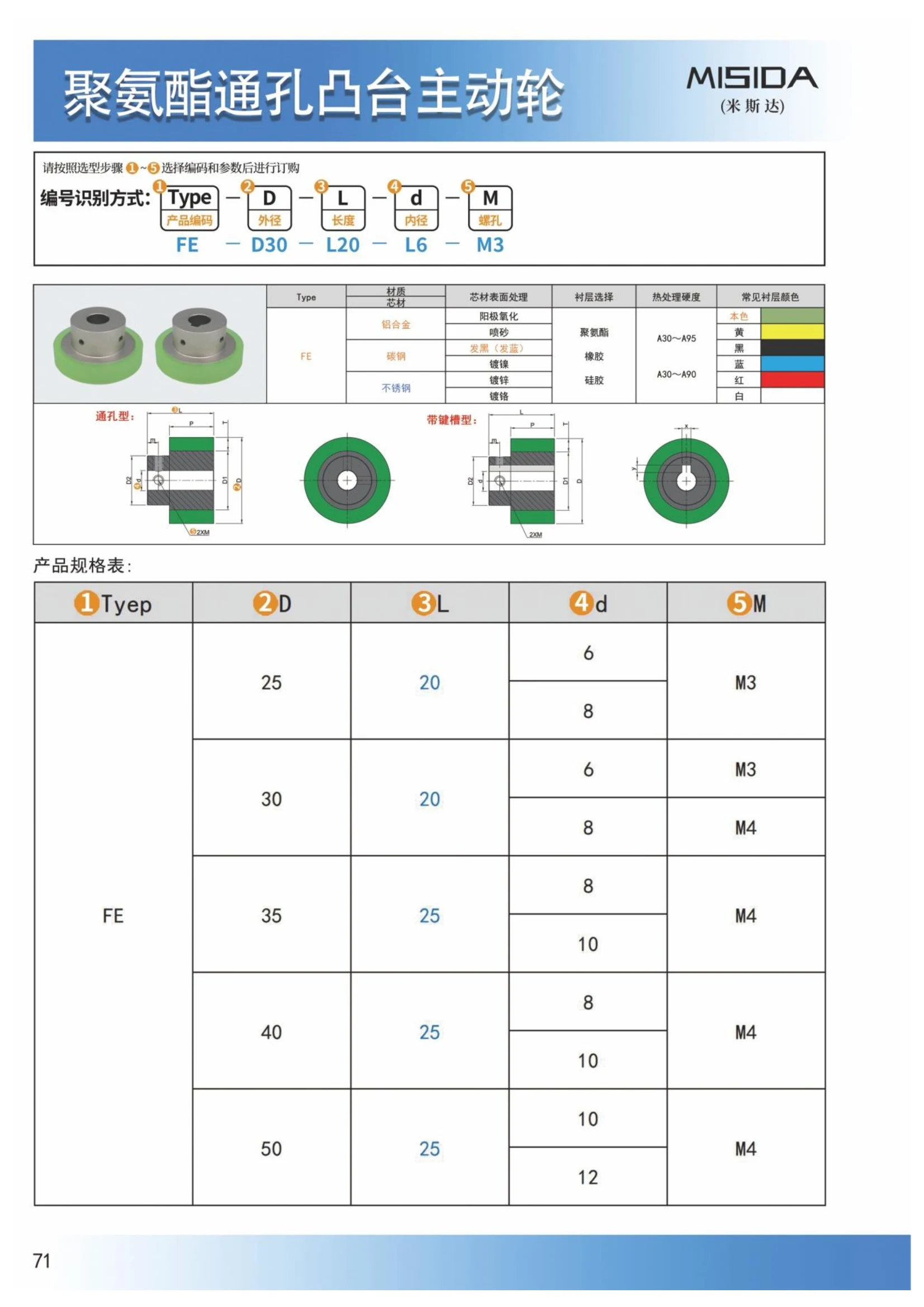
FE Series Polyurethane Through-Hole Boss Drive Wheel
This series consists of polyurethane through-hole boss drive wheels under the Misida brand. Materials are available in aluminum alloy (anodized and sandblasted surface) or carbon steel (blackened or blued). The lining is available in polyurethane or rubber. Common polyurethane colors include yellow, black, blue, red, and white. An example product code is FE D30 L20 L6 M3: FE is the main model, D30 indicates an outer diameter of 30 mm, L20 indicates a length of 20 mm, L6 indicates an inner diameter of 6 mm (as stated in the source), and M3 indicates an M3 thread. Suitable for use as a drive wheel in transmission systems, with a range of material and surface-finish options.
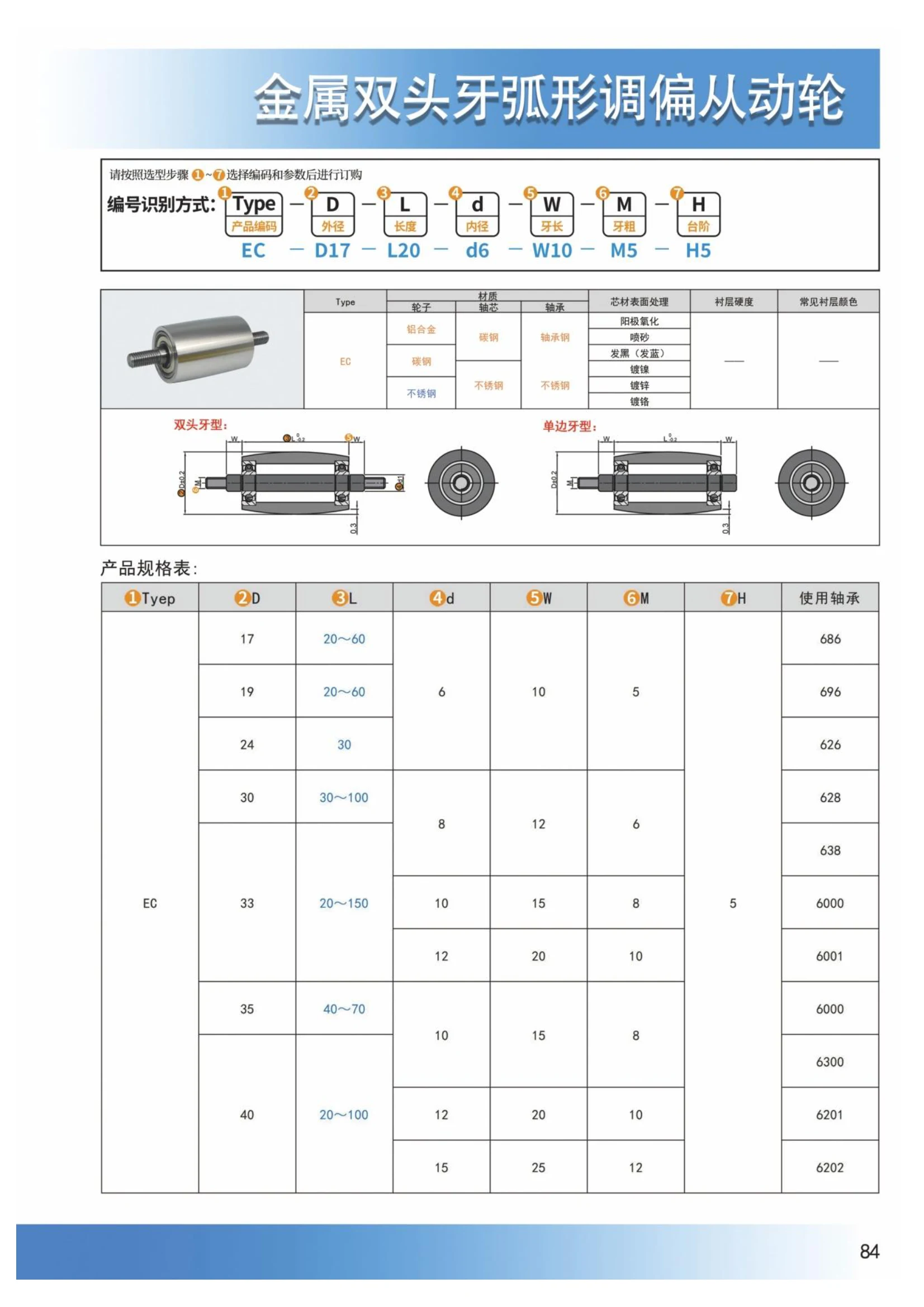
EC Series Metal Double-Thread Curved Tracking Idler
This series comprises metal double-thread curved tracking idlers, model EC. Product codes are formed by combining parameters such as outer diameter, length, inner diameter, thread length, thread root, and shoulder. The outer diameter ranges from 17 to 40 mm, the length from 15 to 150 mm, the inner diameter from 6 to 25 mm, the thread length from 10 to 25 mm, and the thread root from 5 to 12 mm. The shoulder can be specified as 5 or by bearing model (686/696/626/628/6202). The bearings used are primarily 6000 or 6202. These idlers are suited to tracking adjustment mechanisms in automated drive systems and feature a compact design and easy installation.
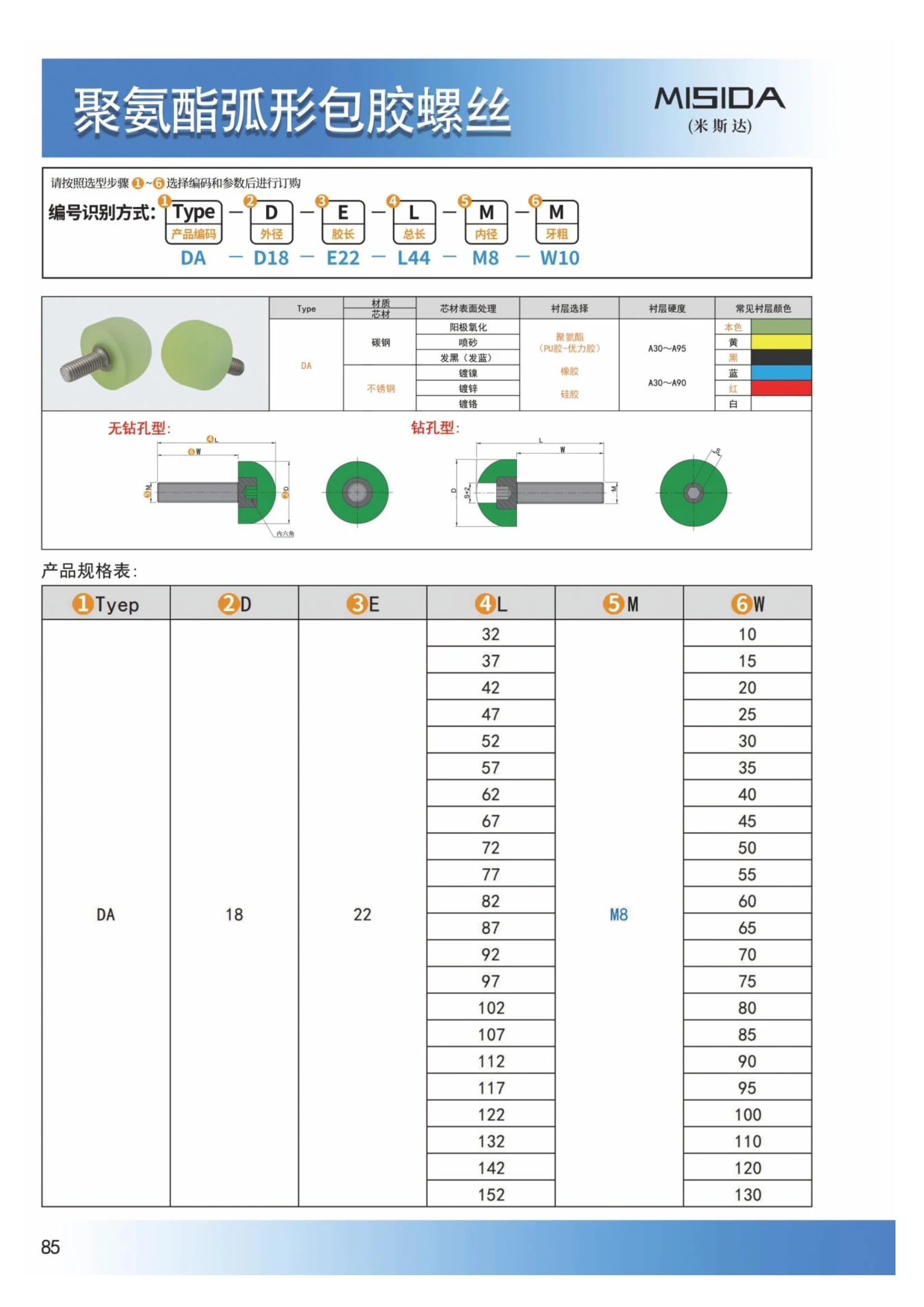
Polyurethane-Coated Curved Screw (MISTA)
MISTA’s polyurethane-coated product range includes curved coated screws, rubber wheels for zipper machines, and more. Polyurethane is wear-resistant, oil-resistant, and shock-absorbing, making it suitable for automation equipment, conveyor lines, zipper machines, and other applications. Products have outer diameters of 18–95 mm and lengths of 12–84 mm. An internal keyway is available, and the surface has a black oxide finish. The coding system includes the DA series (type + outer diameter + rubber length + overall length + inner diameter + thread root) and series listed by model number. Multiple sizes are available to meet different installation requirements. Custom options, such as drilled versions, are available on request.
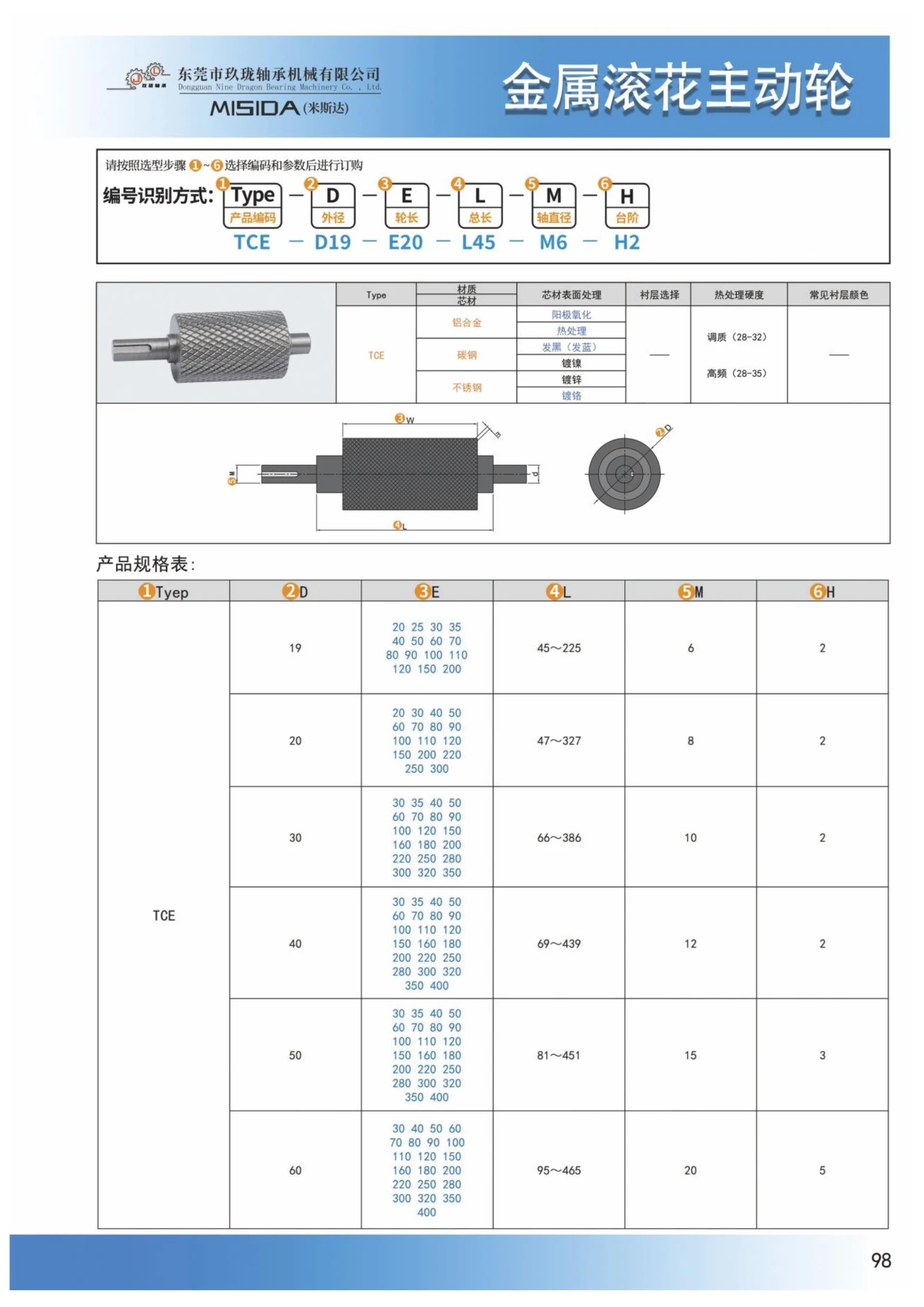
Metal Knurled Drive Roller
This series of metal knurled drive rollers uses friction to drive conveyor belts in conveying systems. The knurled surface increases friction. The product code consists of six parts: the TCE prefix, outer diameter (D), roller length (E), overall length (L), shaft diameter (M), and step (H). Outer diameters of 19, 20, 30, 40, 50, and 60 mm are available, with several discrete roller lengths to choose from. Depending on the outer diameter, overall lengths range from 45 mm to 465 mm; the shaft diameter and step are fixed for each outer diameter. Suitable for automation equipment, conveyor lines, and other applications.
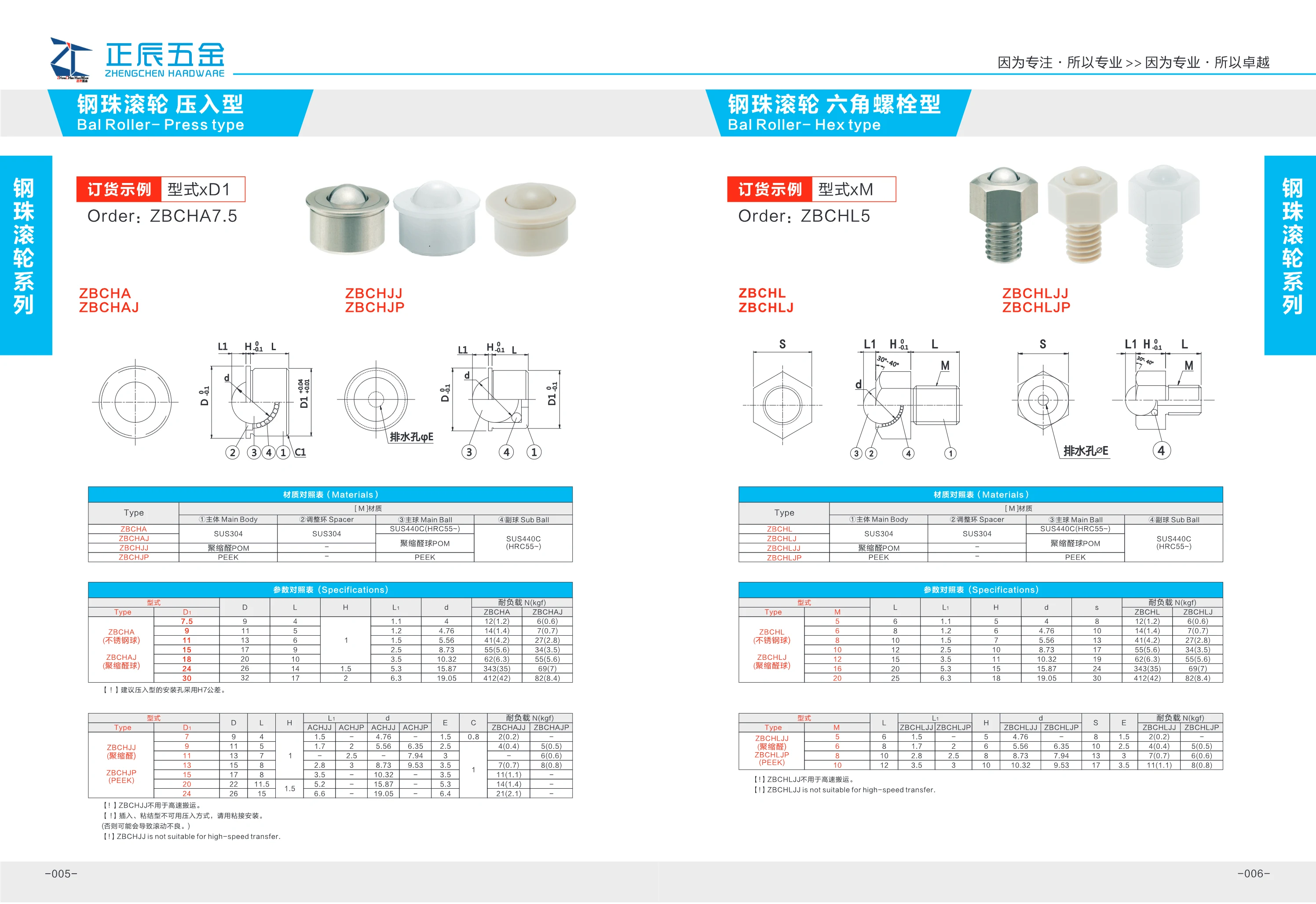
Steel Ball Transfer Roller Series
The Steel Ball Transfer Roller Series (Bal Roller) consists of rolling components used for material handling and positioning. Supported by steel balls, they enable low-friction movement. The series offers several mounting styles, including press-fit (ZBCHA), hex bolt (ZBCHL), stamped flange mount, and ball-plunger roller (ZBCHY). The body is made of bearing steel or SUS304 stainless steel, while the main and auxiliary balls are made of SUS440C (HRC55~). Available sizes include the press-fit ZBCHA7.5 (7.5 mm diameter), the hex-bolt ZBCHL5 (M5 thread), and the ball-plunger roller ZBCHY (69 mm outer diameter, 25.4 mm inner diameter, and 31 mm height). Suitable for guiding, positioning, and conveying in automated equipment.
ZBCHL Steel Ball Roller, Hex Bolt Type
This series of hex bolt-type steel ball rollers uses a rolling steel ball mechanism. Suitable for conveyor lines, sliding doors, and other applications, they are easy to install and wear-resistant. Models begin with ZBCHL, with suffixes of numbers or letters indicating different specifications; ZBCHL5 is an example of an order code. The body is made of bearing steel and zinc-plated.
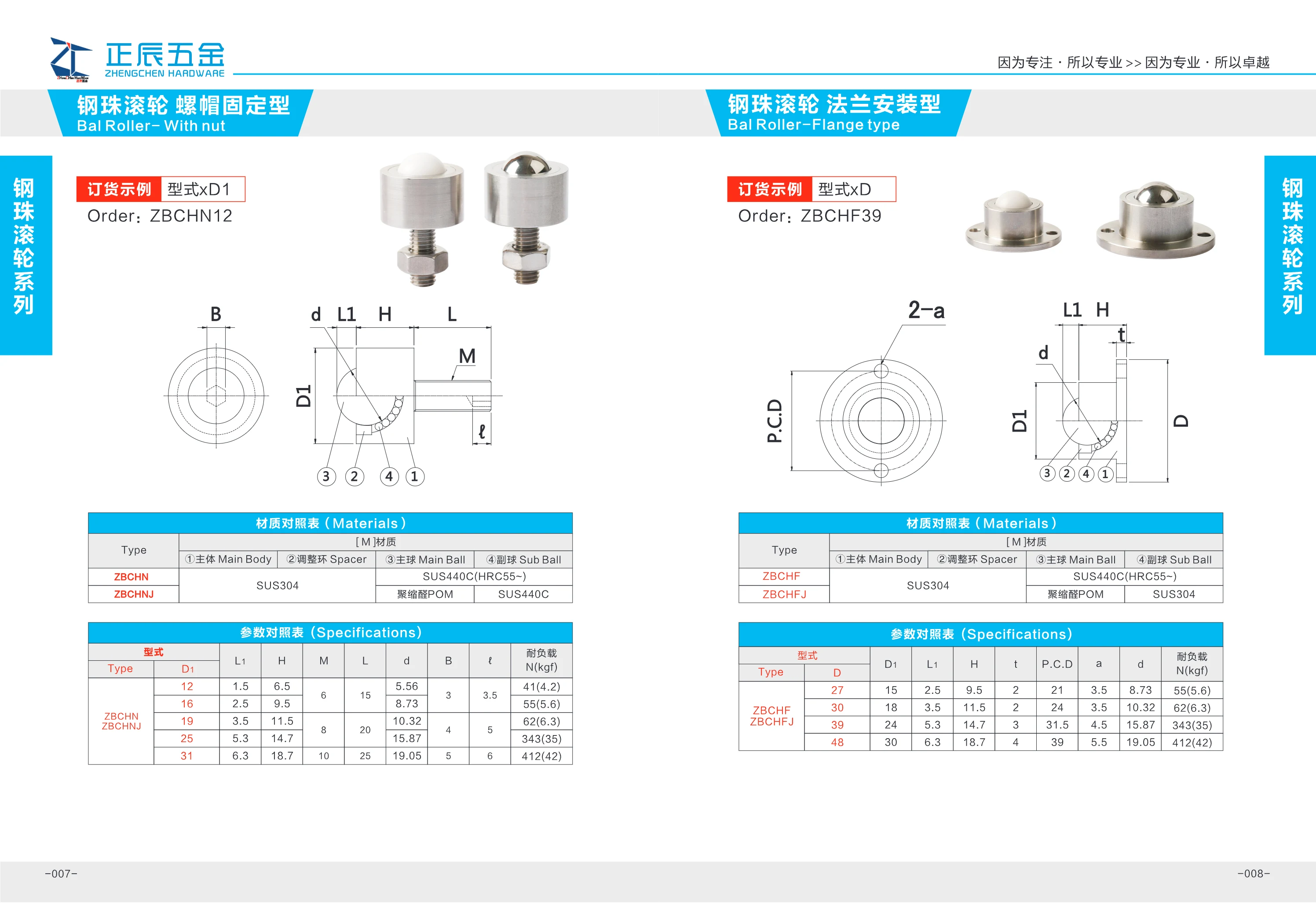
Nut-Mounted Ball Transfer Unit
This series features nut-mounted ball transfer units with a SUS304 body. The main ball is made of SUS440C (HRC 55 or higher) or polyacetal (POM) for the ZBCHNJ series, and the supporting balls are made of SUS440C. These units offer excellent corrosion and wear resistance and are suitable for light- to medium-duty conveyor lines, automation equipment, and similar applications. Sizes range from D1 12 mm to 31 mm, with load capacities from 41 N to 412 N. The compact design is secured with a nut and is available with either all-steel balls or a steel ball and POM combination. Models consist of a type code (ZBCHN/ZBCHNJ) and the D1 size.
Ball Transfer Unit, Nut-Mounted Type
The ZBCHNJ series consists of nut-mounted ball transfer units. The body is made of SUS304 stainless steel, the main ball is made of polyoxymethylene (POM), and the supporting balls are made of SUS440C stainless steel, providing corrosion and wear resistance. Three sizes are available: D1 = 19 mm, 25 mm, and 31 mm, with load capacities of 62 N, 343 N, and 412 N, respectively. Suitable for light- to medium-load sliding guidance and conveying applications, these units feature nut mounting and a compact design, making them ideal for translation and positioning mechanisms in automated equipment.
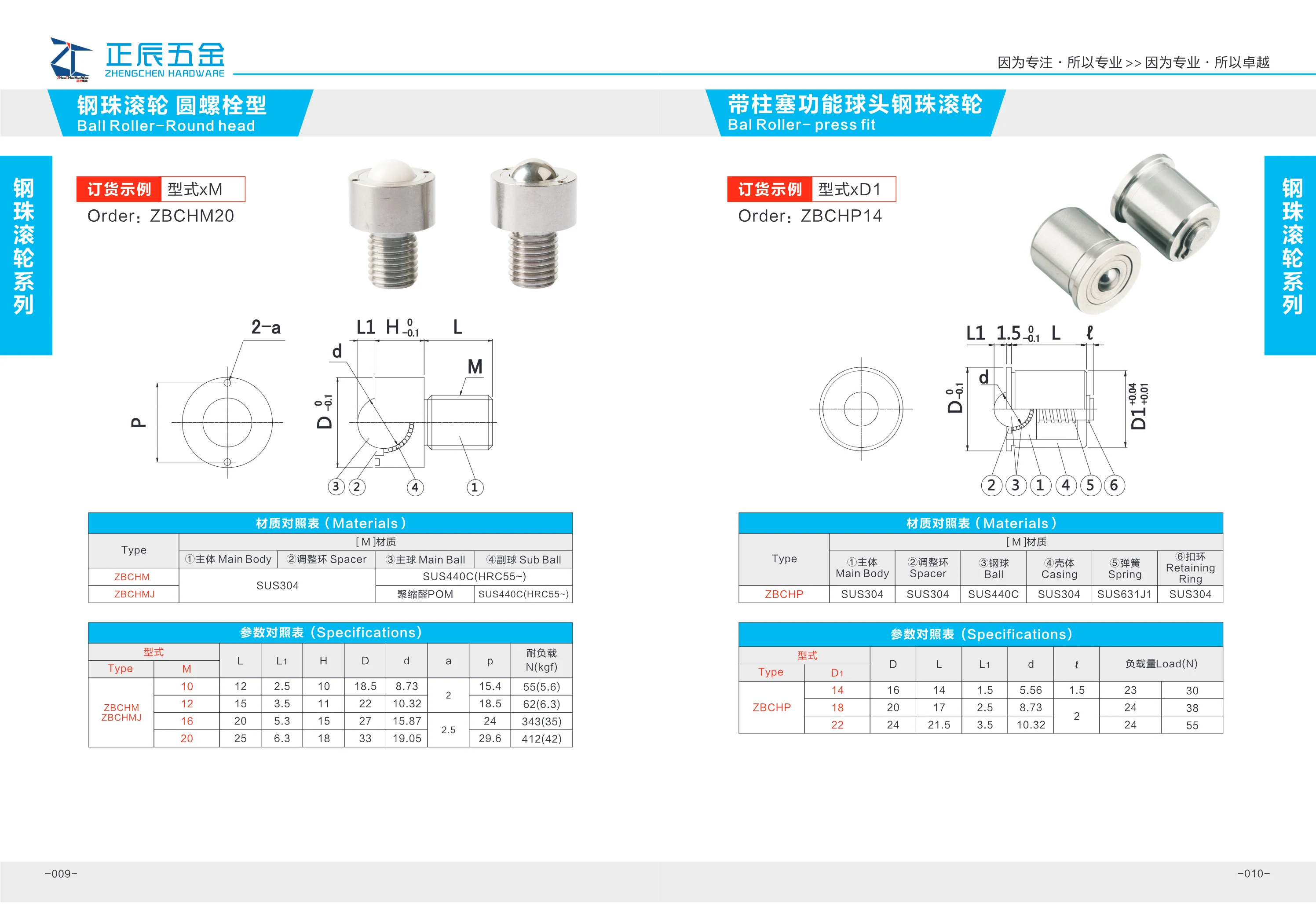
ZBCHM Series Ball Transfer Units (Round Bolt Type)
ZBCHM series ball transfer units are the round bolt type. The body is made of SUS304 stainless steel, the adjusting ring and auxiliary balls are made of SUS440C (HRC55 or higher), and the main ball is made of polyacetal (POM). Suitable for light-load applications such as conveying and positioning, with a load capacity of 55 N (5.6 kgf). Specifications include an M10 thread diameter, 12 mm overall length, 2.5 mm head height, and 18.5 mm roller diameter. The ordering example is ZBCHM20, but the standard specification is available only in M10.
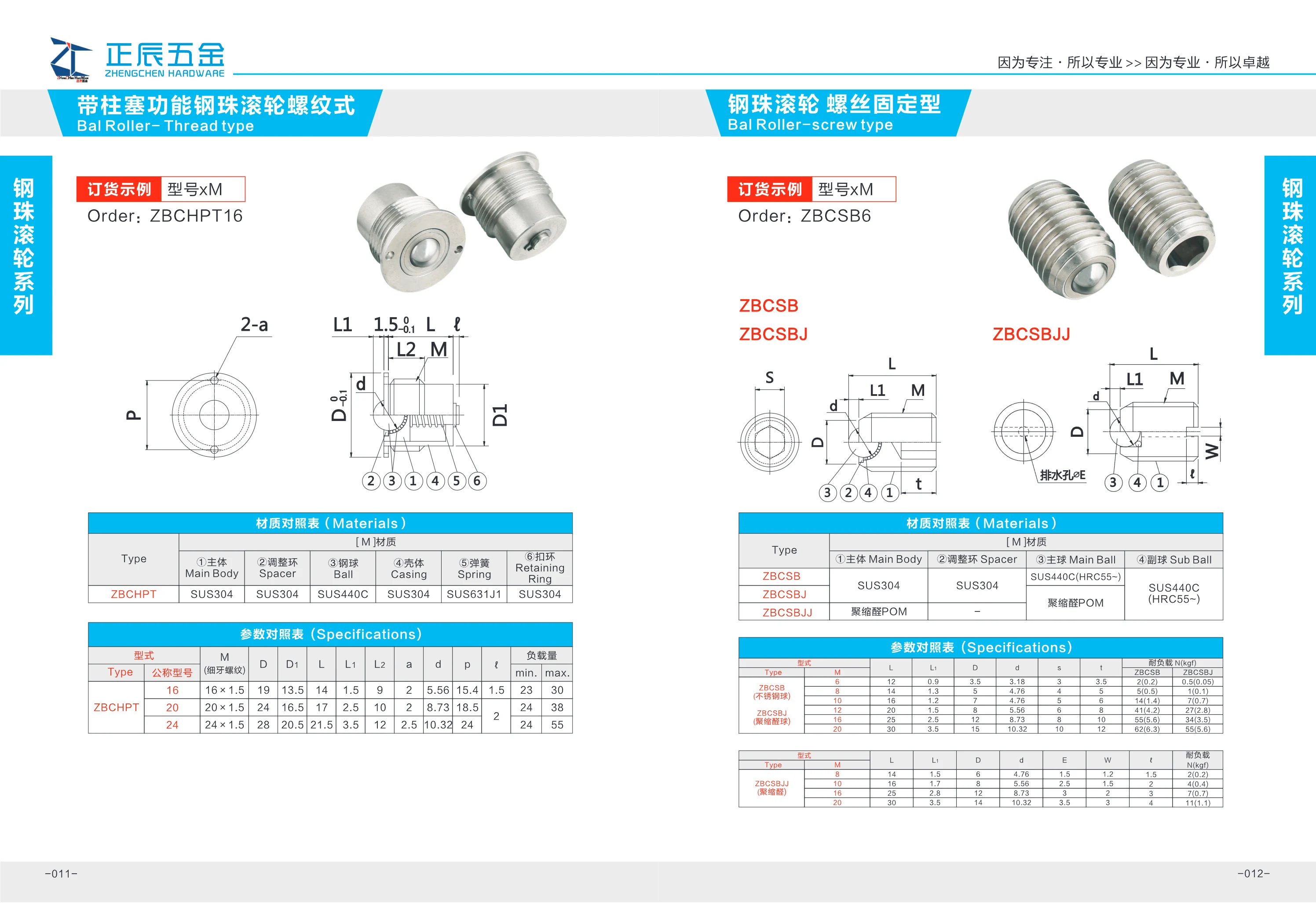
ZBCSB Series Rollers
The ZBCSB series consists of screw-mounted steel ball rollers. They are installed using threads and enable linear or rotary movement through contact between the steel ball and the raceway. These products are commonly used in positioning, push-pull, or guiding mechanisms in automation equipment. Known models include ZBCSB (base model), ZBCSBJ (possibly an extended or special version), and the specific size ZBCSB6 (nominal diameter: 6 mm). The main body is made of SUS304 stainless steel, and the ball is made of SUS440C, offering good corrosion and wear resistance. Load capacity is to be confirmed; specify the complete model when ordering.
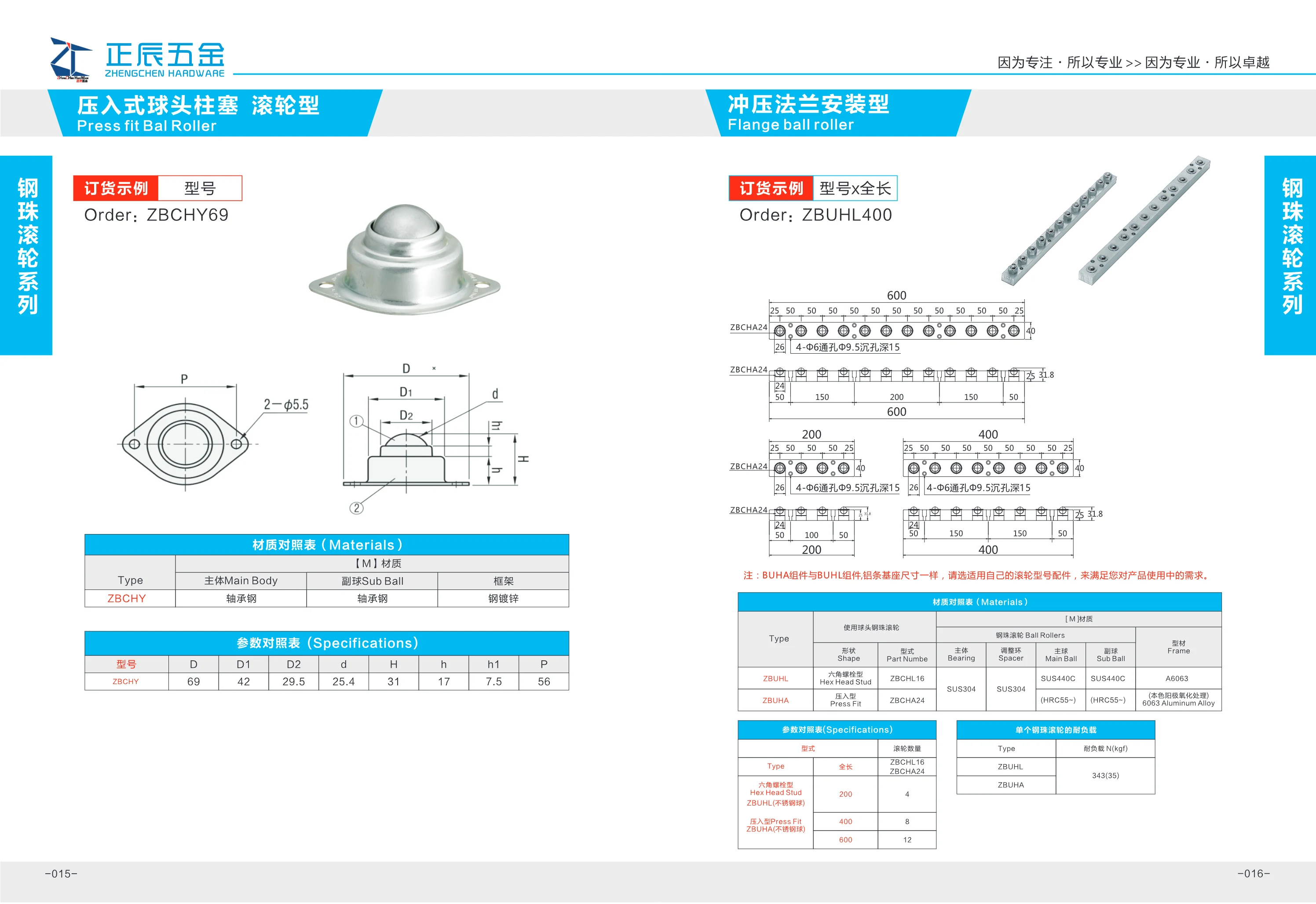
Ball Transfer Roller Series
This series of ball transfer rollers includes two mounting types—hex-head bolt type (ZBULH) and press-fit type (ZBUHA)—as well as press-fit ball-plunger rollers (ZBCHY). The body is made of SUS304 stainless steel, while the main and secondary balls are made of SUS440C stainless steel (hardness HRC55 or higher). These products are suitable for conveying, positioning, and other applications. Dimensions include the outer diameter D, inner diameter d, and height H, accommodating different load requirements and installation spaces.
ZBUHA Series Ball Transfer Units
The ZBUHA Series steel ball transfer units are available in several mounting styles, including press-fit, hex bolt, and stamped flange mount. The body is made of bearing steel or SUS304, while the main and auxiliary balls are made of SUS440C (HRC55~). Suitable for light-duty guiding and conveying in automation equipment. Models include ZBCHY69, ZBCHL16, and ZBCHA24. The specifications for ZBCHY69 are D69, D142, D229.5, d25.4, H31, h17, h17.5, and P56 (units: mm). Load capacity data is not provided; configure according to the number of units used.

CPWA-CPWW Miniature Cross-Shaft Universal Couplings
CPWA-CPWW miniature cross-shaft universal couplings are suitable for drive applications connecting two shafts whose axes lie in the same plane and form an angle of β ≤ 45°. They transmit nominal torques of 11.2–1120 N·m. The CPWA type has a single joint, while the CPWW type has two joints; each joint allows an articulation angle of 45°. Available with either plain bearings or needle roller bearings, they can reach speeds of 1,000 and 4,000 rpm, respectively, and can be fitted with a quick-lock mechanism. Bore connection options include round, hexagonal, and square bores. They offer high concentricity during operation and a long service life. Made from premium 42CrMo alloy steel, they are typically finished with black oxide or chrome plating and supplied with set screws. The two end bores can be freely combined from smaller to larger diameters. Bores are machined to standard H7/H8 tolerances, and custom specifications are available. Multiple sizes are offered, from CPWA1 to CPWW4, to suit different torque and bore-size requirements.
CPWA-CPWW Miniature Cross-Shaft Universal Joint Couplings
Suitable for drive applications connecting two shafts whose axes lie in the same plane and form an angle β ≤ 45°. Transmits nominal torque of 11.2–1120 N·m. The CPWA is a single-joint type, while the CPWW is a double-joint type; each joint can articulate up to 45°. Available with either plain bearings or needle-roller bearings, with maximum speeds of 1,000 and 4,000 rpm, respectively. Quick-locking options are available. Bore connection options include round, hexagonal, and square bores. These couplings offer high concentricity during operation and a long service life. Made from 42CrMo steel, with standard black-oxide or chrome-plated finishes. Supplied with set screws. The bore diameters at the two ends can be freely selected, from smaller to larger. Bores are machined to standard H7/H8 tolerances. Custom specifications are available.

CPWD Series
This series comprises standard precision miniature universal joint couplings, suitable for drive applications connecting two shafts whose axes lie in the same plane and form an angle of ≤45°. They are made from high-quality alloy steels 40Cr, 40CrNi, 20CrMo, or 20CrMnVB; SUS304 or SUS316 stainless steel is available to order. Two configurations are offered: single-joint (00CPWD) and double-joint (00CPCD), with a maximum articulation angle of 45° at each joint. The torque range for the plain-bearing version is unspecified; the needle-bearing version has half the torque capacity of the plain-bearing version. End connections can be customized with round, hexagonal, or square bores, splines, and other options. Standard surface finishes are black oxide or chrome plating, and the couplings come with set screws. Special materials or bore profiles can be custom-made to order.