Transmission Accessories — Page 13
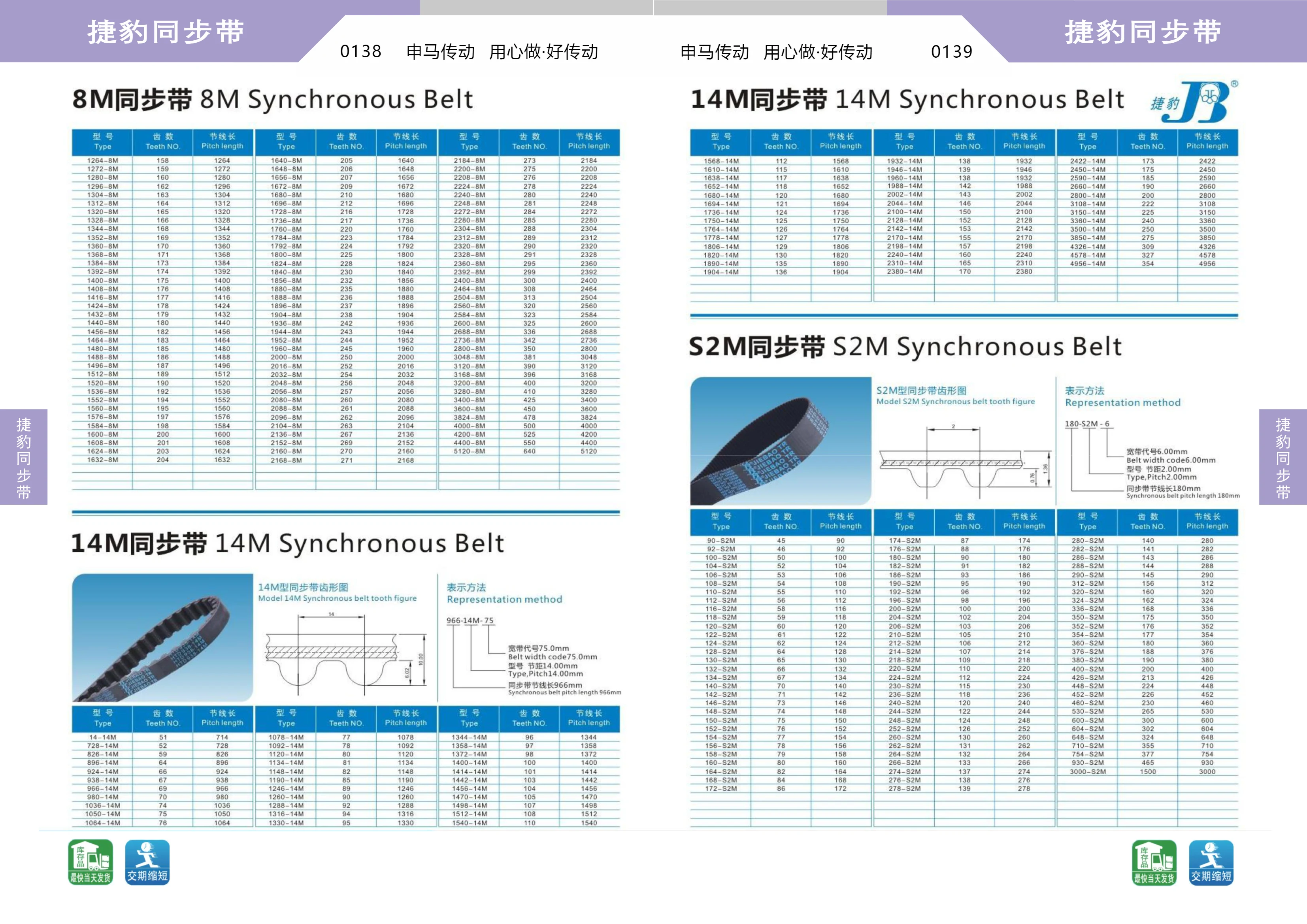
Jaguar 8M Timing Belt
The Jaguar 8M timing belt is an industrial belt with an 8mm pitch and a curvilinear tooth profile (HTD type). Its teeth mesh with pulley grooves to provide slip-free synchronous power transmission. It is widely used in CNC machine tools, automated production lines, packaging machinery, textile machinery, and positioning drives powered by servo motors. Models in the catalog are designated as “pitch length-8M”; for example, 1264-8M denotes an 8M timing belt with a pitch length of 1264mm. Each model has a fixed tooth count (tooth count ≈ pitch length ÷ 8). The catalog covers common pitch lengths from 1264mm to 2380mm, corresponding to approximately 158 to 297 teeth, with adjacent sizes arranged in 8mm increments. Users can select a belt based on pulley center distance and required tooth count. The belt offers high transmission accuracy, low noise and wear resistance, and requires no maintenance or lubrication. It is suitable for synchronous drives operating at medium to high torque and linear speeds.
Jaguar 14M Timing Belt
Jaguar timing belts feature metric tooth profiles and are made of neoprene or polyurethane, with fiberglass or steel cord reinforcement. The tooth surfaces are covered with nylon fabric to reduce friction and noise. The catalog lists three tooth profiles: 8M, 14M and S2M, with pitches of 8mm, 14mm and 2mm respectively. Models are designated by pitch length and tooth profile (e.g., 1400-8M). The three key selection criteria are tooth profile (pitch), pitch length (pitch length = tooth count × pitch) and belt width designation (e.g., 6.00mm). These belts are suitable for medium- to high-speed, low-noise drives in machine tools, packaging, textiles, printing and automated conveying. The 8M specification table on this page covers commonly stocked sizes with pitch lengths of 1264~2380mm and tooth counts of 158~298.
Jaguar S2M Timing Belt
The Jaguar S2M is a curvilinear-tooth timing belt with a 2.00mm pitch and a belt width code of 6.00mm. The pitch length can be selected to suit the application (18mm in the example). Made from high-quality rubber/polyurethane, it features a precise tooth profile, smooth and quiet operation, and good wear resistance. It is suitable for precision drives in office equipment, small automation equipment, 3D printers, medical devices, and more. The designation includes parameters such as the belt width code, model pitch, and belt pitch length. Select the pitch length and belt width based on the pulley tooth count, center distance, and load.

LF Jaw Coupling Series
The LF jaw coupling series uses a flexible spider insert to provide zero-backlash torque transmission, vibration absorption, compensation for parallel and angular misalignment, and electrical insulation. Clamp and set-screw mounting options are available. Applications include XY stages, indexing tables, machine tools, injection molding machines, handling equipment, and dispensing machines. Typical outside diameters range from D14 to D90, overall lengths from L22 to L126, and maximum bore sizes from 6 to 60 mm. Rated torque ranges from 1.2 to 9 N·m, maximum speed from 15000 to 40000 RPM, allowable parallel misalignment from 0.1 to 0.15 mm, and allowable angular misalignment is 1°. The elastomer is available in 3 hardness options.

L Series Jaw Couplings with Locking Assemblies
The L series jaw couplings use a locking assembly (clamping) design and are suitable for connecting servo and stepper motors. The fastening type provides zero-backlash torque transmission at low torque, while the easy-assembly type simplifies installation and removal of the shaft sleeve. The elastomer absorbs vibration, eccentricity and angular misalignment and provides electrical insulation. The elastomeric spider is available in 3 hardness grades, allowing torque capacity and misalignment compensation to be selected for the operating conditions. Models cover outer diameter D 55~95 mm, length L 78~126 mm, bore diameter D1-D2 12~50 mm, rated torque 34~220 N·m, maximum speed 7200~13000 rpm, allowable eccentricity 0.02 mm, angular misalignment 1°, axial deviation 0.8~1 mm, and weight 320~1800 g.
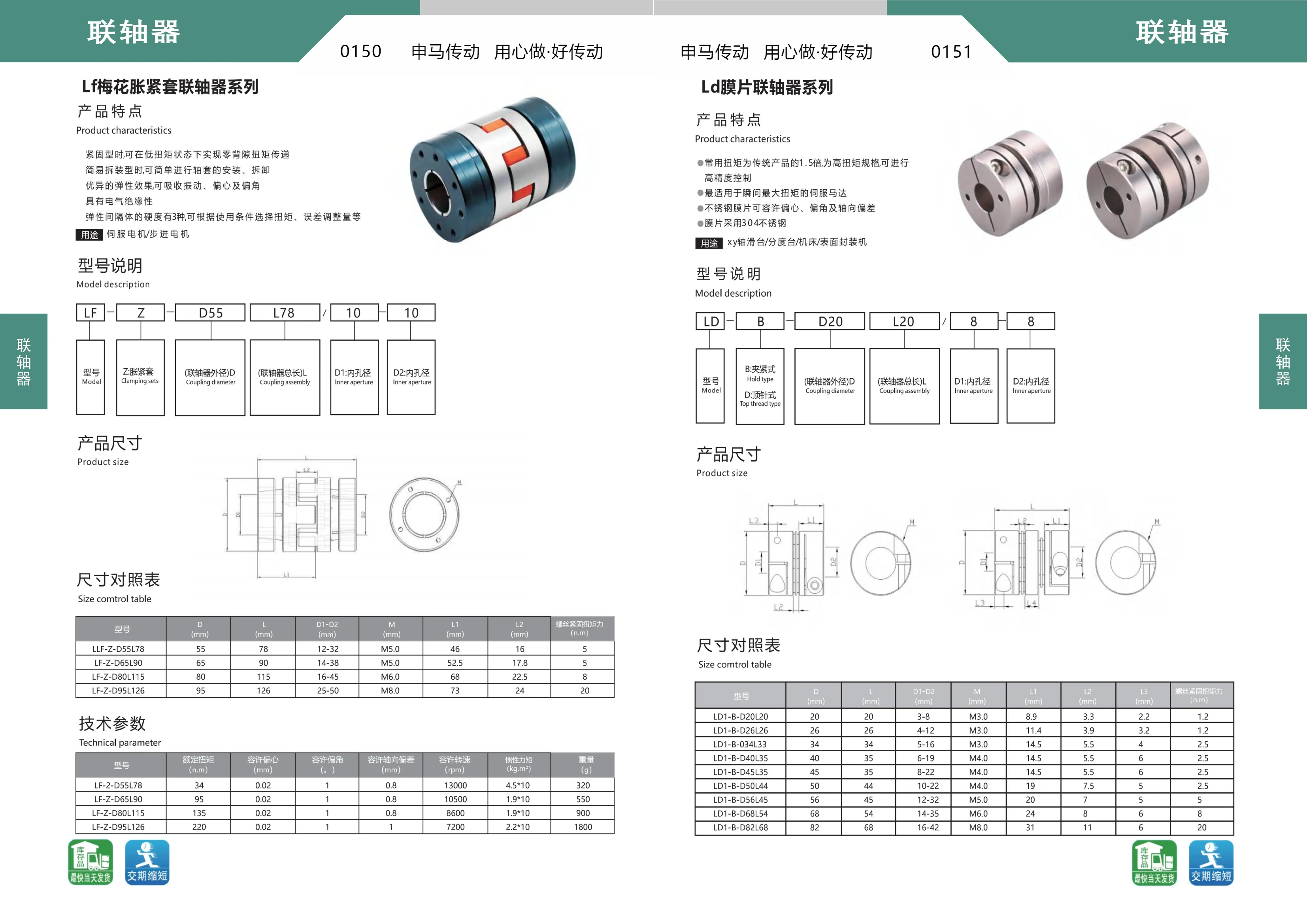
Stainless Steel Diaphragm Coupling
The stainless steel diaphragm coupling uses a 304 stainless steel diaphragm pack as its flexible element. The diaphragms transmit torque through elastic deformation while compensating for radial, angular, and axial misalignment between the shafts. Its normal operating torque is approximately 1.5 times that of conventional products, making it a high-torque coupling capable of high-precision control. It is particularly suited to applications where servo motors momentarily reach maximum torque. The diaphragm design is backlash-free, highly rigid, and dynamically responsive, making it suitable for high-speed precision connections between servo or stepper motors and ball screws or gearboxes. Selection typically involves considering rated torque, maximum speed, allowable radial, angular, and axial misalignment, moment of inertia, bore diameter range, fastening bolt specifications, and tightening torque. A safety margin should also be allowed for actual loads and installation errors.
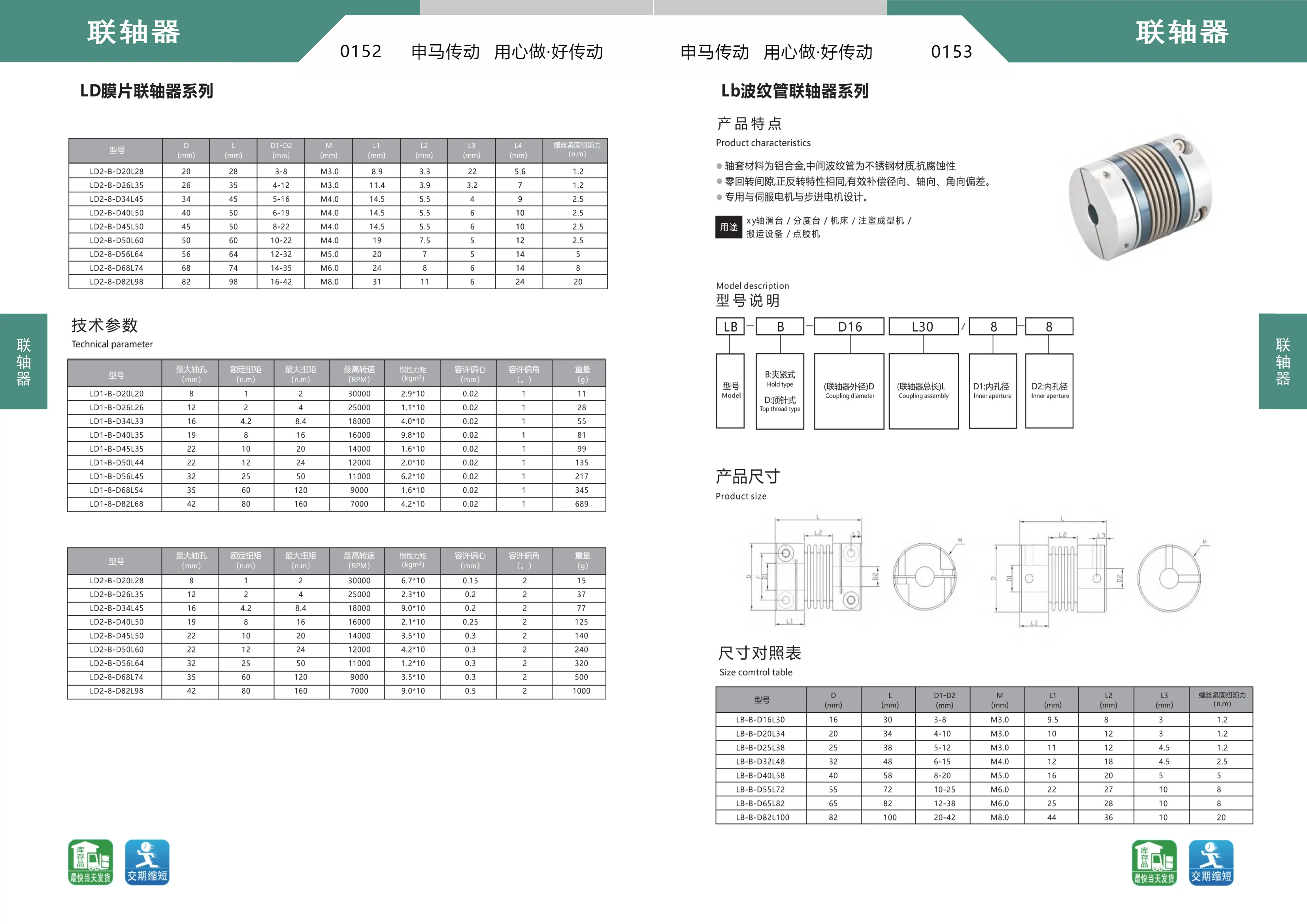
LD Series Diaphragm Couplings
The LD series from Shenma Transmission is a high-precision metal diaphragm coupling designed for connecting servo and stepper motors. It features aluminum alloy hubs and a stainless steel diaphragm assembly, with zero backlash and identical characteristics in forward and reverse rotation. It compensates for radial, axial and angular misalignment. The series includes two subseries: LD1-B (allowable eccentricity of approximately 0.02mm, allowable angle of 1°, and high rigidity) and LD2-B (allowable eccentricity of 0.15~0.5mm, allowable angle of 2°, and greater flexibility). Sizes cover outside diameters of D20~D82mm, lengths of 28~98mm, and bores of 3~42mm, with screw tightening torque up to 20N·m and maximum speeds of 20000~30000rpm.

LB Series Bellows Couplings
Manufactured by Shenma Transmission, LB series bellows couplings feature aluminum alloy hubs and a stainless steel bellows for good corrosion resistance. They offer zero backlash, identical performance in forward and reverse rotation, and effective compensation for radial, axial, and angular misalignment. They are designed for use with servo and stepper motors. The series includes two designs: LB-B (general-purpose) and LB-D (high-speed). Sizes cover outer diameters D16~D82mm and lengths L27~L100mm, with available bore ranges D1-D2 from 3-8mm to 20-42mm. Locking screws range from M3.0~M8.0, with tightening torque of 1.2~20N·m. Rated torque is 0.8~70N·m, allowable radial misalignment is 0.1~0.2mm, allowable angular misalignment is 1.5~2°, and allowable axial misalignment is 0.3-1.0mm. Allowable speeds are 3200~8500rpm for LB-B and 10000~15000rpm for LB-D, with weights of 8~700g. Typical applications include x-y axis stages, indexing tables, machine tools, injection molding machines, handling equipment, and dispensing machines.
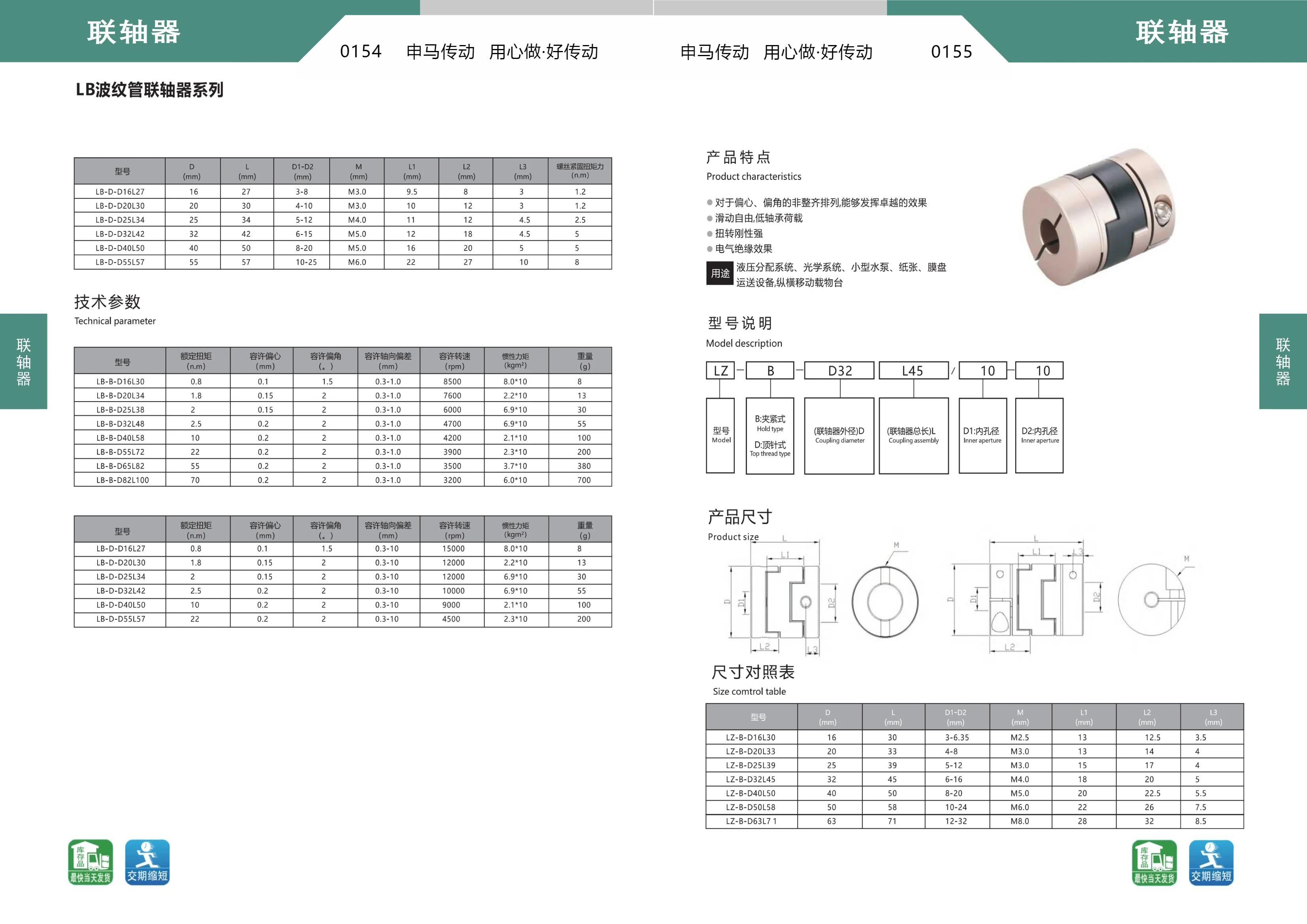
LZ Series Couplings
LZ series couplings are mechanical power transmission components. The catalog features the LZ-B design, with models designated by their outside diameter D and length L. Common sizes range from D16 to D63 mm and L30 to L71 mm, with bore ranges from 3–6.35 mm to 12–32 mm and fastening threads from M2.5 to M8. Mounting dimensions such as L1, L2 and L3 are also specified. The series is suitable for power transmission applications requiring two shafts to be connected. Select a model based on shaft diameter, outside diameter, length and available installation space.
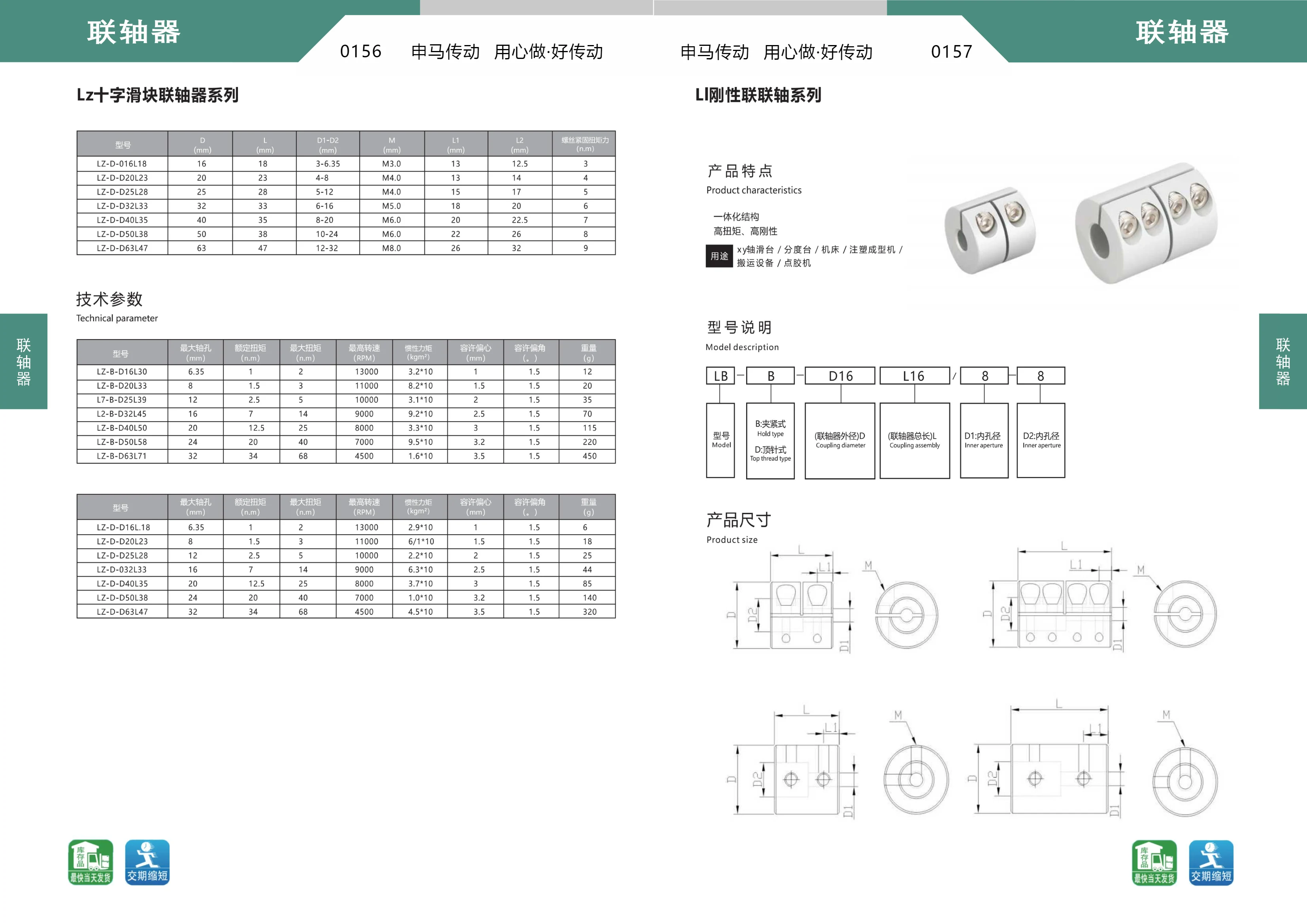
LZ Series Oldham Couplings
LZ series Oldham couplings feature an integrated cross-slide design that connects two shafts while compensating for radial and angular misalignment. They are suitable for high-speed drives requiring a degree of offset compensation and are commonly used to connect stepper or servo motors to lead screws and linear slides. Models are classified by bore diameter, outside diameter D16~D63, and length L18~L71. Specifications include maximum bore diameters of 6.35~32mm, rated torque of 1~34N·m, maximum torque of 2~68N·m, maximum speed of 4500~13000rpm, allowable offset of 1~3.5mm, allowable angular misalignment of 1.5°, weight of 12~450g, and screw tightening torque of 3~5N·m. The couplings are compact, provide smooth power transmission, and require no maintenance.

L Series Rigid Couplings
L Series rigid couplings feature a one-piece design with high torque capacity and rigidity. They are suitable for applications requiring precise torque transmission and minimal torsional backlash, including XY-axis stages, indexing tables, machine tools, injection molding machines, material handling equipment, and dispensing machines. Models are available in B (clamp type) and D (set-screw type) configurations, with a choice of bore diameters at the D1 and D2 ends. The series is suitable for connecting servo motors to drive components such as ball screws and timing belt pulleys, and is secured by clamps or set screws during installation.
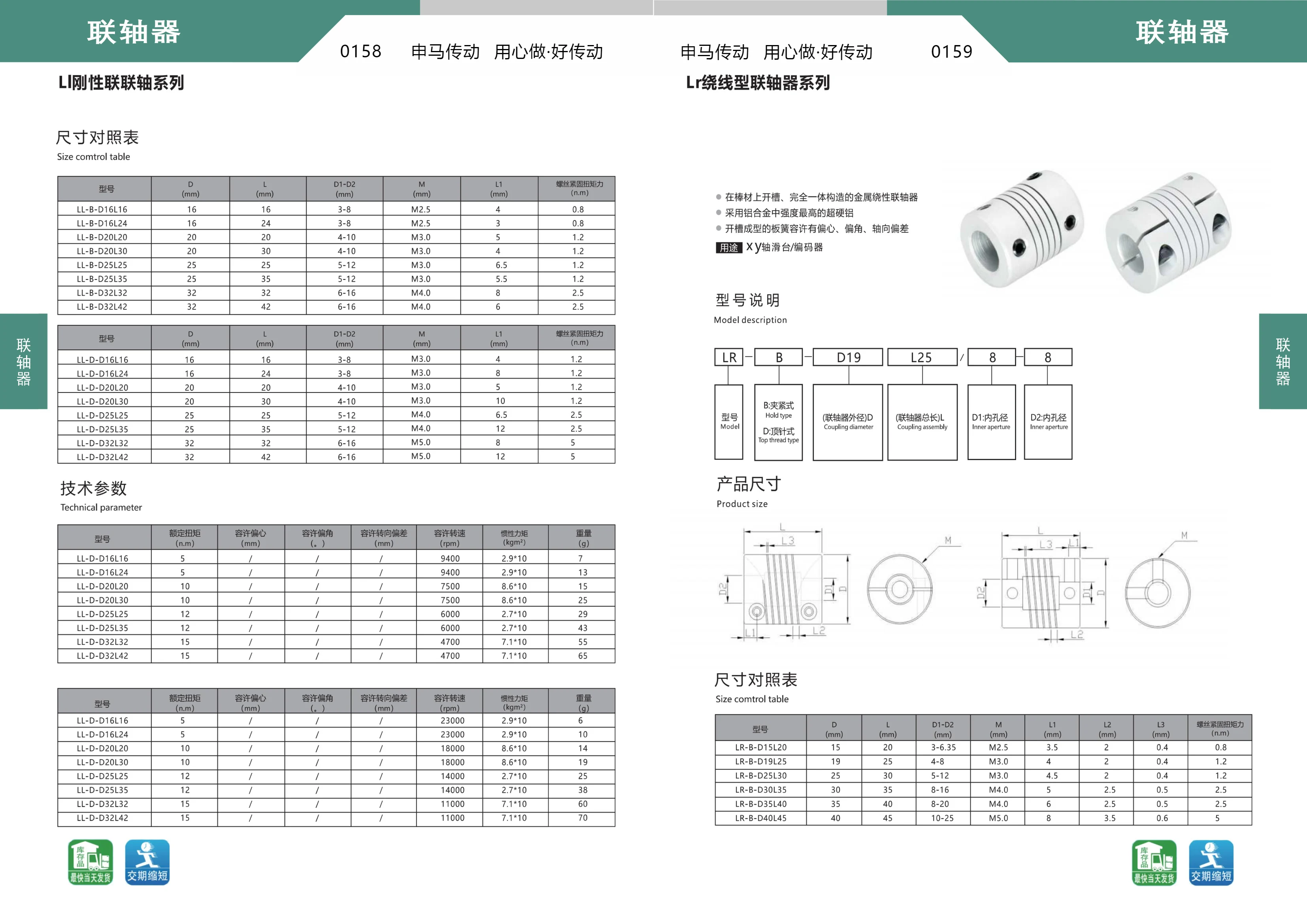
LL-D Series Couplings
The LL-D series consists of compact set-screw couplings designed for flexible connection and torque transmission between two shafts. They are suitable for light-duty applications involving small servo motors, stepper motors, encoders, lead screws, and similar equipment. Model codes specify the outer diameter and length; for example, LL-D-D16L16 has an outer diameter of 16mm and a length of 16mm. Common outer diameters are 16, 20, 25, and 32mm, with short and long lengths available for each diameter (16/24, 20/30, 25/35, 32/42). Each outer diameter accommodates a different bore range, from 3-8mm to 6-16mm, allowing selection to match the actual motor and driven shaft diameters. Set screw sizes increase with the outer diameter from M2.5 and M3.0 to M4.0. The distance L1 from the screw center to the end face ranges from 3~8mm, and the specified tightening torque ranges from 0.8~2.5N·m. During assembly, tighten to the applicable torque to avoid damaging the shafts and screws.
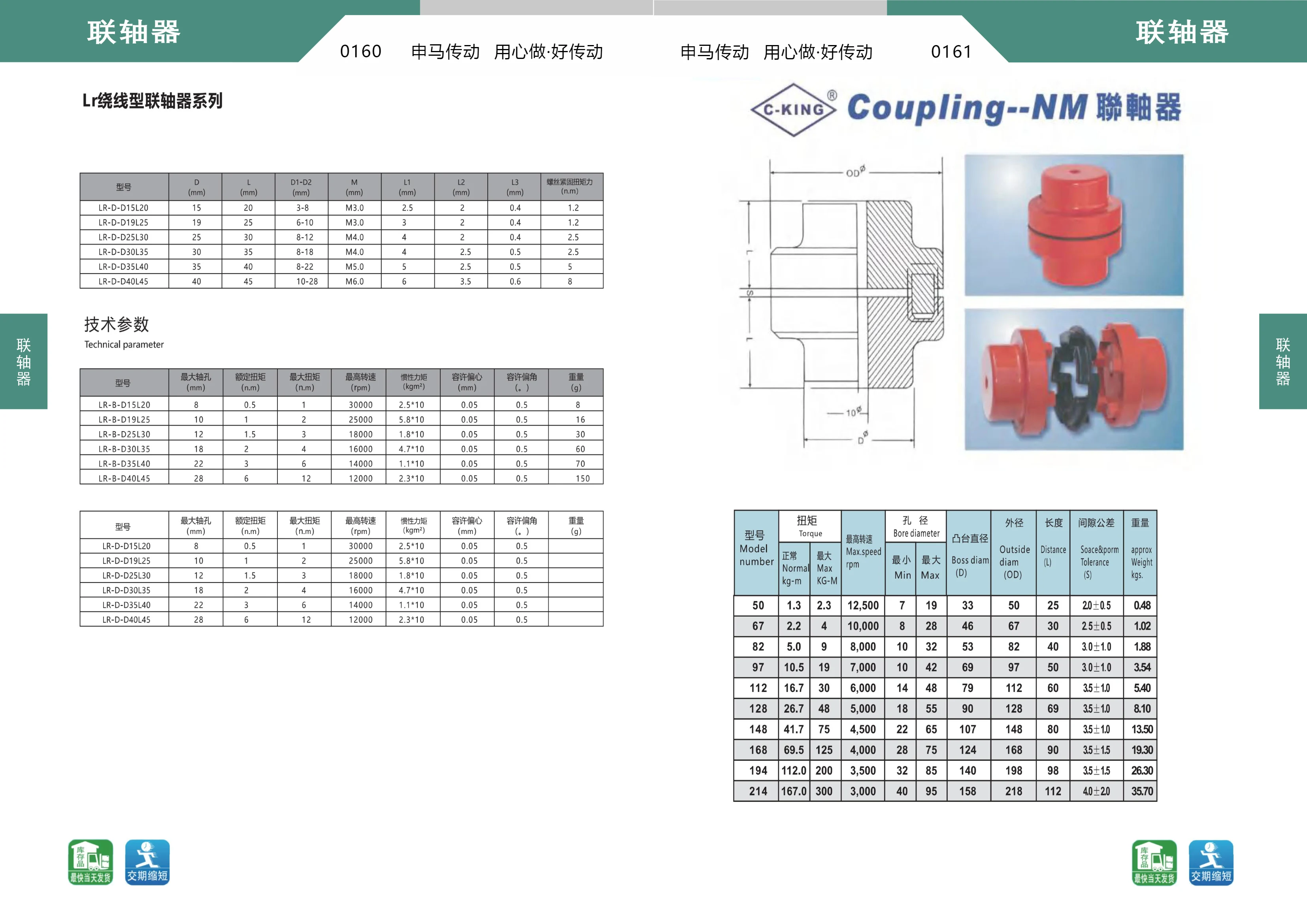
LR Series Wire-Wound Couplings
The LR series wire-wound flexible couplings are part of the C-KING coupling range and are suited to low-power transmission applications involving servo motors, stepper motors, lead screws and encoders. Six sizes are available, with outside diameters D15~D40 and lengths L20~L45. Maximum bore sizes range from 8~28 mm, rated torque from 0.5~6 N·m, maximum torque from 1~12 N·m and maximum speed from 12000~30000 rpm. Allowable eccentricity is 0.05 mm and allowable angular deviation is 0.5°. The listed models include LR-B and LR-D. The technical specifications table provides torque, speed, moment of inertia, weight and other data for quick selection.

FCL Series Flexible Pin and Bush Couplings
FCL series flexible pin and bush couplings use pins fitted with elastic bushes. Their simple design makes installation and replacement easy. During operation, they dampen vibration from mechanical transmission and absorb shocks caused by uneven motion. They accommodate axial, radial and angular misalignment between shafts, significantly improving operating quality and stability. Allowable misalignment: radial displacement 0.2~0.6mm, angular deviation 0°30'~1°30'. They are widely used in lightly loaded, motor-driven power transmission systems of small and medium capacity, including reducers, cranes, compressors, textile machinery, pumps and gearboxes. Models range from FCL-90~FCL-400, with outer diameters of 90~400mm, pin numbers F1~F7, bores of 8~40mm, maximum speeds of 1600~4000rpm, maximum torques of 4~3550N·m and weights of 1.54~127.70kg.
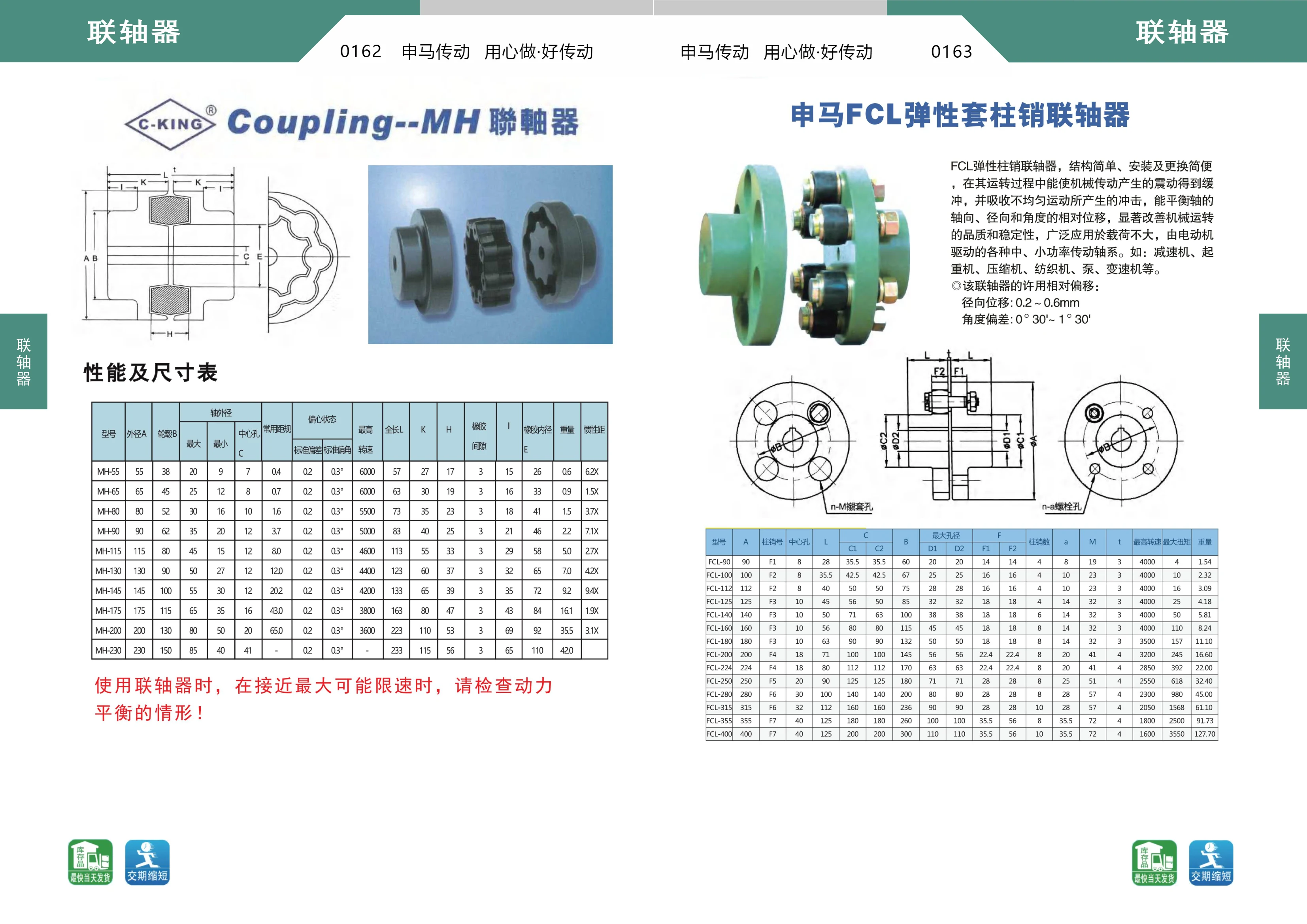
MH Series Flexible Jaw Couplings
Shenma Transmission MH series flexible jaw couplings consist of two jaw hubs and an intermediate rubber spider. They damp vibrations generated by mechanical transmission, absorb shocks caused by uneven motion, and compensate for radial and angular misalignment between shafts. They are widely used in small and medium-power drive systems for gear reducers, cranes, compressors, textile machinery, pumps and variable-speed drives. The range covers outer diameters of 55~230mm, hub lengths of 38~150mm, maximum machinable bores of 20~85mm, minimum bores of 9~50mm, overall lengths of 57~233mm, rubber spider outer diameters of 26~110mm and a rubber gap of 3mm. Maximum speeds range from 3600~6000rpm, typical torque (listed in the source as “常用距规”) from 0.4~65N·m, and individual weights from 0.6~42.0kg. The source specifies standard radial misalignment compensation of 0.2mm and angular compensation of 0.3°. Models MH-55~MH-230 are selected by outer diameter. Dynamic balance must be checked when operating near the maximum permissible speed.
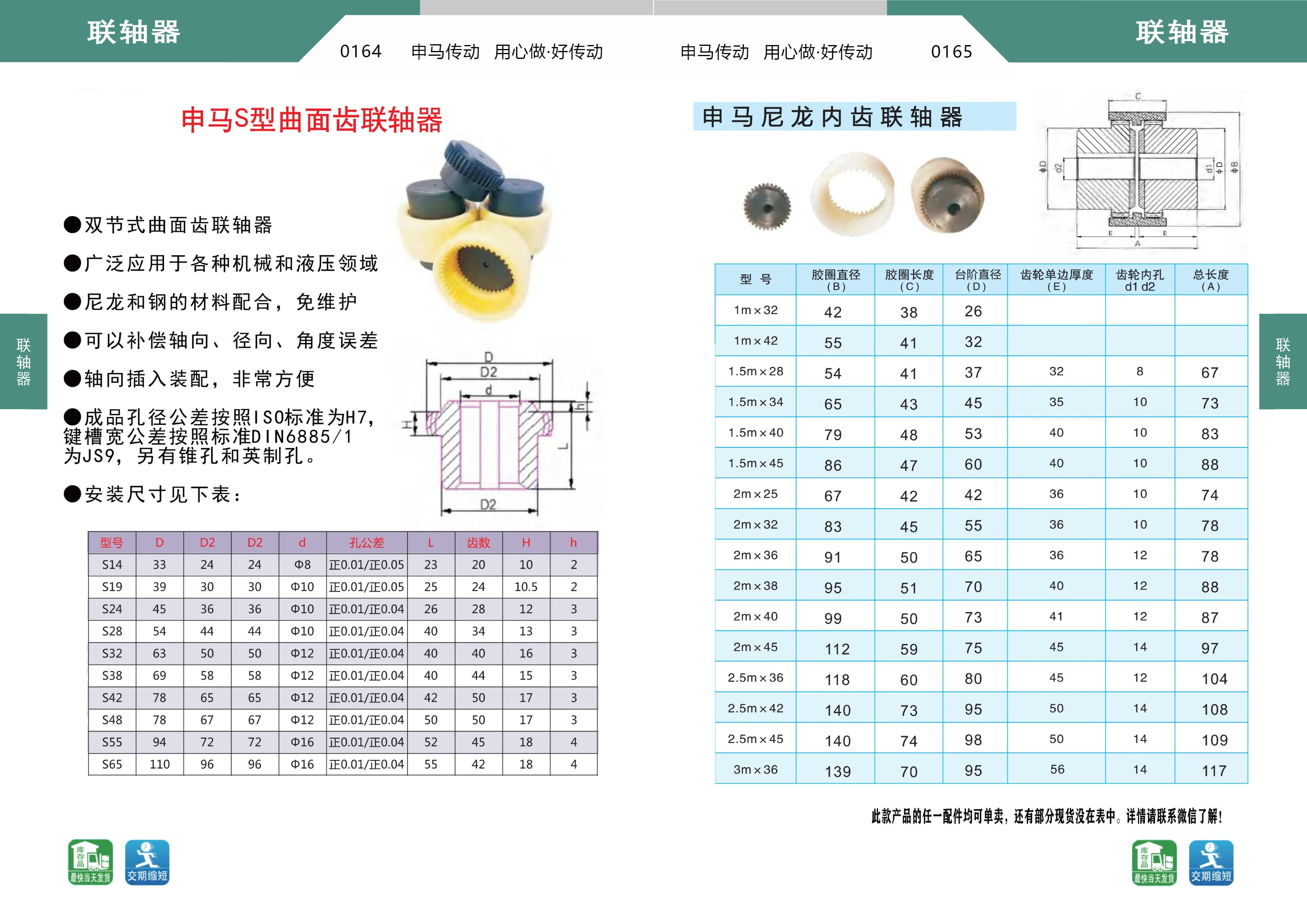
Shenma S-Type Curved-Tooth Gear Coupling
The Shenma S-type curved-tooth gear coupling is a two-piece coupling made from nylon and steel. It is maintenance-free, compensates for axial, radial and angular misalignment, and is easy to assemble by axial insertion. Finished bore tolerances are ISO H7, and keyway width tolerances are JS9 in accordance with DIN6885/1. Tapered and imperial bores are also available. Models range from S14 to S65, with outer diameter D of 33~110 mm, bore diameter d of Φ8~Φ16 mm, length L of 23~55 mm, and 20~50 teeth. The series is suitable for power transmission connections in a variety of mechanical and hydraulic applications.
Shenma Nylon Internal Gear Coupling
The Shenma nylon internal gear coupling features an internal gear ring that meshes with externally toothed hubs. Elastic deformation of the nylon gear ring compensates for radial, angular and axial misalignment between the two shafts. The coupling reduces vibration and noise, requires no lubrication or maintenance, and is suitable for general mechanical drives with low to medium torque. The catalog provides complete mounting dimensions by size: sizes range from 1m×32 to 3m×36, with ring diameter (B) 42~140 mm, ring length (C) 38~74 mm, step diameter (D) 26~98 mm, individual gear thickness (E) 32~56 mm, gear bore d1/d2 8~14 mm, and overall length (A) 67~117 mm. All components are available separately. Please inquire about additional in-stock items not listed in the catalog table.
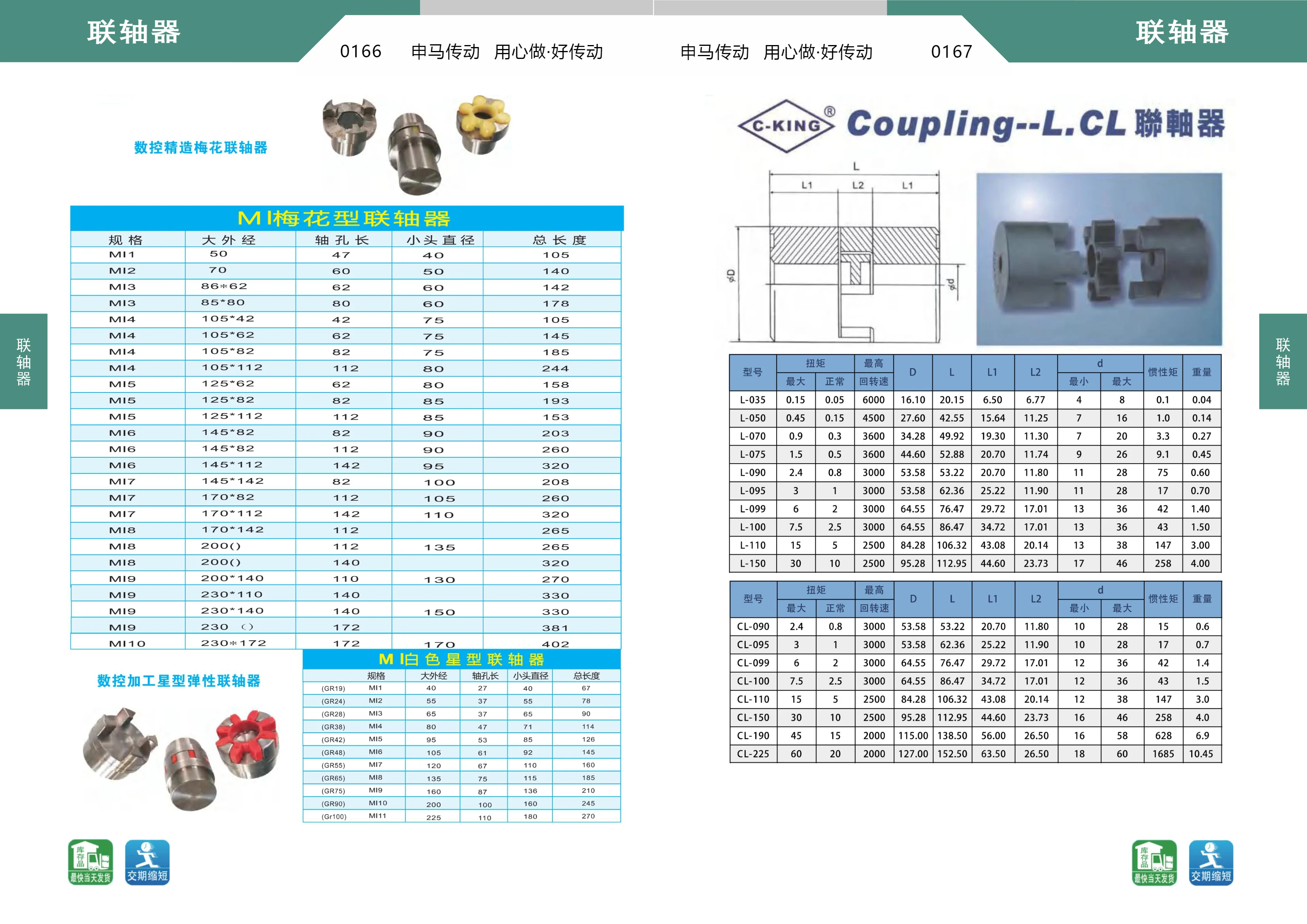
L Series Couplings
L series couplings are flexible couplings designed for low- to medium-power precision drives. They are commonly used to connect servo and stepper motors to ball screws, encoders, and gearboxes, compensating for shaft misalignment and absorbing shock. The series comprises 10 sizes, from L-035 to L-150, covering precision low-torque to medium-torque applications. Key specifications include maximum torque of 0.15~30 N·m, normal torque of 0.05~10 N·m, maximum speed of 2000~6000 rpm, outside diameter D of 16.10~95.28 mm, overall length L of 20.15~112.95 mm, mounting dimensions L1 and L2, and bore diameter d of 4~46 mm. Each size is available with different bore combinations to suit various motor and screw shaft diameters. Select a model from the table based on the required transmitted torque, speed, and bore sizes, and do not exceed the maximum speed. The same page also lists CL variants with the same dimensions as the L type, slightly different moments of inertia and weights, and sizes extending to CL-225, for different stiffness and damping requirements.
CL Series Couplings
CL series couplings are available in models from CL-090 to CL-225, classified by outside diameter. They connect motors to lead screws or shaft ends and transmit torque. The catalog lists specifications including maximum torque, rated torque, maximum rotational speed, outside diameter D, overall length L, L1/L2 dimensions, and minimum and maximum bore diameters. The series covers maximum torques of 2.4~60 N·m, maximum speeds of 2000~3000 rpm, outside diameters of approximately 53.58~127 mm, and bore diameters of approximately 10~60 mm. Select a coupling based on load torque, speed, bore fit, and available installation space.
GR Series Star Couplings
GR series star couplings use a star-shaped elastomer as a cushioning element to provide a flexible connection between servo or stepper motors and ball screws or drive shafts. They compensate for radial, angular, and axial misalignment and absorb vibration. The catalog covers GR19, GR24, GR28, GR38, GR42, GR48, GR55, GR65, GR75, GR90, and GR100 sizes, with dimensions including maximum outer diameter, bore length, small end diameter, and overall length to help select the right coupling for the shaft diameter and available installation space.
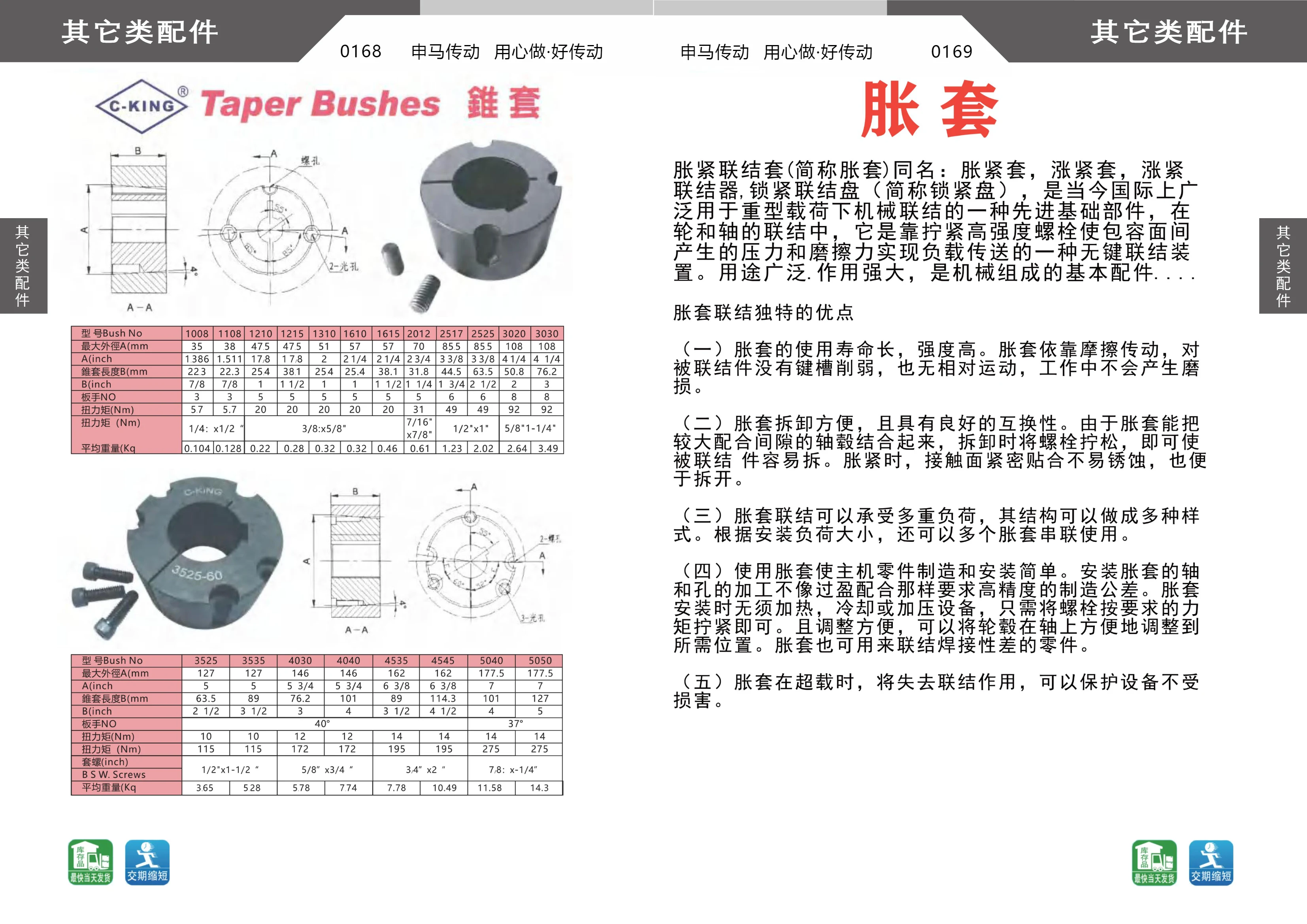
Locking Assemblies
Locking assemblies are advanced mechanical components used to create keyless connections between hubs and shafts under heavy loads. Tightening high-strength bolts generates pressure and friction between the mating surfaces, making them widely suitable for power transmission. Their advantages include friction-based transmission without keyways that weaken connected components, relative movement or wear, resulting in high strength and a long service life. They are easy to remove by loosening the bolts and offer good interchangeability. Available in various designs, they can withstand multiple loads and be installed in series to suit the load. Installation requires no heating, cooling or pressurizing equipment; the bolts simply need to be tightened to the specified torque. Shaft and bore machining tolerances are less demanding than for interference fits, the hub position on the shaft can be easily adjusted, and components that are difficult to weld can also be connected. This series also includes common taper bush sizes, with models such as 1008, 1108, 1210, 1615, 2012, 2517, 3030, 3525, 4040, 5040 and 5050. Specifications range from 35–177.5mm in maximum outer diameter, 22.3–127mm in taper bush length and 10–57 N·m in tightening torque, accommodating a variety of shaft diameters and hub combinations.
Taper Bush
A taper bush is a basic power transmission component used to create a keyless friction connection between a shaft and a hub. Tightening high-strength bolts presses the tapered surfaces together, transferring torque and axial force through contact pressure and friction. It eliminates the weakening of the shaft and hub caused by keyways, is easy to install and remove, offers good interchangeability, and can be used in multiple units in series. This series covers 20 sizes from Bush No 1008 to 5050, with maximum outside diameter A of 35~177.5mm, bush length B of approximately 22.3~127mm, and matching wrench sizes 3~14 with corresponding tightening torques. The model number is the standard Bush No: the first two digits indicate the maximum bore size (inches×10), and the last two indicate the bush length (inches×10). For example, 1008 has a 1.0-inch bore and is 0.8 inches long, while 2012 has a 2.0-inch bore and is 1.2 inches long. The same page also describes locking assemblies: they release their grip under overload to protect equipment and are suitable for mechanical connections under heavy loads.
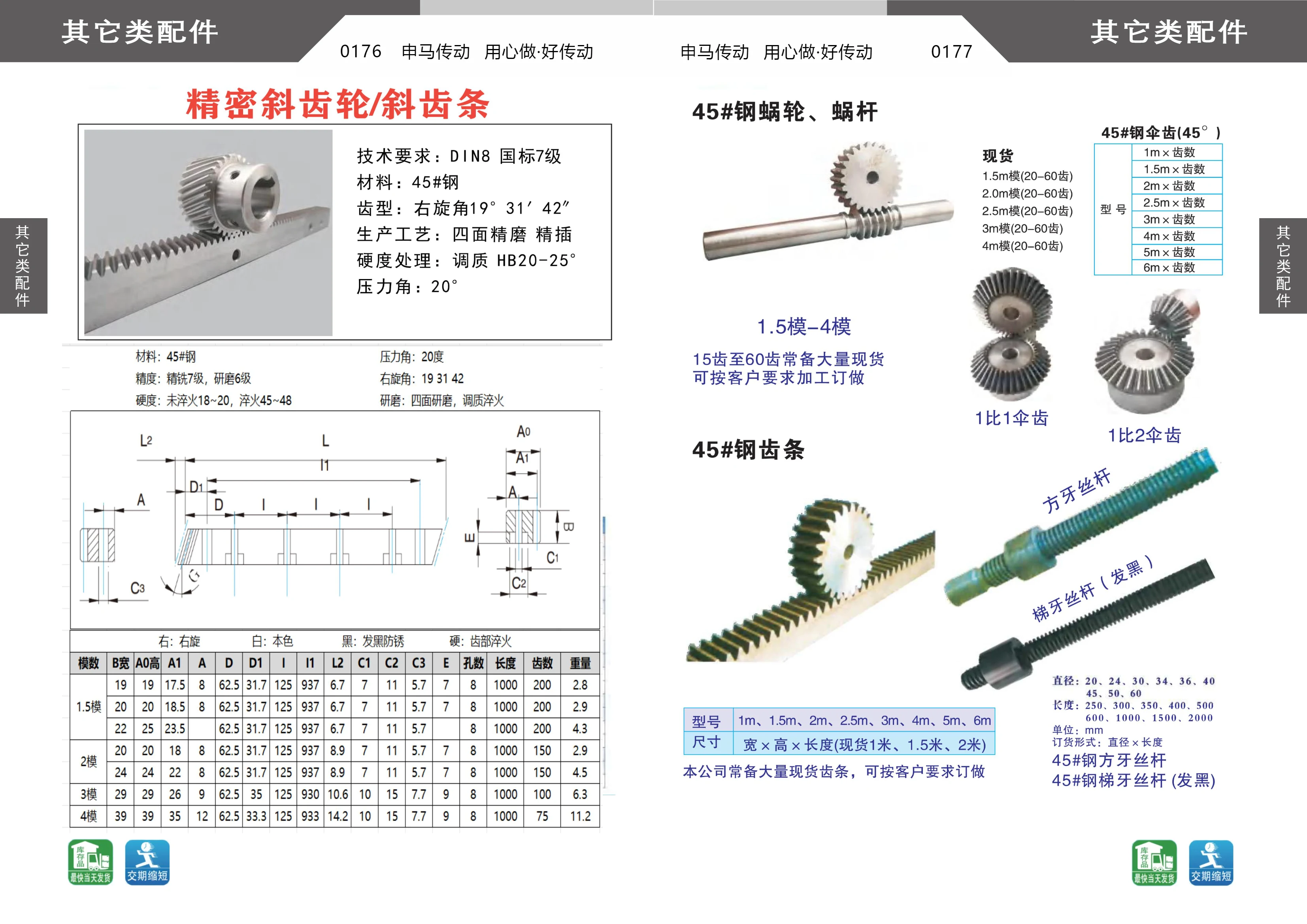
Precision Helical Gears / Helical Racks
Made from 45# steel, these precision helical gears and racks are used in machine tool feeds, precision drives, and linear motion systems for automated equipment. The helical gears meet DIN8 and Chinese national standard grade 7 accuracy, with a right-hand helix angle of 19°31′42″ and a pressure angle of 20°. They are quenched and tempered to a hardness of HB20-25, with four sides precision-ground and teeth precision-shaped. The helical racks are available in two accuracy grades: precision-milled grade 7 and ground grade 6. They have a pressure angle of 20° and a right-hand helix angle of 19°31′42″, with a hardness of 18-20 before quenching and 45-48 after quenching. Custom machining is available to customer requirements.
45# Steel Worm Gears and Worms
These worm gears and worms are made from high-quality 45# carbon structural steel. Common modules include 1.5m, 2.0m, 2.5m, 3m and 4m, with 20~60 teeth. Large quantities are normally in stock. They are used in reduction drives, indexing mechanisms and worm gear sets for various types of machinery. Custom manufacturing is available to customer drawings or samples, including non-standard tooth counts, modules and bore sizes. The tooth surfaces can be quenched and tempered, providing good load capacity, smooth transmission and low noise.
45# Steel Bevel Gears
The 45# steel bevel gear series is made from 45# steel and designed to transmit motion and power between intersecting shafts. The range includes 45° bevel gears (modules 1m to 6m, with customizable tooth counts), 1:1 bevel gears, and 1:2 bevel gears. Common specifications range from module 1.5 to module 4, with 15 to 60 teeth. A large selection is regularly stocked, and custom machining is available to customer requirements. These gears offer high strength, good wear resistance, and smooth transmission, and are widely used in machine tools, gear reducers, agricultural machinery, and other drive systems.
45# Steel Gear Rack
The 45# steel gear rack (helical rack) is a linear drive component in a rack-and-pinion system. It meshes with a helical gear to convert rotary motion into linear motion and vice versa. Made from 45# steel, this series has a 20° pressure angle and right-hand teeth with a helix angle of 19°31′42″. It can be manufactured to DIN8/Chinese national standard grade 7 accuracy; precision milling achieves grade 7, while grinding achieves grade 6. Hardness is 18-20 in the unquenched state and 45-48 after quenching. Four-sided precision grinding, precision shaping, and quenching and tempering (HB20-25) are also available. Large quantities are regularly stocked, and custom manufacturing is available to customer drawings or requirements. Applications include linear drives for machine tools, automation equipment, and lifting mechanisms.
SRJ Series Flexible Couplings
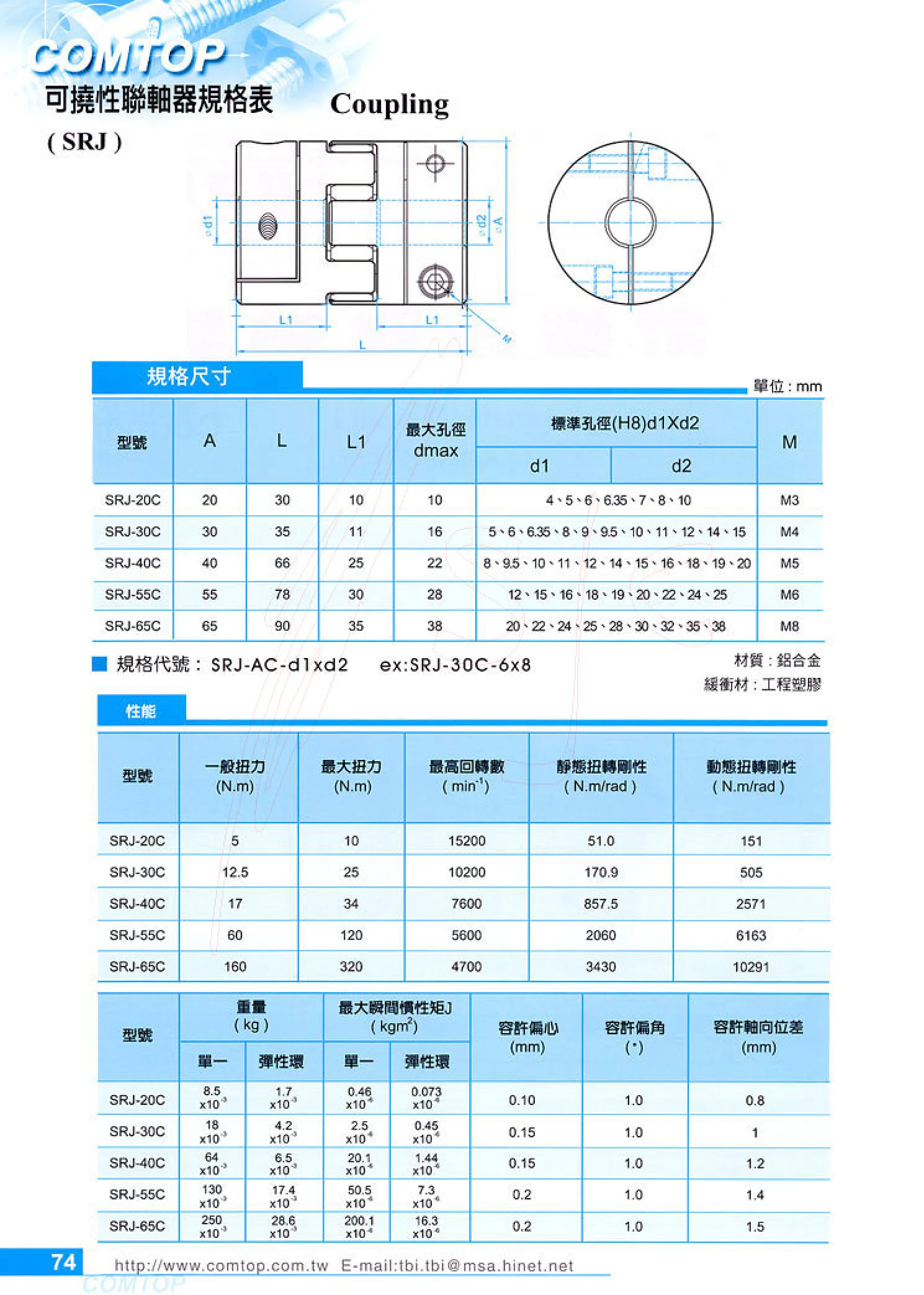
SRJ series flexible couplings (elastic couplings) feature aluminum alloy hubs and an engineering plastic cushioning element. They provide a flexible connection between servo motors and ball screws or gear reducers, compensating for radial, angular, and axial misalignment while absorbing vibration and shock. Five sizes are available, with outer diameters of 20/30/40/55/65 mm, lengths of 30~90 mm, and maximum bore diameters of 10~38 mm. Standard bores are available in sizes from 4~38 mm with an H8 tolerance. The bore diameter at each end can be specified separately (e.g., SRJ-30C-6×8). Rated torque is 5~160 N·m, maximum torque is 10~320 N·m, maximum speed is 4700~15200 min⁻¹, static torsional stiffness is 51~3430 N·m/rad, dynamic torsional stiffness is 151~10291 N·m/rad, and weight is 8.5 g~250 g. They are suitable for high-speed, high-precision, zero-backlash positioning applications.
FL Series Flanged Ball Screw Bearings
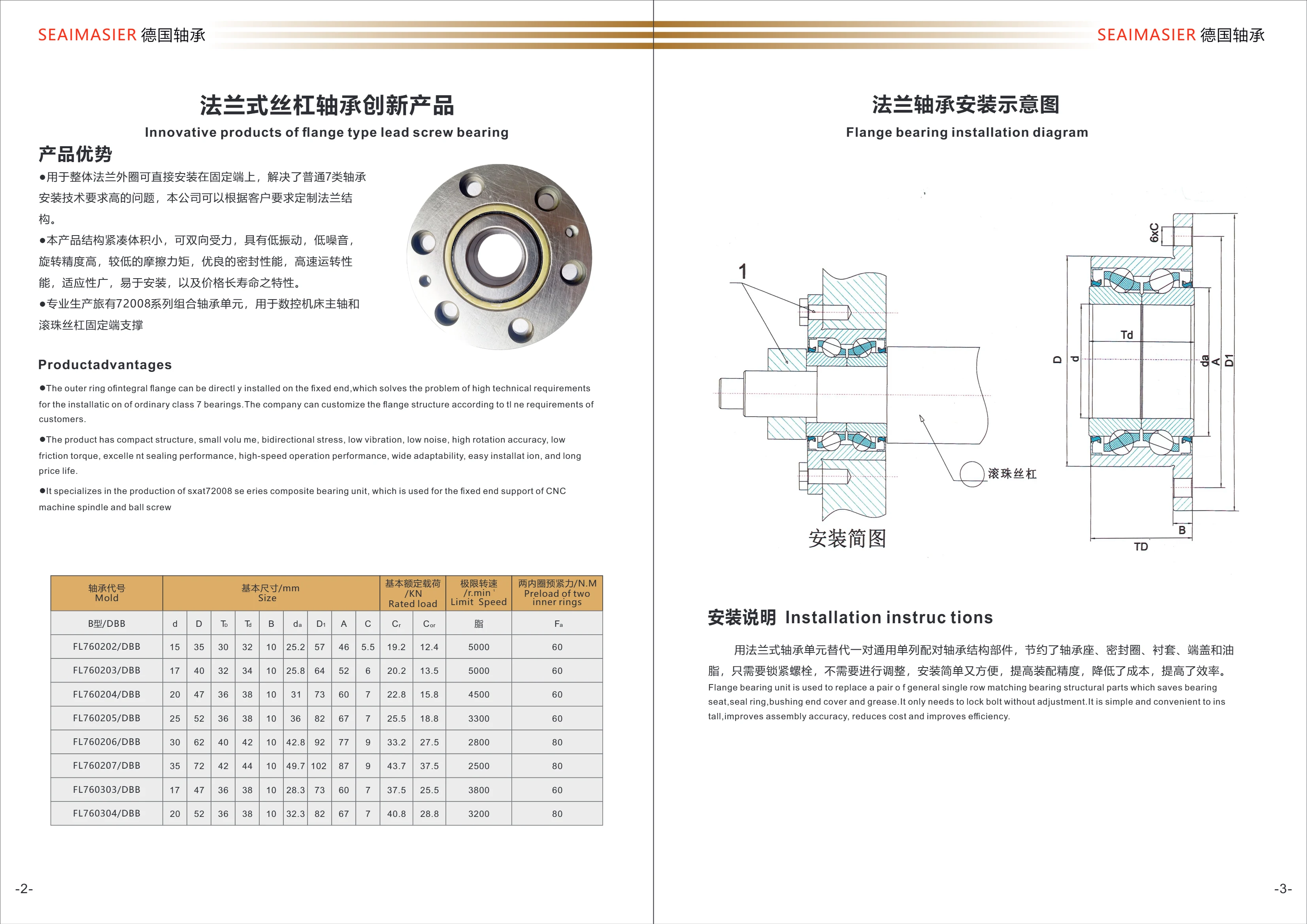
The FL series consists of integrated flanged ball screw bearings (combined bearing units) with a flanged outer ring for direct mounting on the fixed end of a ball screw or on a CNC machine tool spindle. The flange plate is secured directly with locking bolts, replacing a pair of universally matched single-row bearings and eliminating the need for a bearing housing, seals, bushings, end covers, and grease. No preload adjustment is required, simplifying installation, improving assembly accuracy, and reducing costs. These compact bearings support axial loads in both directions and offer low vibration, low noise, high rotational accuracy, low friction torque, excellent sealing, and strong suitability for high-speed operation. Basic dimensions cover bore diameters d of 15~35mm and outside diameters D of 35~72mm, with a preload of 60~80N·m on the two inner rings and a grease-lubricated limiting speed of 2500~5000r/min. Flange designs can also be customized to customer requirements.
760 Series Sealed Angular Contact Ball Bearings
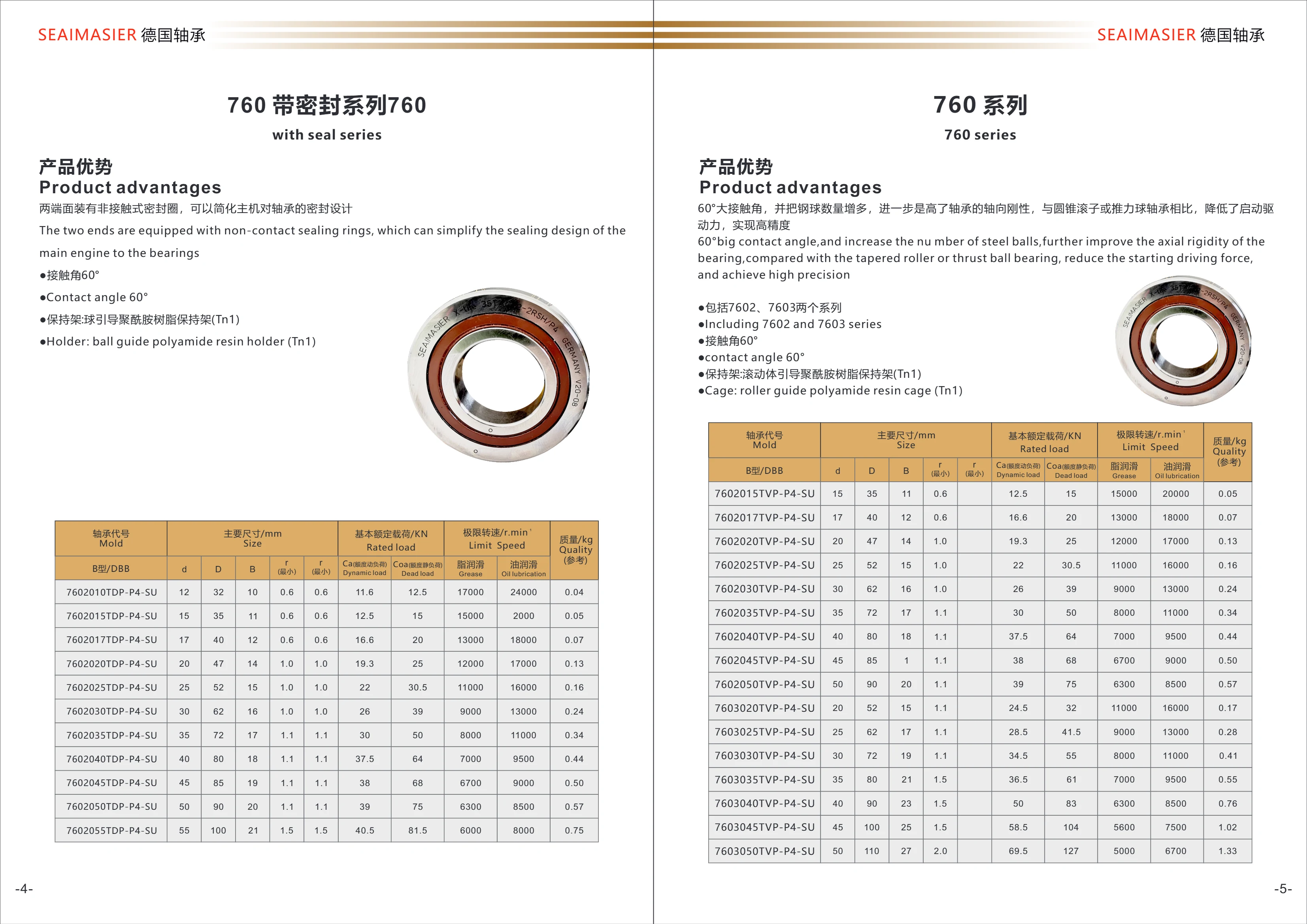
The 760 series comprises sealed angular contact ball bearings for machine tool spindles. With a 60° contact angle and an increased number of steel balls, they provide greater axial rigidity and require less starting torque than tapered roller or thrust ball bearings, enabling high precision. Non-contact seals on both sides simplify the bearing sealing design of the host machine. The cage is a rolling-element-guided polyamide resin cage (Tn1). The series includes the 7602 and 7603 subseries, with bore diameters of 12~55mm, outside diameters of 32~110mm, and widths of 10~27mm. Basic dynamic load ratings are 11.6~69.5kN, and static load ratings are 12.5~127kN. Limiting speeds are 5000~17000 r/min with grease lubrication and 6700~24000 r/min with oil lubrication. Precision grade: P4.

TAC Series Thrust Angular Contact Ball Bearings
The TAC series consists of high-precision thrust angular contact ball bearings designed specifically for ball screws. Their boundary dimensions conform to the international BS standard. With a 60° contact angle, they accommodate combined loads that are predominantly axial and can be freely combined in multiple rows, including back-to-back arrangements such as DBB. The bearings feature a rolling-element-guided polyamide resin cage (TN1), while the 60° contact angle provides both high axial rigidity and high-speed capability. The basic series offers bore diameters of d=15~60mm, outside diameters of 47~120mm, widths of 15/20mm, basic dynamic load ratings of 21.9~67.5kN, static load ratings of 26.6~130kN, limiting speeds of 1800~6000r/min with grease and 2300~8000r/min with oil, and masses of 0.135~1.11kg. The sealed series features 2RSH high-speed seals and P4 precision. The seals prevent contaminants such as plastic, wood and metal chips and cutting fluid from entering the bearing, helping prevent the approximately 40% of premature screw bearing failures caused by contamination. Lifetime lubrication makes the bearings maintenance-free and eliminates the need for an oil lubrication system. Applications include machine tool screw support and precision transmission.
TAC Series Angular Contact Thrust Ball Bearings
TAC series angular contact thrust ball bearings, available in unsealed B type and sealed 2RSH/P4 designs, are high-precision bearings designed specifically for ball screw support. They have a 60° contact angle and a rolling-element-guided polyamide resin cage (TN1). Their boundary dimensions conform to the international BS standard, and they can be freely combined. Sealed versions feature lifetime grease lubrication and high-speed seals that prevent contaminants such as plastic, wood chips, metal chips, and cutting fluid from entering the bearing. Approximately 40% of premature machine tool screw bearing failures are caused by contaminant ingress; the seals effectively extend service life and enable maintenance-free operation without an oil lubrication system. Bore diameter: 15~60mm; outer diameter: 47~120mm; width: 15~20mm; dynamic load rating: 21.9~67.5kN; limiting speed with grease lubrication: 1800~6000 r/min.

H Series Ultra-High-Speed Motorized Spindle Bearings (Steel Balls)
The H series comprises ultra-high-speed angular contact ball bearings for grinding and engraving/milling motorized spindles. Their internal parameters are analytically optimized to minimize rolling element slippage at high speeds. They are suitable for grease, oil mist, oil-air, and oil jet lubrication. The range includes the H70, H72, and H719 series, with contact angles of C (15°) or AC (25°). Rolling elements are steel balls (unmarked) or ceramic balls (HQ1). Cages are outer-ring-guided phenolic resin cages (unmarked) or inner-ring-guided polyamide resin cages (TN1). The high-precision series is available only in P4 and P2 grades and can be preloaded at constant pressure for high-speed and ultra-high-speed operation. The range covers bore diameters of 15~90mm. The table lists parameters including d, D, B, minimum chamfer r, rated dynamic/static loads, limiting speeds for grease/oil lubrication, and reference mass.

B Series Spindle Bearings (Steel Balls)
B series spindle bearings with steel balls are high-speed, high-precision bearings primarily used in motorized spindles for grinding, engraving and milling. Their internal parameters are specially optimized for motorized spindle applications, with low temperature rise under grease lubrication. The range includes the B70 and B72 series, with a 15° contact angle. Cage options are an outer-ring-guided cage for static grease lubrication (no designation) and a ball-guided PEEK cage (no designation). Rolling elements are steel balls (no designation) or ceramic balls (HQ1). The high-precision series is available only in P4 and P2 grades. These bearings are suitable for high and ultra-high speeds with constant-pressure preload, and can be lubricated with grease, oil mist or oil-air systems. Main dimensions: bore diameter 10mm to 90mm, outside diameter 26mm to 160mm, width 8mm to 30mm. Basic dynamic load rating: 3.0kN to 131.3kN. Limiting speed with grease lubrication: 8000 to 80000 r/min.
LHSAS Series Ball Stud
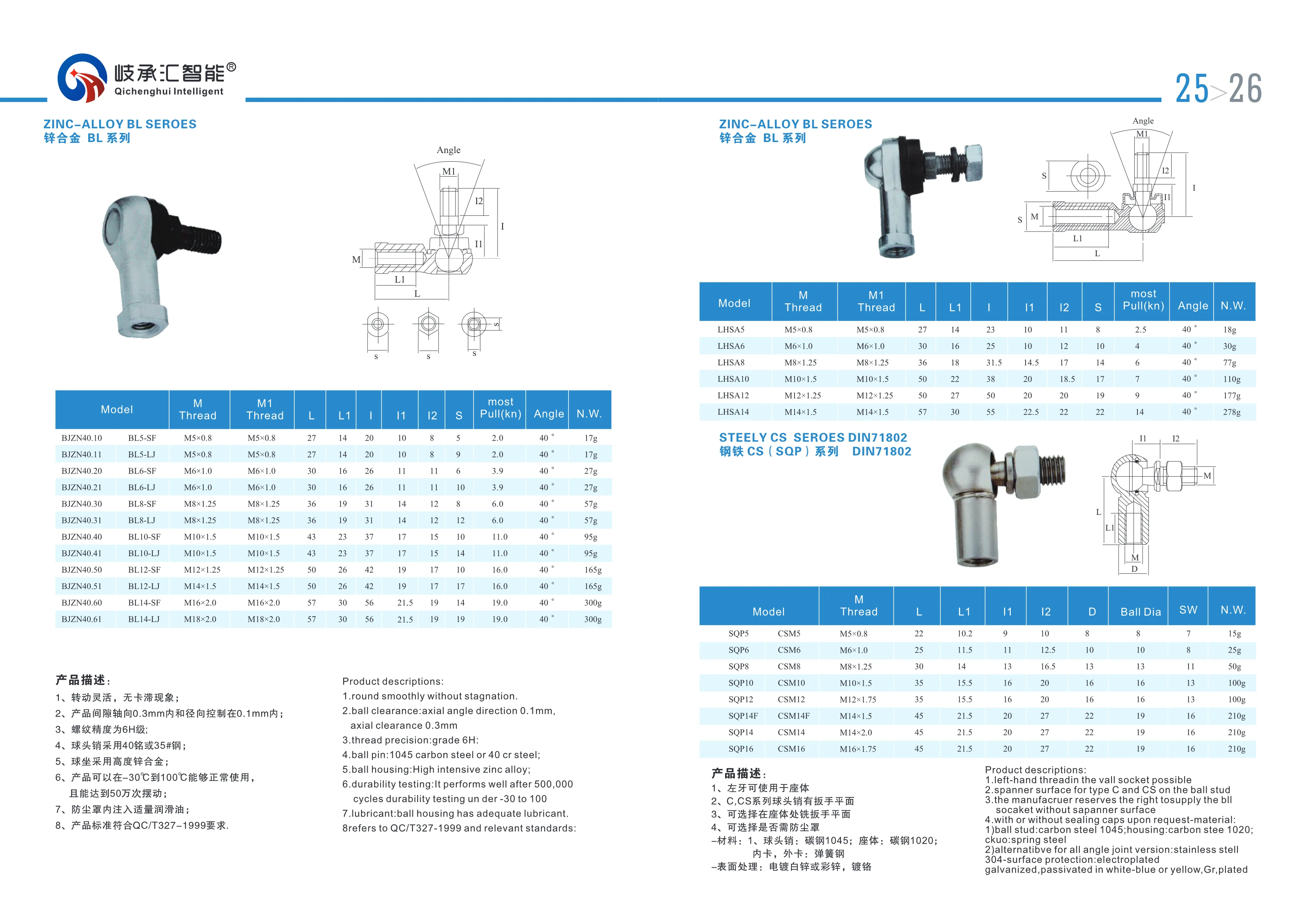
LHSAS Series ball studs feature ball studs made of 40Cr or 35 steel and seats made of high-zinc alloy. The threads meet tolerance class 6H, and the studs rotate smoothly without sticking. Axial clearance is no more than 0.3 mm, and radial clearance is no more than 0.1 mm. The products have passed 500,000-cycle oscillation durability testing and operate reliably in temperatures from -30°C to 100°C. A range of thread sizes is available, including M5×0.8, M6×1.0, M8×1.25, M10×1.5, M12×1.25, and M14×1.5. Suitable for a variety of mechanical connections and transmission mechanisms, they comply with QC/T 327-1999.
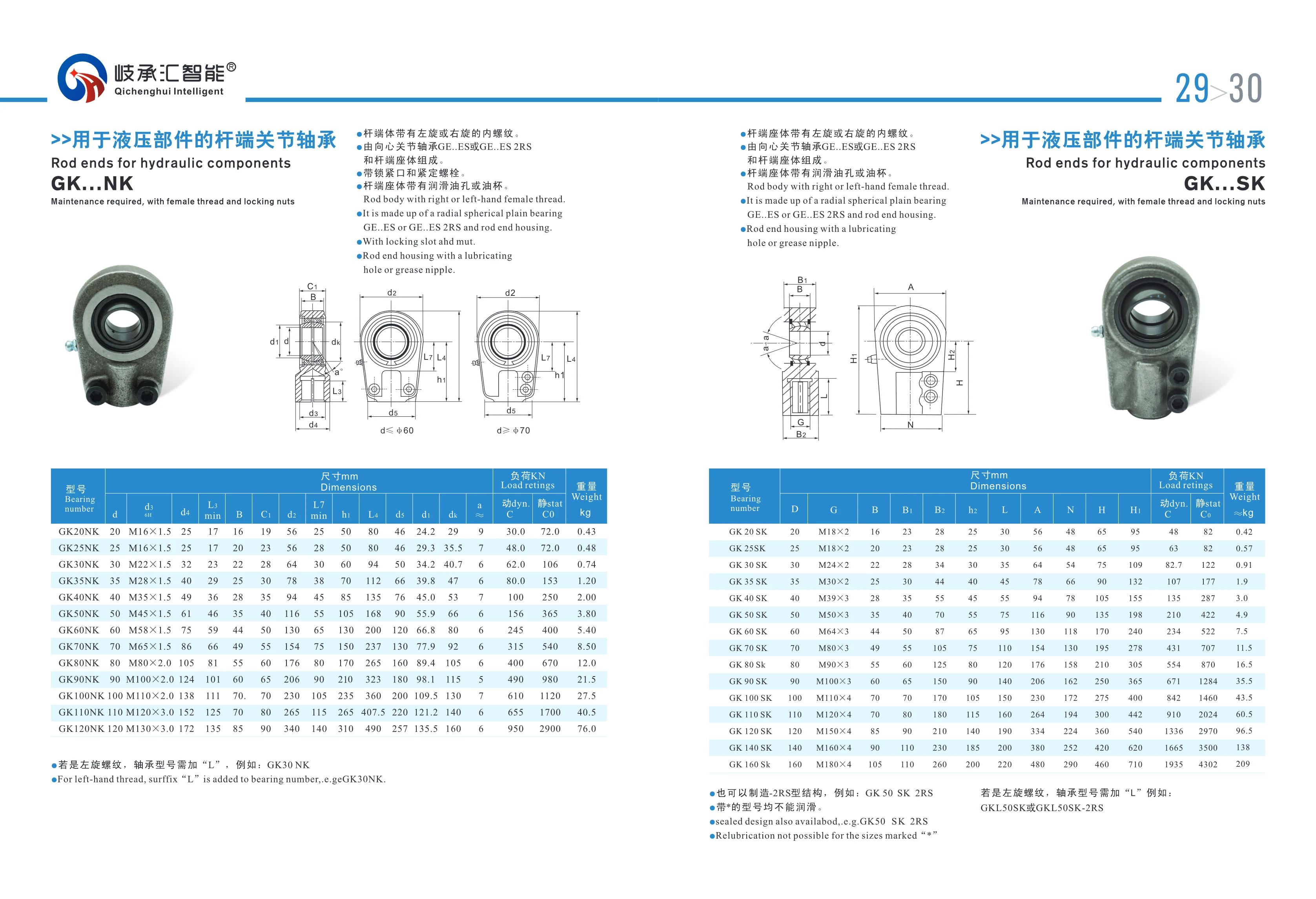
GK Series Rod End Spherical Plain Bearings
This series of rod end spherical plain bearings is designed for hydraulic components and is available in two types: GK...NK and GK...SK. Both types require maintenance and feature an internal thread and a locknut. Each consists of a GE...ES or GE...ES 2RS spherical plain bearing and a rod end housing fitted with a lubrication hole or grease nipple. Left- or right-hand threads are available. Suitable for connections and oscillating motion in hydraulic systems.
GK...SK
The GK...SK series comprises maintenance-required rod end spherical plain bearings for hydraulic components, with an internal thread and locknut. The rod end body has a right- or left-hand internal thread and consists of a GE...ES or GE...ES 2RS radial spherical plain bearing fitted into a rod end body. The body features a lubrication hole or grease nipple, making the series suitable for connections and motion transmission in hydraulic systems. A range of sizes and load capacities is available to meet the needs of different hydraulic applications.
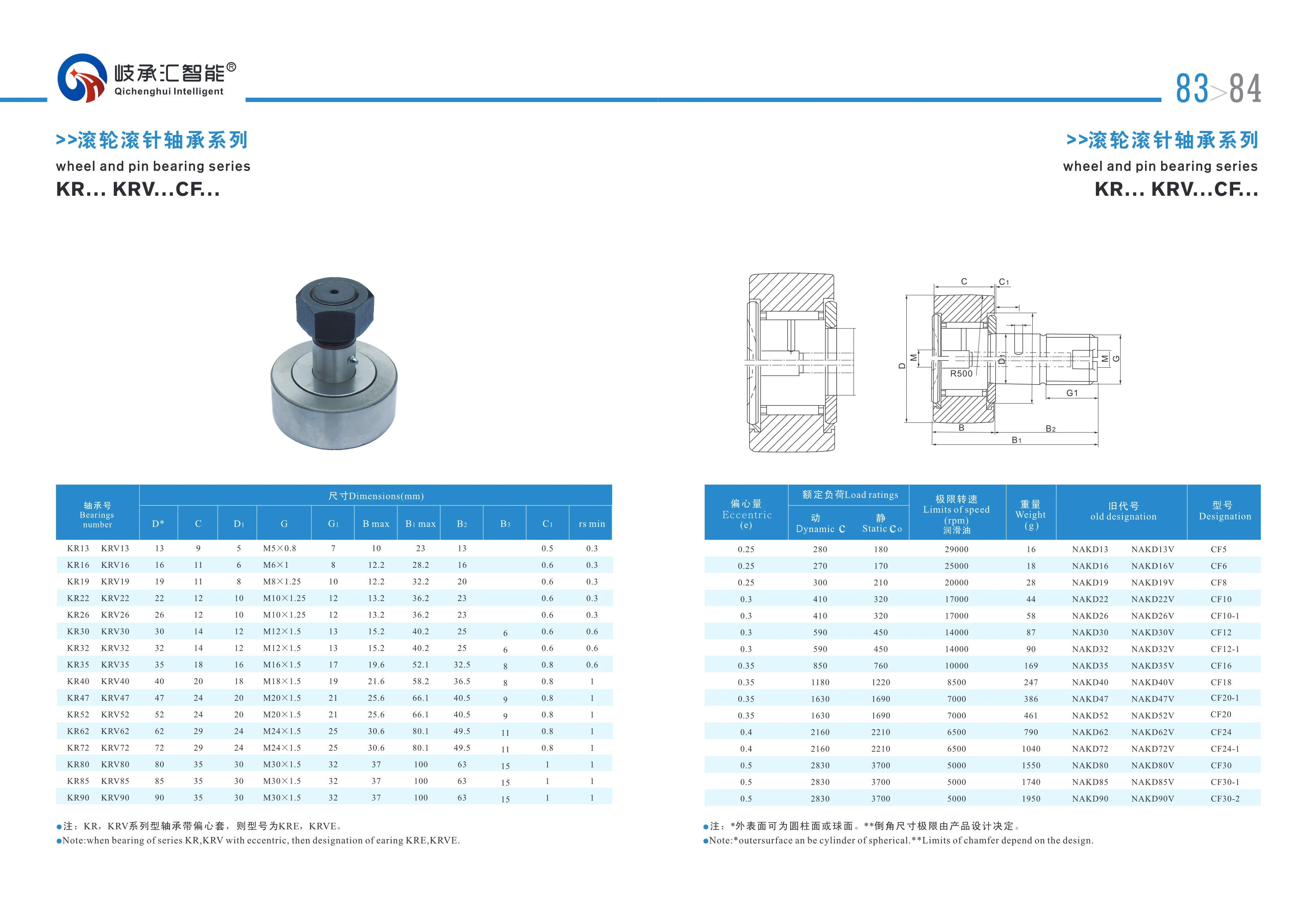
KR Series
KR Series cam followers, also known as stud-type track rollers, are single-row needle roller bearings consisting of a stud and needle rollers. They are widely used in automation, conveying, and packaging equipment, as well as other applications requiring high rigidity, high load capacity, and rapid response. Their compact design allows direct mounting on a threaded shaft, and a range of sizes is available to suit different load and space requirements. The range includes standard models (KR) and models with an eccentric collar (KRE/KRVE), which allows fine adjustment of the mounting position. The outer ring is made of high-strength steel, and the optimized needle roller arrangement ensures low friction and long service life. Limiting speeds range from 5,000 to 29,000 rpm, dynamic load ratings from 280 to 2,830 N, static load ratings from 180 to 3,700 N, and weights from 16 to 1,950 g. Dimensions cover outer diameters of 13–90 mm and widths of 9–35 mm. These bearings are interchangeable with the IKO KR series.

BF Series
The BF Series includes flexible couplings and support units. The flexible couplings feature aluminum-alloy hubs and a polyurethane elastomer, secured with clamping screws. They have zero backlash, absorb vibration, and compensate for radial and angular misalignment, making them suitable for low-torque applications in confined spaces. The support units are BF-type units designed to secure the ends of ball screws and are available for shaft diameters from 8 to 40 mm. The couplings come with elastomers in three different hardnesses and perform identically in clockwise and counterclockwise rotation.
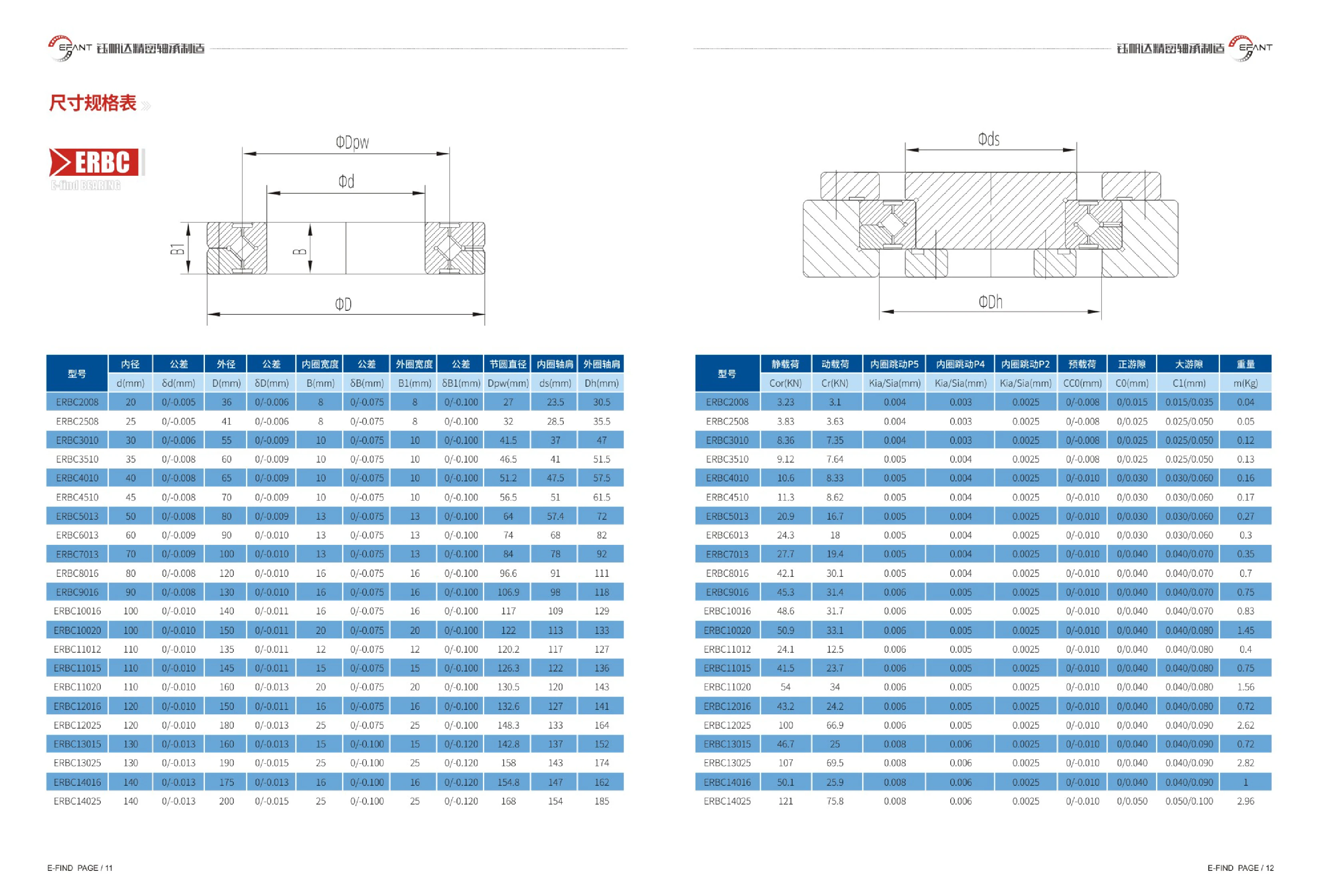
ERBC Series Crossed Roller Bearings
ERBC series crossed roller bearings feature rollers arranged at 90° to one another, allowing them to support radial, axial and moment loads simultaneously. They offer high rigidity, high rotational accuracy and a compact, thin-wall design. The catalog covers bore diameters of 20–1250 mm, outer diameters of 36–1500 mm and widths of 8–110 mm. For each model, it specifies bore diameter, outer diameter, inner ring width and outer ring width tolerances, pitch diameter, and inner and outer ring shoulder dimensions. Three accuracy grades (inner ring runout) are available: P5, P4 and P2, along with three clearance configurations: CC0 (preload), CO (positive clearance) and C1 (large clearance). Static load Cor, dynamic load Cr and weight are also listed. Model numbers consist of the ERBC prefix followed by bore diameter and width figures (for example, ERBC2008 has a 20 mm bore diameter and an 8 mm width). These bearings are commonly used in the rotating sections of CNC rotary tables, swiveling milling heads, direct-drive motors and precision testing equipment. Internal or external gears, additional flanges, surface heat treatment, and matching bearing housings and shafts can be customized.
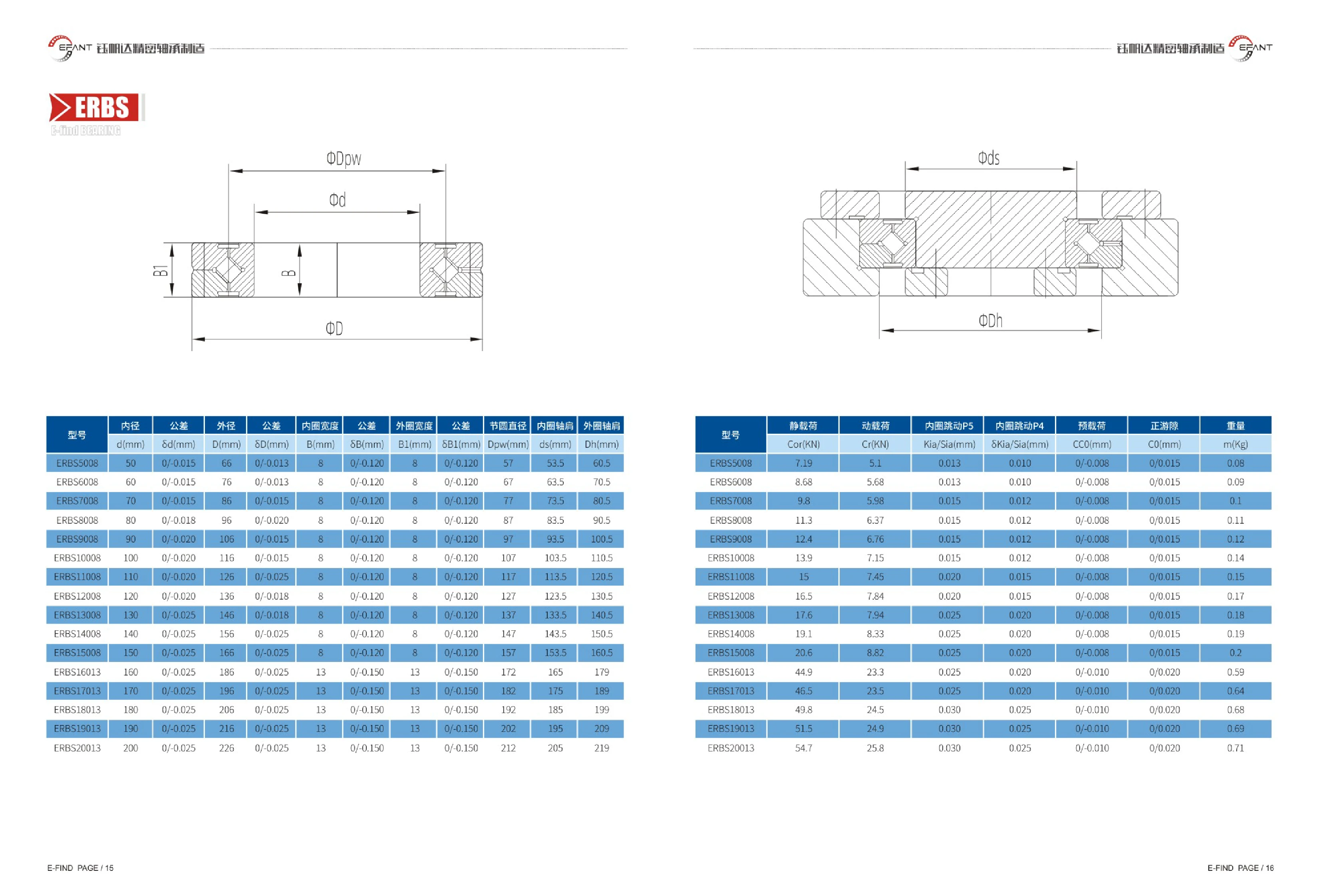
ERBS Series Constant-Section Thin-Wall Bearings
ERBS series constant-section thin-wall bearings are precision ball bearings with a constant radial cross-section and thin walls. They are suited to applications with limited space that require low weight and high rigidity, such as robot joints, aerospace, medical devices, semiconductor equipment and precision rotary mechanisms. The series has bore diameters of 50~200 mm, outside diameters of 66~226 mm and two width options of 8 mm and 13 mm. Pitch diameters range from 57~212 mm, inner ring shoulder diameters from 53.5~205 mm and outer ring shoulder diameters from 60.5~219 mm. Static load ratings are 7.19~54.7 kN and dynamic load ratings are 5.1~25.8 kN. Options include P5/P4 inner ring runout grades, CC0 preload and CO positive clearance. Each bearing weighs 0.08~0.71 kg.
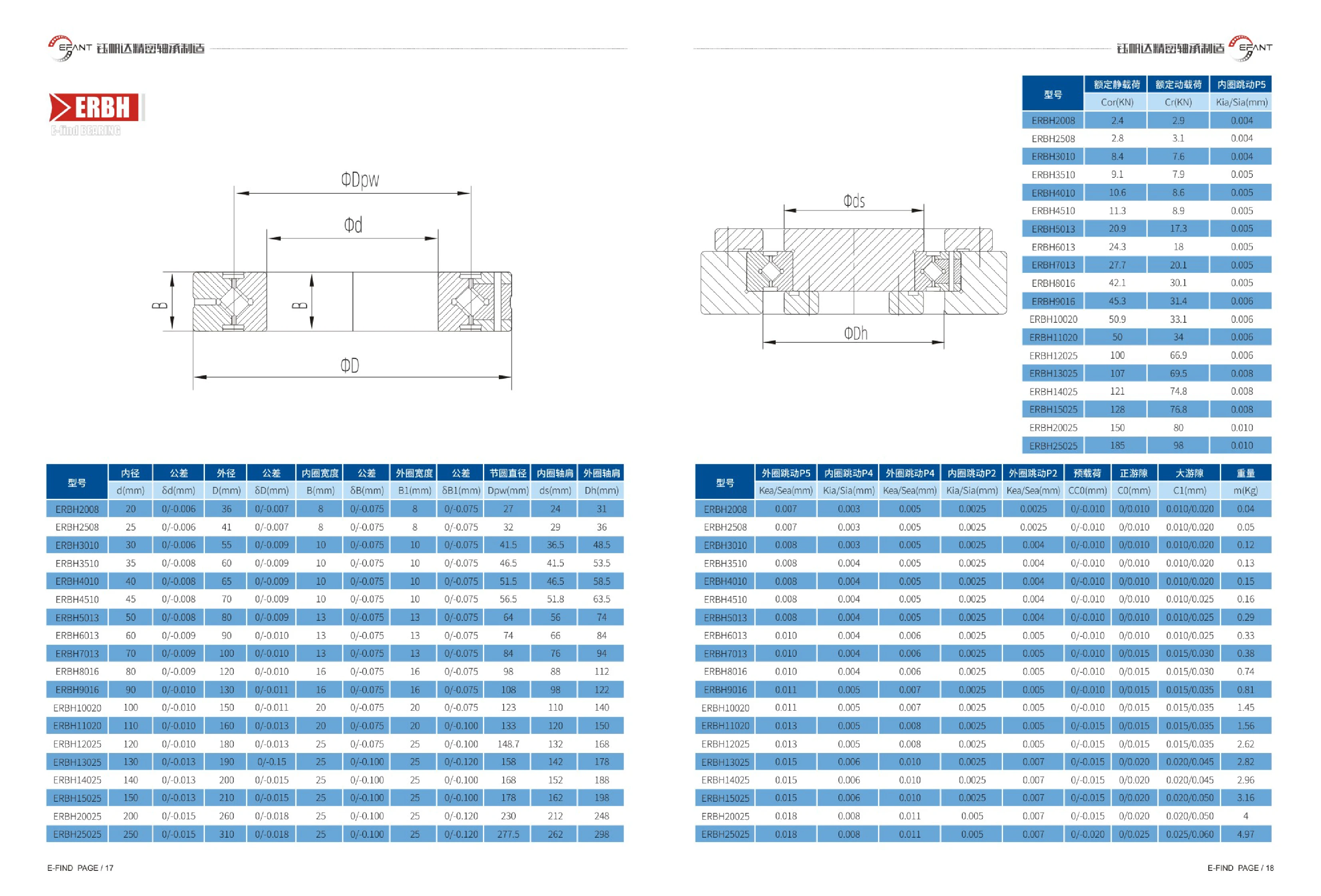
ERBH Series Constant-Section Thin-Wall Bearings
The ERBH series consists of precision constant-section (thin-wall) bearings with inner and outer rings of equal width. The range includes 19 sizes, with inner diameters of 20~250mm, outer diameters of 36~310mm, and widths of 8~25mm. The catalog specifies inner diameter d, outer diameter D, inner ring width B, outer ring width B1, pitch diameter Dpw, inner ring shoulder ds, outer ring shoulder Dh, and their respective tolerances. It also lists P5, P4, and P2 inner/outer ring runout values, preload groups (such as 0/-0.010 and 0/-0.020), positive clearance groups (0/0.010 and 0/0.025), large clearance groups (0.010/0.020, 0.010/0.025, 0.020/0.050, and 0.025/0.060), and reference weights for each size. These bearings are suitable for industrial robot joints and reducers, precision rotary tables, semiconductor and medical equipment, optical instruments, and other applications with limited cross-sectional space that require high rigidity and low runout. Select a model by its inner diameter and width, then choose the P5/P4/P2 accuracy class and preload or clearance group according to the equipment's precision and rigidity requirements.
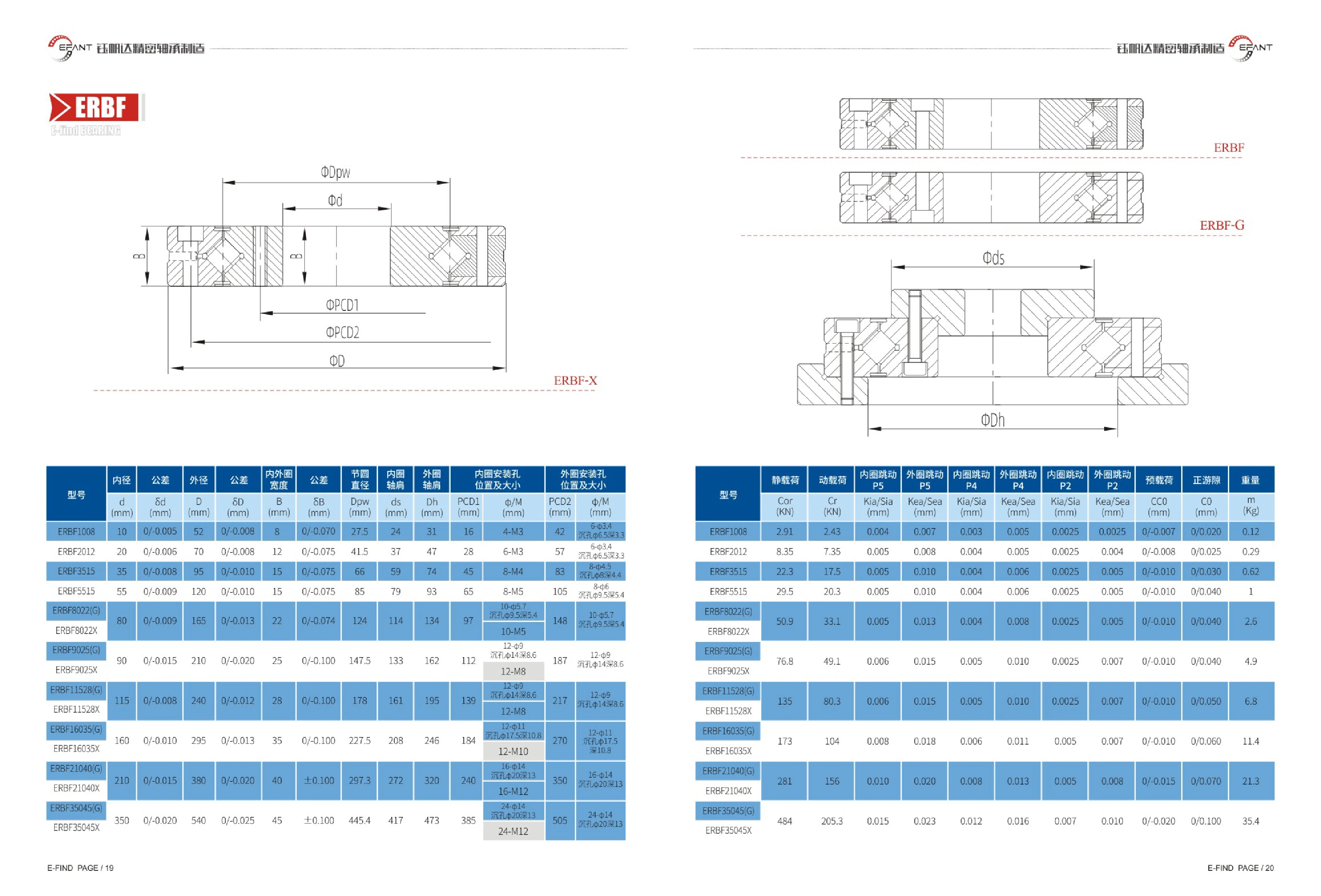
ERBF-X Series Crossed Roller Bearings
The ERBF-X series comprises crossed roller bearings with mounting holes in both the inner and outer rings. Their rollers are arranged at 90° to one another, allowing them to support radial, axial and moment loads simultaneously. They offer high rigidity, high rotational accuracy and a compact design. Applications include robot joints, precision rotary tables, indexing tables, medical equipment and rotary mechanisms in industrial automation. Models cover inner diameters of 10~350 mm and outer diameters of 52~540 mm, with P5/P4/P2 runout grades and preload or positive clearance options. The main difference between G and X types is the outer ring mounting hole design: the X type uses threaded holes.
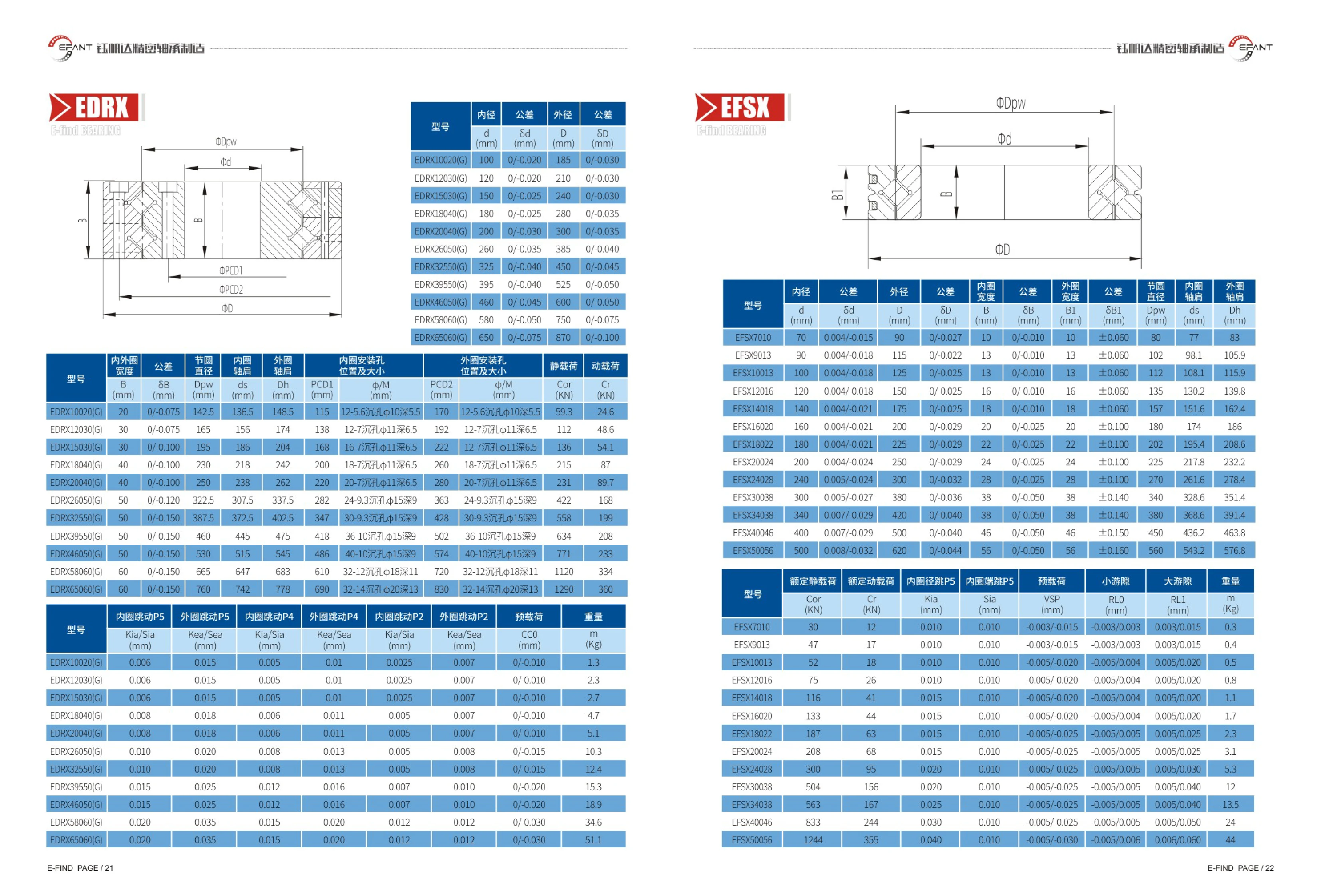
EDRX/EFSX Series Thin-Section Bearings
EDRX/EFSX series thin-section bearings are suitable for precision rotating assemblies with limited installation space, such as robot joints, precision rotary tables, and indexing tables. The EDRX type is available in 15 sizes, with bore diameters of 100~900 mm and outer diameters of 185~1100 mm. Bore tolerances range from 0/-0.020~0/-0.100 mm and outer diameter tolerances from 0/-0.030~0/-0.100 mm. The EFSX type is available in 13 sizes, with bore diameters of 70~500 mm and outer diameters of 90~620 mm. Inner and outer ring widths, pitch circle diameter, and inner and outer ring mounting-hole pitch circle diameters are also specified. Bore tolerance is tightened to 0.004~0.008 mm, width tolerance is 0/-0.010~0/-0.050 mm, and mounting-hole pitch tolerance is ±0.06~±0.16 mm, facilitating direct bolting to adjacent structures. Select the size by matching the bore diameter, outer diameter, and tolerance class to the equipment shaft system's accuracy requirements.
EFSX Series Crossed Roller Bearings
The EFSX series consists of thin-section crossed roller bearings with the same dimensions as the SX0118 series. Rollers are arranged at 90° to one another, allowing the bearings to accommodate radial loads, axial loads in both directions, and overturning moments simultaneously, with high rigidity and rotational accuracy. Model numbers consist of EFSX + bore diameter + width; for example, EFSX7010 denotes a bore diameter of 70mm and a width of 10mm. The catalog covers 13 sizes with bore diameters of 70~500mm, outside diameters of 90~620mm, and widths of 10~56mm. Bore diameters have unilateral negative tolerances starting at 0.004~0.008mm; outside diameter tolerance is 0~-0.044mm, inner ring width tolerance is 0/-0.010~0/-0.050mm, and outer ring width tolerance is ±0.060~±0.160mm. The catalog also specifies the pitch circle diameter and the mounting hole pitch circle dimensions (center distances) for the inner and outer rings, facilitating direct bolt mounting. These bearings are widely used in applications requiring high rigidity and rotational accuracy, including robot joints, precision rotary tables, indexing tables, radar, and medical equipment.
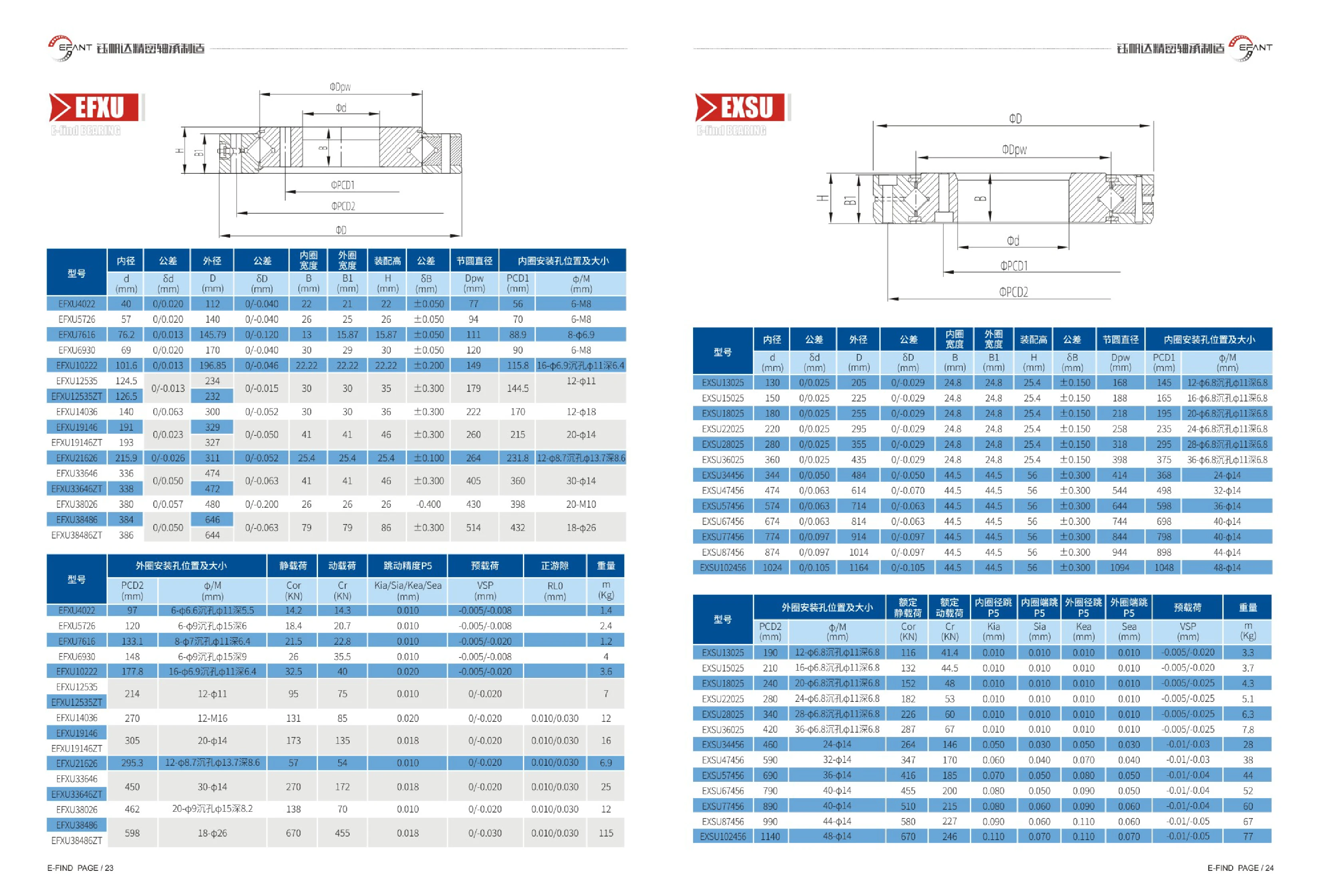
EFXU Series Bearings
The EFXU series consists of slewing bearings (turntable bearings) with mounting holes in the inner ring. The catalog provides a complete range of dimensions and tolerances in tabular form. The series covers inner diameters of 40~384 mm (including the imperial conversions of 76.2, 101.6, and 215.9 mm for EFXU7616, EFXU10222, and EFXU21626, respectively), outer diameters of 112~646 mm, inner ring widths of 13~79 mm, outer ring widths of 15.87~79 mm, and assembly heights of 15.87~86 mm. Each size specifies the inner diameter tolerance (e.g., 0/0.020), outer diameter tolerance (e.g., 0/-0.040), assembly height tolerance (±0.050~±0.300), pitch circle diameter Dpw, inner ring mounting hole pitch circle PCD1, and the type and number of inner ring mounting holes (M8 and M10 threaded holes, φ6.9, φ8.7, φ11, φ14, φ18, and φ26 through holes, and counterbored versions). The ZT model suffix denotes a variant with inner and outer diameters different from the standard model. These bearings are suitable for load-bearing and drive structures in low-speed rotation, oscillation, or positioning applications.
EXSU Series Bearings
EXSU series bearings are listed in the catalog under both EXSU and EFXU designations, covering bore diameters from 40mm to 1024mm. Key dimensions include bore diameter d, outside diameter D and its upper and lower deviations, inner ring width B, outer ring width B1, assembly height H and its tolerance, pitch circle diameter Dpw, and inner ring mounting hole pitch circle PCD1 and hole type (such as 6-M8, 12-φ11, and 20-φ14; some have φ6.9 holes with φ11 counterbores 6.4 deep). Tolerances vary by size: smaller sizes typically have bore tolerances of 0/0.020 and outside diameter tolerances of 0/-0.040; medium and large sizes use wider tolerances of 0/0.063 and 0/-0.063, respectively, while assembly height tolerances increase from ±0.050 to ±0.150 or ±0.300. Models with the ZT suffix have dimensions similar to standard models and are distinguished by their structure or variant. This series is widely used in rotary tables, indexing tables, articulated mechanisms, and other applications requiring high rigidity and rotational accuracy.
EFRT Series Rotary Table Bearings
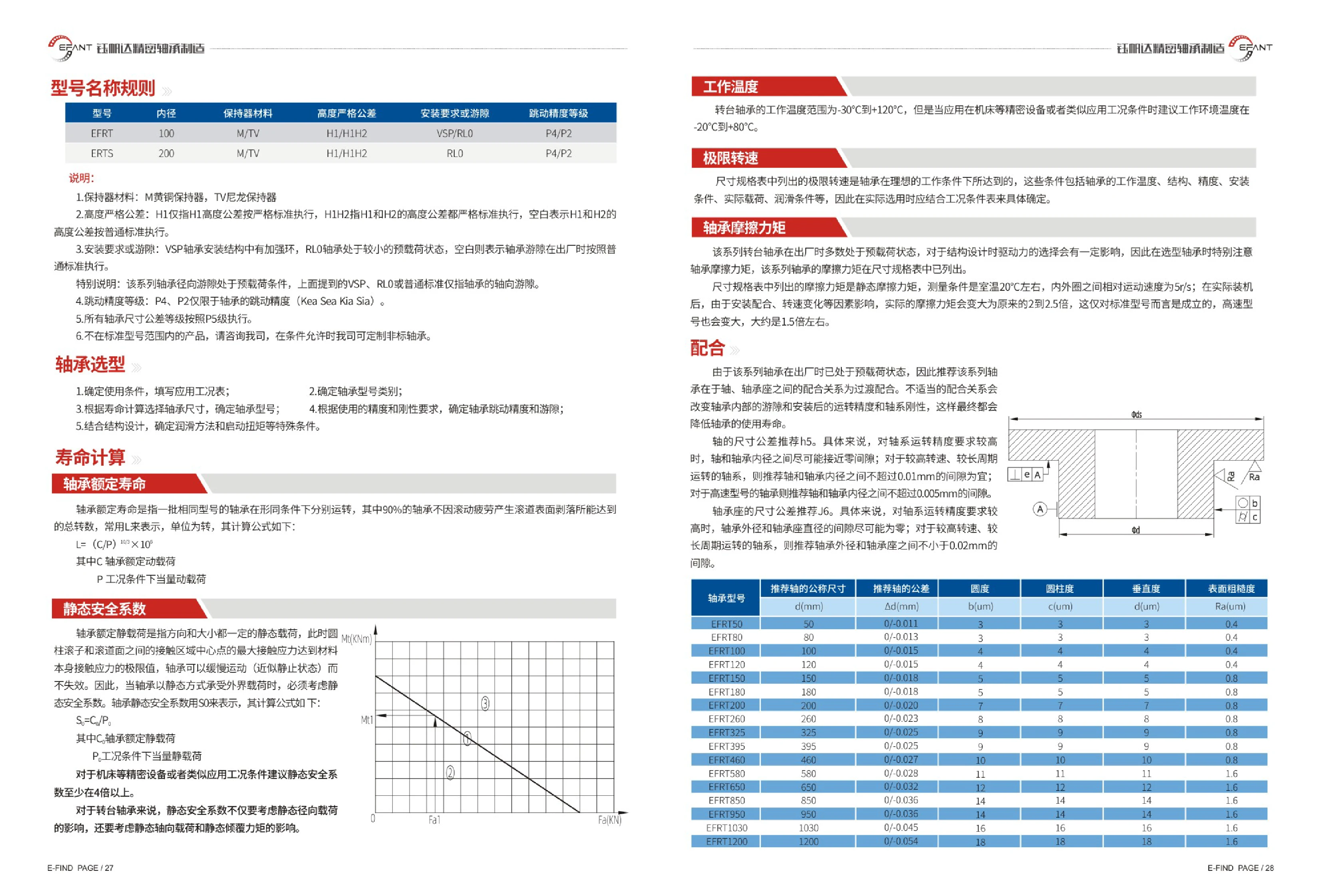
The EFRT series comprises precision rotary table bearings, including the ERTS variant, for applications such as machine tool rotary tables, indexing tables and CNC rotary tables that must simultaneously support axial loads, radial loads and tilting moments. Most bearings are supplied preloaded and use a combined axial and radial cylindrical roller arrangement. A reinforcing ring (VSP) can be added to increase shaft system rigidity. The model designation combines bore diameter, cage material (M for brass cage / TV for nylon cage), tight height tolerance (H1 or H1H2), mounting requirements or clearance (VSP for a reinforcing ring, RL0 for reduced preload, blank for the normal standard), and runout accuracy class (P4 / P2). Dimensional tolerances are uniformly specified to P5. Bore sizes range from 50~1200 mm, with an operating temperature of -30℃~+120℃ (-20℃~+80℃ recommended for precision equipment). An H5 shaft tolerance and J6 housing tolerance are recommended, using a transition fit.
EFRT/ERTS Series Turntable Bearings
EFRT/ERTS series turntable bearings are high-rigidity precision turntable bearings (slewing bearings) with mounting holes in the inner and outer rings. They are used in machine tool rotary tables, indexing tables, vertical-to-horizontal conversion heads, and other applications requiring simultaneous support of axial loads, radial loads, and tilting moments. The bearings are generally supplied preloaded. Transition fits are recommended for the shaft and bearing housing (shaft tolerance h5 and housing tolerance J6). Radial clearance is under preload; VSP, RL0, and the standard version refer only to axial clearance. Brass cages (M) or nylon cages (TV) are available. Height tolerances are available in the tighter H1 or H1H2 grades. Mounting configurations include VSP with a reinforcing ring, RL0 with reduced preload, and the standard version. Runout accuracy is available in P4/P2; dimensional tolerances for all bearings conform to P5. Bore diameters range from 50~1200mm, and the operating temperature is -30℃~+120℃. Actual friction torque is approximately 2~2.5 times the static value in the table (approximately 1.5 times for the high-speed type).