product — Page 74

Aluminum Alloy Load Cell
This series of aluminum alloy load cells features an aluminum alloy sensing element, high accuracy, strong resistance to off-center loads, easy installation, and an IP65 protection rating. It is suitable for liquid filling and weighing, electronic scales, counting scales, electronic balances, and industrial weighing systems, as well as force measurement and weighing in custom equipment. Rated capacities range from 3~30kg, with options including 5kg, 10kg, 20kg, and 50kg. Accuracy classes include C3, C4, and C5. Safe overload is 150%F.S., output sensitivity is approximately 2.0mV/V, the operating temperature range is approximately -20~80℃ (some pages list 20~80℃), and temperature sensitivity drift is approximately 0.01~0.03%F.S./10℃. Parameter tables on different pages contain mixed OCR data, so specifications should be verified against the required capacity and accuracy when selecting a model.

Alloy Steel Load Cell
Made of alloy steel, this load cell offers excellent stability, high accuracy, easy installation and IP65 protection. It is suitable for precision weighing systems such as single- and double-deck electronic platform scales. Capacity: 5-20t; accuracy class: 2.0/3.0±0.002%m/V; output sensitivity: 2.0±0.002mV/V; safe overload: 150%F.S.; ultimate overload: 200%F.S.; zero output: ±1%F.S.; temperature effect: 0.02%F.S./10℃. Dimensions vary by capacity: 235×110×66×32mm (L×L1×L2×H) for 5-8t, 279×133×82.5×67mm for 10t, and 318×153×89×82.5mm for 20t.
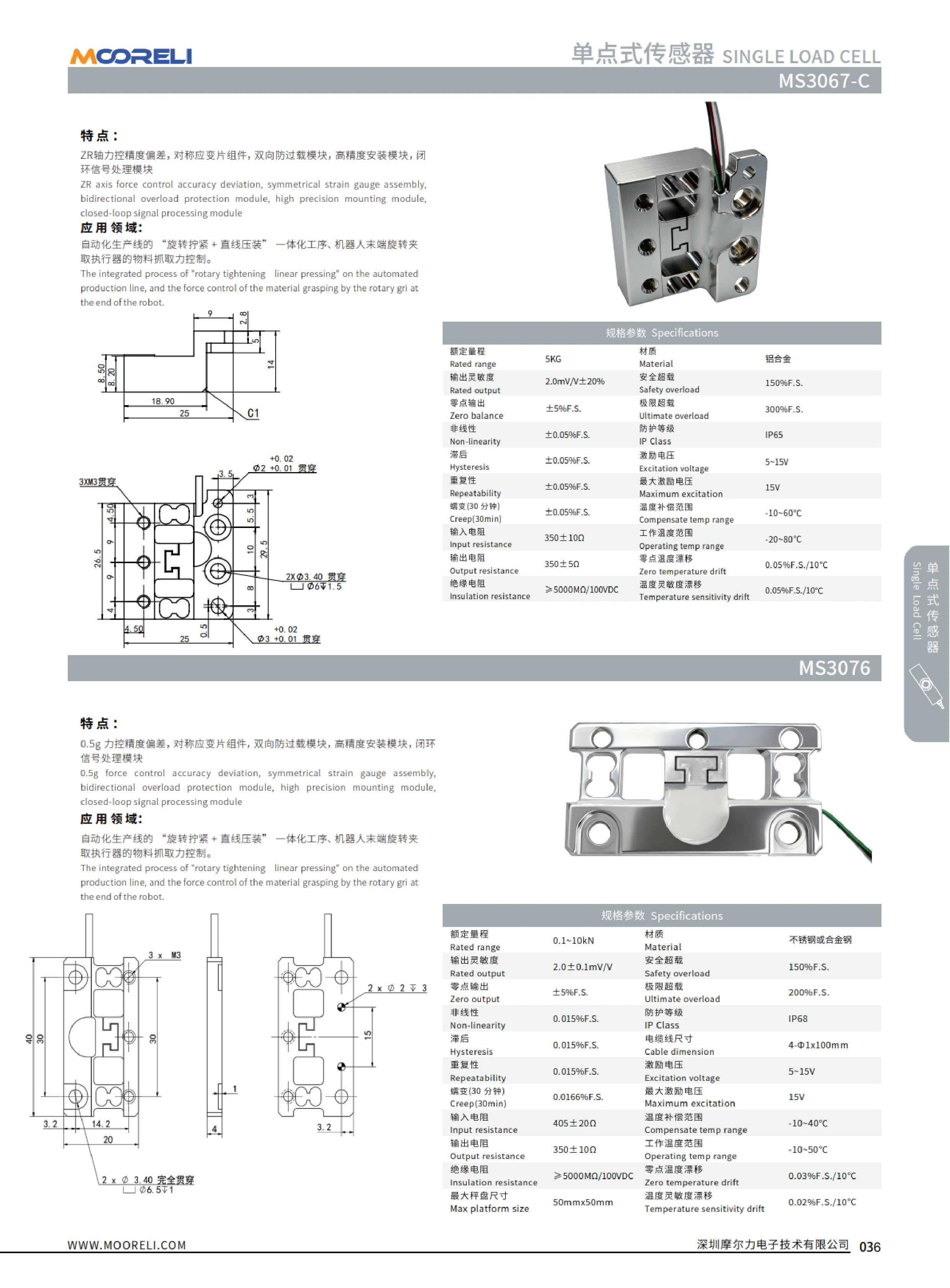
ZR Series Axial Force Control Sensor
The ZR Series axial force control sensor uses a symmetrical strain gauge assembly to detect axial forces, achieving force control accuracy within 0.5g. It integrates bidirectional overload protection, a high-precision mounting module, and a closed-loop signal processing module to protect sensitive elements and maintain stable output under overload conditions in either direction. It has a rated capacity of 5KG, a rated output of 2.0mV/V (±20%), a combined error of approximately ±5%F.S., an output impedance of 350±10Ω, and an IP65 protection rating. It is available for applications across the 0.1~10kN range. The sensor is primarily used in integrated rotary tightening and linear press-fitting processes on automated production lines, as well as for controlling gripping force in robotic rotary grippers during material handling. It provides real-time force feedback for assembly and gripping operations, enabling closed-loop force control.

Weighing Module
The weighing module is a high-precision electronic weighing sensor based on the resistance strain principle. Made of aluminum alloy, it offers high accuracy and easy installation. Multiple modules can be arranged in an array for multi-line weighing, making it suitable for in-line weighing and inspection in automated tablet, dispensing, liquid filling, and capsule production processes. Rated capacities include 4kg, 8kg, 10kg, and 15kg. Output sensitivity is 2.0±20%mV/V, zero output is 2.0±20%mV/V, and nonlinearity, hysteresis, and repeatability are all ±0.01%F.S. Input impedance is approximately 410±10Ω and output impedance is approximately 350±5Ω. Good temperature stability supports fast, reliable multipoint weighing in industrial environments.

Electronic Scale Weighing Module
The electronic scale weighing module provides high-precision weight measurement in industrial automation. It is easy to install and can be arranged in arrays for multi-line weighing. It is suitable for weighing and inspection applications involving tablets, dispensing, liquid filling systems, and capsules. Available rated capacities are 20, 30, 50, and 100 kg. The module is made of aluminum alloy, with a zero balance of ±5%F.S., output sensitivity of 2.0±20%mV/V, and nonlinearity of ±0.01%F.S. Some rows in the catalog table contain OCR duplicates; refer to the product label and original manufacturer drawings for the exact capacity, cable assignments, and mounting dimensions.

Electronic Weighing Module
The electronic weighing module is made of aluminum alloy and is available in two rated capacities: 150g and 300g. It offers high accuracy and easy installation, and can be arranged in arrays for simultaneous weighing across multiple stations and lines. Key electrical specifications include a rated output of 2.0±20%mV/V, zero output of ±5%F.S., nonlinearity of ±0.01%F.S., hysteresis, insulation resistance, and an input impedance of approximately 350±5Ω. Its IP65 protection rating makes it suitable for dusty environments and light water splashes. The modular design simplifies integration into weighing stations on automated equipment. It is widely used for high-precision, low-capacity weighing of tablets and capsules, as well as in dispensing and liquid filling systems. Select the specification according to the rated capacity (150g / 300g), taking installation space and array configuration into account.
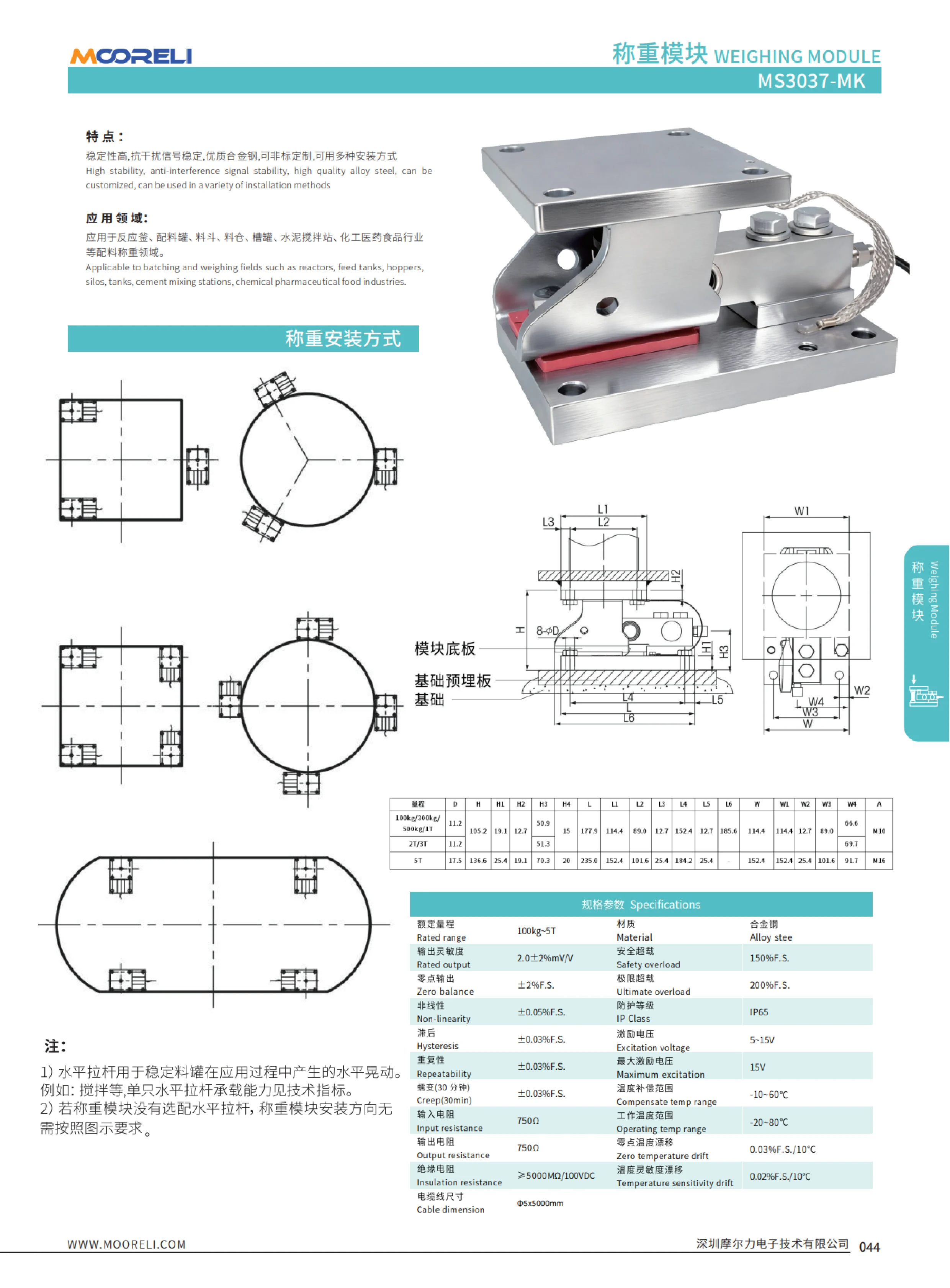
Weigh Module Base Plate
The weigh module base plate (embedded foundation plate) provides a mounting foundation for weigh modules in batching and weighing systems. It secures the module to the floor foundation or equipment support, ensuring vertical loading without lateral interference. Made from high-quality alloy steel, the plate offers high structural strength and helps maintain stable signals by reducing interference. It resists deformation under prolonged loads, ensuring consistent, reliable weighing accuracy. Supporting multiple mounting methods, it is suitable for reactors, batching tanks, hoppers, silos, storage tanks, cement mixing plants, and batching and weighing applications in the chemical, pharmaceutical, and food industries. The catalog lists models by weighing capacity, ranging from 100kg/50kg to higher capacities (2t/3t, 5t, 10t, 20t, 50t, 100t, 200t, 500t, and 1000t). Each model includes overall and mounting-hole dimensions such as D, H, H1~H4, L, L1~L6, W, W1~W4, and A. Custom configurations are also available on request.

Static Torque Sensor
The static torque sensor uses the resistance strain gauge principle. Strain gauges bonded to an elastic beam form a full-bridge circuit. After compensation for temperature, zero point, sensitivity and other electrical parameters, it outputs a differential mV/V analog signal that varies linearly with torque. One end has a shaft, flange or square drive and cannot rotate relative to the other end under load. The sensor is compact, easy to install and use, and offers high accuracy and stable, reliable performance. Rated ranges include 4Nm, 0-100Nm, 1-10kN and 1000-5000Nm, with flange connections at both ends. It has an IP65/IP66 protection rating and an aluminum alloy construction. Both safe and ultimate overload are rated at 120%F.S.; insulation resistance is ≥200MΩ; output sensitivity is 1.0±0.2mV/V; nonlinearity, hysteresis and repeatability are each ±0.1%F.S.; and the temperature compensation range is 20-50K. It is suitable for measuring and controlling static and non-continuously rotating torque, including use in torque testing equipment such as torque wrenches and in on-site testing under operating conditions.

Non-Contact Torque Sensors
Non-contact torque sensors transmit torque signals without physical contact, eliminating wear and extending service life. They are suitable for torque measurement and control in static and intermittent rotation applications. Typical outputs include a 10±5KHZ frequency signal, a 4-20mA current signal, and ±5VDC and ±10VDC voltage signals. They can output torque signals for both forward and reverse rotation, making them easy to integrate with PLCs, data acquisition cards, or display instruments. The shaft assembly is made of stainless steel and supports speeds up to 15000RPM. A keyed-shaft version is also available, with keyed shafts at both ends and selectable speeds up to 1800 rpm. These sensors offer high accuracy and stable, reliable performance. Optional speed output and panel displays provide real-time readings of torque, speed, power, and other parameters. They are widely used in motor testing, drivetrain monitoring, tightening and assembly, and test rigs.
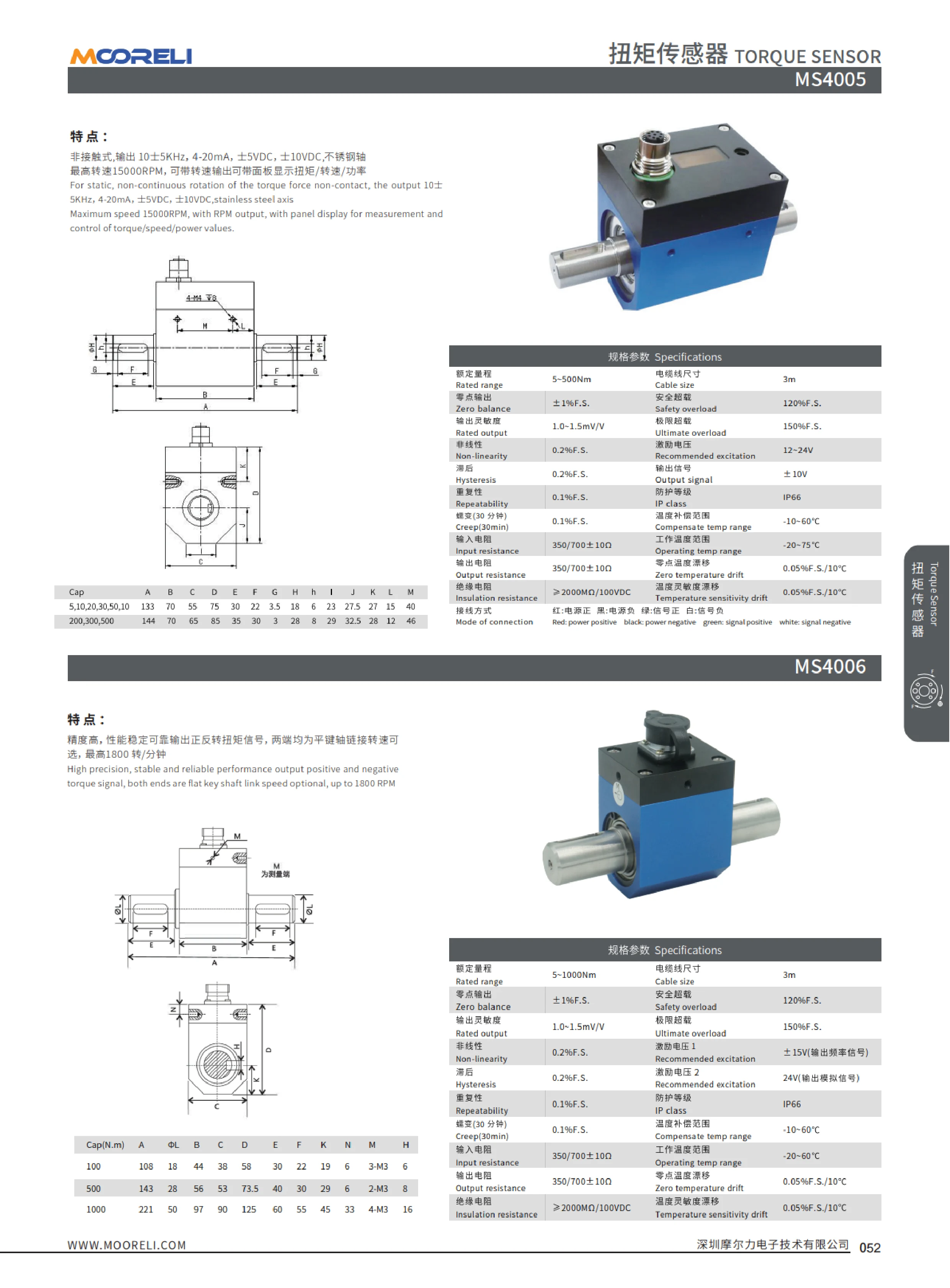
Parallel-Key Shaft Reaction Torque Sensor
This reaction torque sensor features parallel-key shaft connections at both ends and measures torque in both forward and reverse directions. It offers high accuracy and stable, reliable performance, with selectable operating speeds up to 1800 r/min. It is suitable for rotating or static torque measurement applications requiring reaction torque detection. Select the sensor based on rated torque, speed, output signal type, and whether speed output or a panel display is required. No specific model codes are listed on this page.
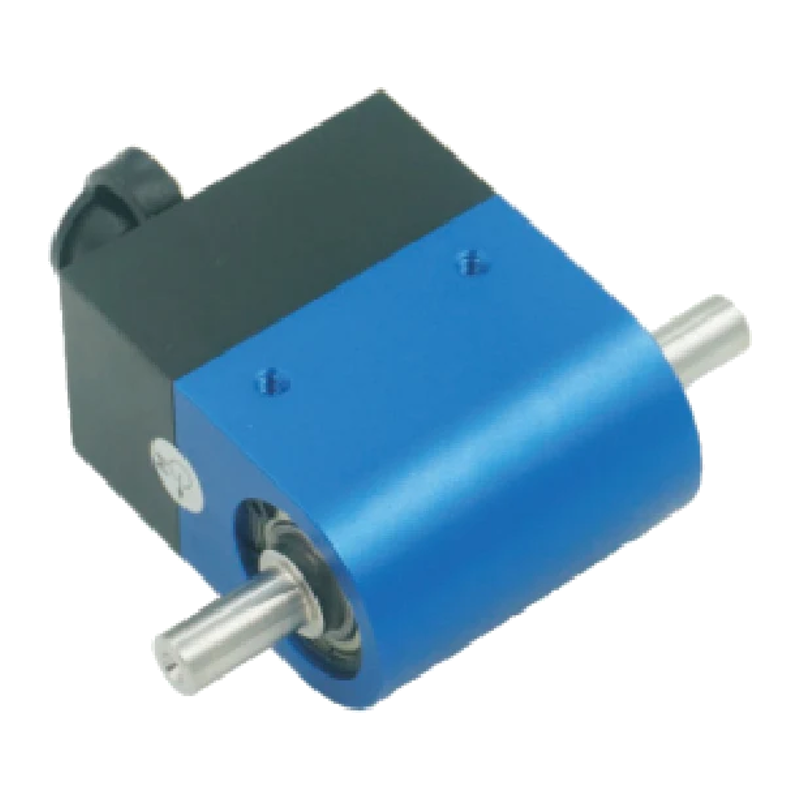
Strain Gauge Torque Sensor
The strain gauge torque sensor combines a resistive strain sensing element with an integrated circuit to measure torque in both directions on a rotating shaft. It offers high accuracy and stable, reliable performance, with keyed connections at both ends for easy installation and use. Rated ranges cover 0.1~5 N·m, with a safe overload capacity of 150% F.S., zero output of ±2% F.S., output sensitivity of 1.0~1.5 mV/V, and a maximum measurement speed of 1800 r/min. It is suitable for rotary drive applications requiring low-range, bidirectional torque measurement.

Torque Sensors
The torque sensor series includes contact and non-contact designs with stainless steel shafts. The elastic shaft is made of 17-4PH stainless steel. The sensors offer high accuracy, stability and interference resistance in a compact, lightweight design that is easy to install. They can operate independently without a secondary instrument, directly outputting a frequency signal or analog output proportional to torque (0-10V, 5V, ±10V, 4-20mA, RS485 or RS232). Forward and reverse torque can be measured continuously without repeated zero adjustment. The non-contact version can provide speed output at speeds up to 8000RPM, with an optional OLED panel displaying torque, speed and power. Ranges extend from 50N to over 1000N, with a combined accuracy of ±1%F.S. Overall dimensions are labeled by segment, including A~M and H1~H3.

6-Axis Force Sensor
A 6-axis force sensor simultaneously measures three force components (Fx, Fy, Fz) and three torque components (Mx, My, Mz) in three-dimensional space. Its one-piece 17-4PH stainless steel construction provides high accuracy, strong resistance to off-axis loads, low interference, and easy installation. Custom specifications are available. Rated capacity: F(x/y/z) 500N, M(x/y/z) 12N·m; combined accuracy: ≤1%F.S.; output sensitivity: ±2mV/V; input resistance: 780±20Ω; output resistance: 700±5Ω; insulation resistance: ≥5000MΩ/100VDC; excitation voltage: 5~12V; operating temperature range: -20~80℃; safe overload: 150%F.S.; ultimate overload: 200%F.S. Applications include robotic arms, multidirectional force control, machine tool cutting force measurement, rehabilitation medical equipment, aircraft testing, force-controlled robotic grinding, assembly, hand-guided teaching, and scientific research. An aviation connector is used for wiring; power supply connections are EXC+ blue and EXC- black, with differential signal outputs for each axis.

3-Axis Force Sensor
The 3-axis force sensor features an integrated construction, high accuracy, strong resistance to off-axis loads, low interference, and easy installation. Custom specifications are available. It is suitable for robotic arms and multidirectional force control, and is widely used in machine-tool cutting, drilling and milling force measurement, rehabilitation medical equipment, aircraft testing, robotic force-controlled grinding, assembly, hand-guided teaching, and scientific research. Sensor coordinate system: The X-axis is perpendicular to the signal cable connector direction; the Y-axis is perpendicular to the X-axis, with its positive direction pointing toward the tool-side pin hole; and the Z-axis runs along the sensor's axial centerline. Positive torque follows the right-hand rule. Key specifications include rated capacity (X/Y/Z:1000KG), output sensitivity (approximately 1.5mV/V), combined accuracy (≤0.1%F.S.), excitation voltage (5~15V), operating temperature range (-20~80℃), safe overload (150%F.S.), and material (alloy steel/stainless steel).

Three-Axis Force Sensor
Made from aluminum alloy, this compact three-axis force sensor is easy to install and features independent internal bridges for each axis. Designed primarily for three-axis force measurement systems, it measures forces along the X, Y and Z axes simultaneously. Rated capacities are 50/100/200/300/500N for X/Y and 50/100/200/300/500/1000N for Z. Zero output is ±2%F.S., output resistance is 350±5Ω, insulation resistance is ≥5000MΩ/50VDC, safe overload is 150%F.S. and ultimate overload is 300%F.S. It is suitable for force feedback and force measurement applications where space is limited.

Cylindrical 3-Axis Force Sensor
The cylindrical 3-axis force sensor features a one-piece stainless steel construction and simultaneously measures force along the X, Y, and Z axes. It offers high accuracy, strong resistance to off-axis loading, low cross-axis interference, and easy installation. Rated capacities are available in several ranges, including 10~100N, 500N, and 50~5000N for the X/Y/Z axes. Specifications include approximately 1.0mV/V output sensitivity, ±2%F.S. zero output, 350±10Ω or 750±10Ω output resistance, ≥5000MΩ/100VDC insulation resistance, 150%F.S. safe overload, -10~40℃ temperature compensation range, -20~75℃ operating temperature range, and 15VDC excitation voltage. A Φ3.2×3000mm cable is included as standard. The sensor is primarily used to detect and control multidirectional forces at robotic arm end effectors and in various automated equipment. Custom capacities and mounting dimensions are available.
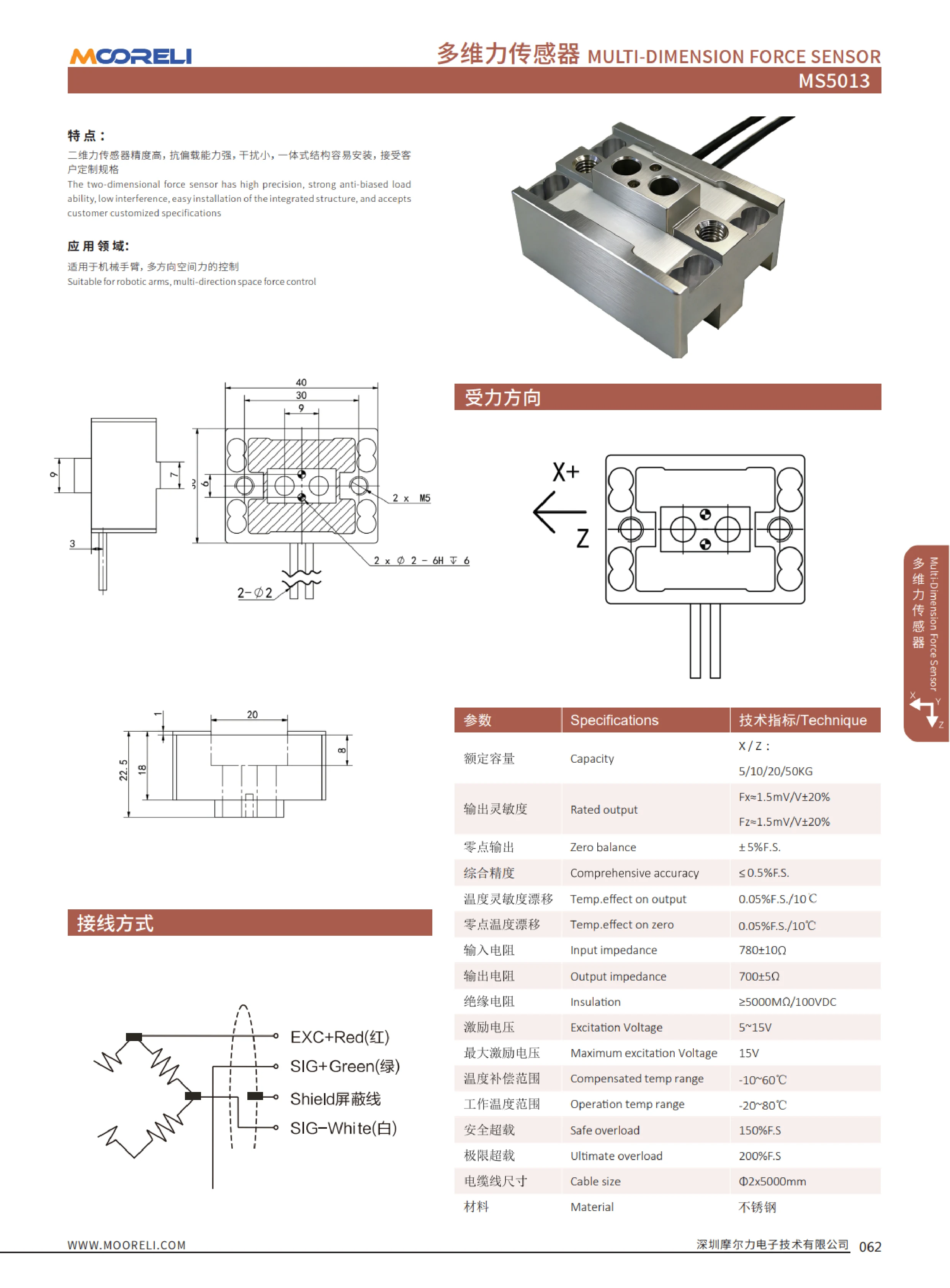
Two-Axis Force Sensor
This two-axis force sensor features a one-piece stainless steel construction, high accuracy, strong resistance to off-center loads, low interference, and easy installation. Specifications can be customized to meet customer requirements. It measures forces in the X and Z directions simultaneously, with rated capacities of 5/10/20/50KG. Output sensitivity is approximately 1.5mV/V±20%, combined accuracy is ≤0.5%F.S., zero output is ±5%F.S., input resistance is 780±10Ω, output resistance is 700±5Ω, insulation resistance is ≥5000MΩ/100VDC, excitation voltage is 5~15V, operating temperature is -20~80℃, safe overload is 150%F.S., and ultimate overload is 200%F.S. A Φ2×5000mm cable is supplied as standard. It is suitable for robotic arms and multidirectional force control applications.

Multi-Axis Force Sensor
This multi-axis force sensor (two-axis force sensor) simultaneously measures rotational torque and pressure. It offers high accuracy, strong resistance to off-center loads, low interference, a compact design, and easy installation. It is suitable for robotic arms and applications requiring multidirectional force control, and can be customized to customer specifications. Rated capacity: Fz:50N, Mx:0.5N·m; output sensitivity: approximately 1.0~1.5mV/V; combined accuracy: ≤0.1%F.S.; input/output resistance: 780kΩ/700kΩ; insulation resistance: ≥5000MΩ/100VDC; excitation voltage: 5~15V; operating temperature: -20~80℃; safe overload: 150%F.S.; ultimate overload: 200%F.S.; cable: 2-Φ2×3000mm; material: aluminum alloy.
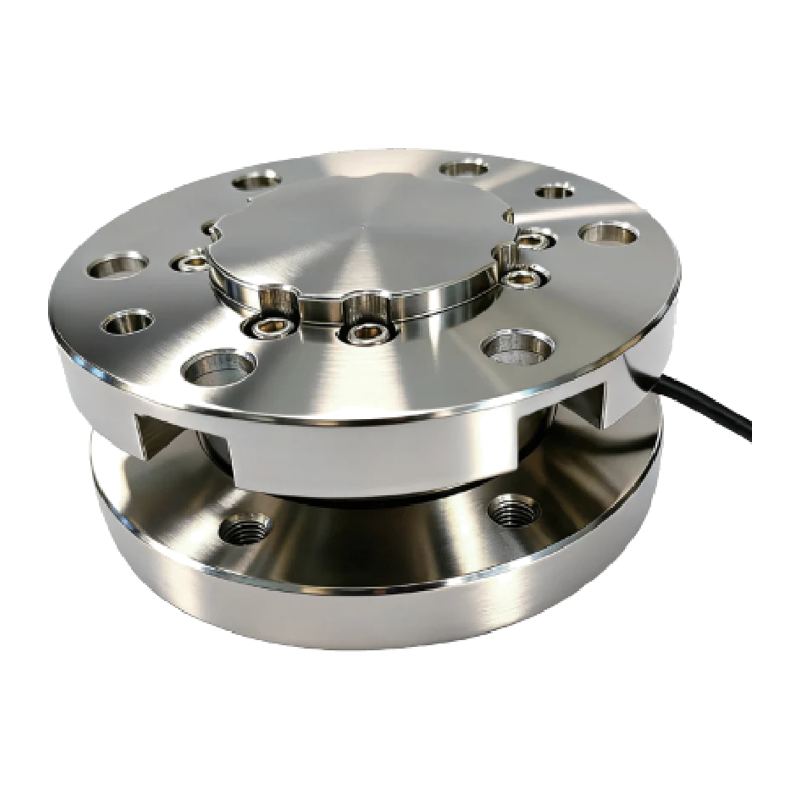
Cylindrical 3-Axis Force Sensor
The cylindrical 3-axis force sensor features a one-piece stainless steel elastic element and can simultaneously measure forces in three directions. It offers high accuracy, strong resistance to off-axis loads, and low cross-channel interference. Its integrated design simplifies installation, and specifications can be customized to meet customer requirements. It is suitable for force sensing at the end of robotic arms and for multidirectional force control and feedback. Key specifications: rated capacity options of 100KG and 200KG; output sensitivity of 1.8mV/V±20%; temperature sensitivity drift and zero temperature drift both 0.05%F.S./10℃; input resistance 780±10Ω, output resistance 700±5Ω, insulation resistance ≥5000MΩ/100VDC; excitation voltage 5~15V, maximum excitation voltage 15V; compensated temperature range -10~60℃, operating temperature range -20~80℃; safe overload 150%F.S., ultimate overload 200%F.S.; cable dimensions Φ5×3000mm.

High-Precision Cantilever Tension Sensor
The high-precision cantilever tension sensor is made of all-steel stainless steel, 17-4 stainless steel, or aluminum alloy. It has an IP66 protection rating, a compact design, and is easy to install. Paired with an idler roller shaft, or fitted with a split clamp, movable pulley, and shaft, it provides stable tension measurement for fabrics, tapes, wires, strips, and similar materials. The measurement range is 1N~10N, with an accuracy class of 0.1%F.S. Rated output, zero output, hysteresis, and the effects of temperature on zero and sensitivity are all controlled within ±2%F.S. The sensor offers strong overload resistance, withstanding loads up to 5 times its rated range. It is widely used in automated tension measurement equipment, the weaving industry, and wire tension monitoring and control systems. It is also suitable for precision force measurement applications such as medical machinery and electronic component lead bending tests.

Tension Sensors
Resistance strain gauge tension sensors are used in automated tension measurement and control systems for in-line monitoring in industries such as medical machinery, presses, weaving, wire, and fabric tapes. Designs include cantilever, double-nut ring, and three-pulley types. Housing materials include aluminum alloy, 1/4 stainless steel, and alloy steel. Aluminum alloy models are compact, highly accurate, and easy to install. Stainless steel and alloy steel models offer compact construction, high overall accuracy, corrosion and oil resistance, and good long-term stability. Measuring ranges span 10N~2000N, with an accuracy class of approximately ±0.1%F.S. and a rated output of 2.0±0.2mV/V (2.0mV/V±20% for some models). Nonlinearity, repeatability, and hysteresis can reach ±0.05%F.S. Input/output resistance is approximately 410Ω, operating temperature is 20~80℃, and protection rating is IP65 or IP66.

Double-Nut Ring Tension Sensor
Made of 17-4 stainless steel, the double-nut ring tension sensor is compact and highly accurate. Its double-nut ring design makes it easy to install and use, and it has an IP56 protection rating. It is suitable for automated medical machinery, textile manufacturing, and tension measurement and control systems for wire, fabric tape, and similar materials. Its measurement range is 10N-100N, with an accuracy of 0.05%F.S., a rated output of 2.0±0.2mV/V, and a zero output of ±2%F.S. It is ideal for space-constrained applications requiring stable tension feedback.

Tension Measurement Sensor
This tension measurement sensor features a modular, highly integrated design with high accuracy, fast response, and a full range of interfaces. It includes built-in overload protection and a 5-digit display for convenient on-site readings and setup. Available measurement ranges are 200G, 500G, 1KG, 2KG, and 5KG, accommodating tension measurement for different wire diameters and materials. Overall accuracy is 0.1%F.S., nonlinearity is ≤0.2%mV/V, repeatability is ±0.2%mV/V, and safe overload is 150%F.S. The sensor operates on a 12~30DCV power supply and supports 0~5V / 0~10V / ±5V / ±10V analog outputs and RS485 communication. Its 100~14kHz acquisition frequency provides high-speed sampling for winding applications. Operating temperature is -10~60℃, and the protection rating is IP65. It is widely used in automated tension measurement equipment, copper wire and fiber tension control on high-speed cable machines, cable manufacturing for electronic components, and tension measurement and control systems in the textile industry.

Flat-Plate Force Sensor
The flat-plate force sensor is made of alloy steel, with stainless steel used for certain models. Its thin, flat design is compact and visually appealing. With an overall IP65 protection rating, it provides reliable long-term operation in dusty, oily, and humid industrial environments. It monitors process force in equipment such as press-fit machines for new energy applications and electric vehicle motor assembly. It is also suitable for force analysis on industrial presses and press-fit force measurement in precision assembly equipment for electronic components. Key specifications include rated capacity, zero output, output linearity and nonlinearity (±0.2%F.S.), repeatability, maximum excitation voltage (15V), input impedance, output impedance, insulation resistance, cable specifications, and operating temperature range. Models can be selected to suit different press-fit tonnages and installation spaces.

Grip Force Sensor
This compact, low-profile sensor features an attractive design and stainless steel construction. It is available in five rated ranges: 0-50N, 0-100N, 0-300N, 0-500N, and 0-1000N. It offers an output sensitivity of 2.0mV/V±20%, nonlinearity of ±0.2%F.S., a safe overload rating of 150%F.S., IP65 protection, a compensated temperature range of -10~60℃, and an operating temperature range of -20~80℃. It is suitable for force analysis in industrial presses and precision electronic component assembly equipment, as well as grip and clamping force analysis in medical rehabilitation equipment and robotic motion systems.
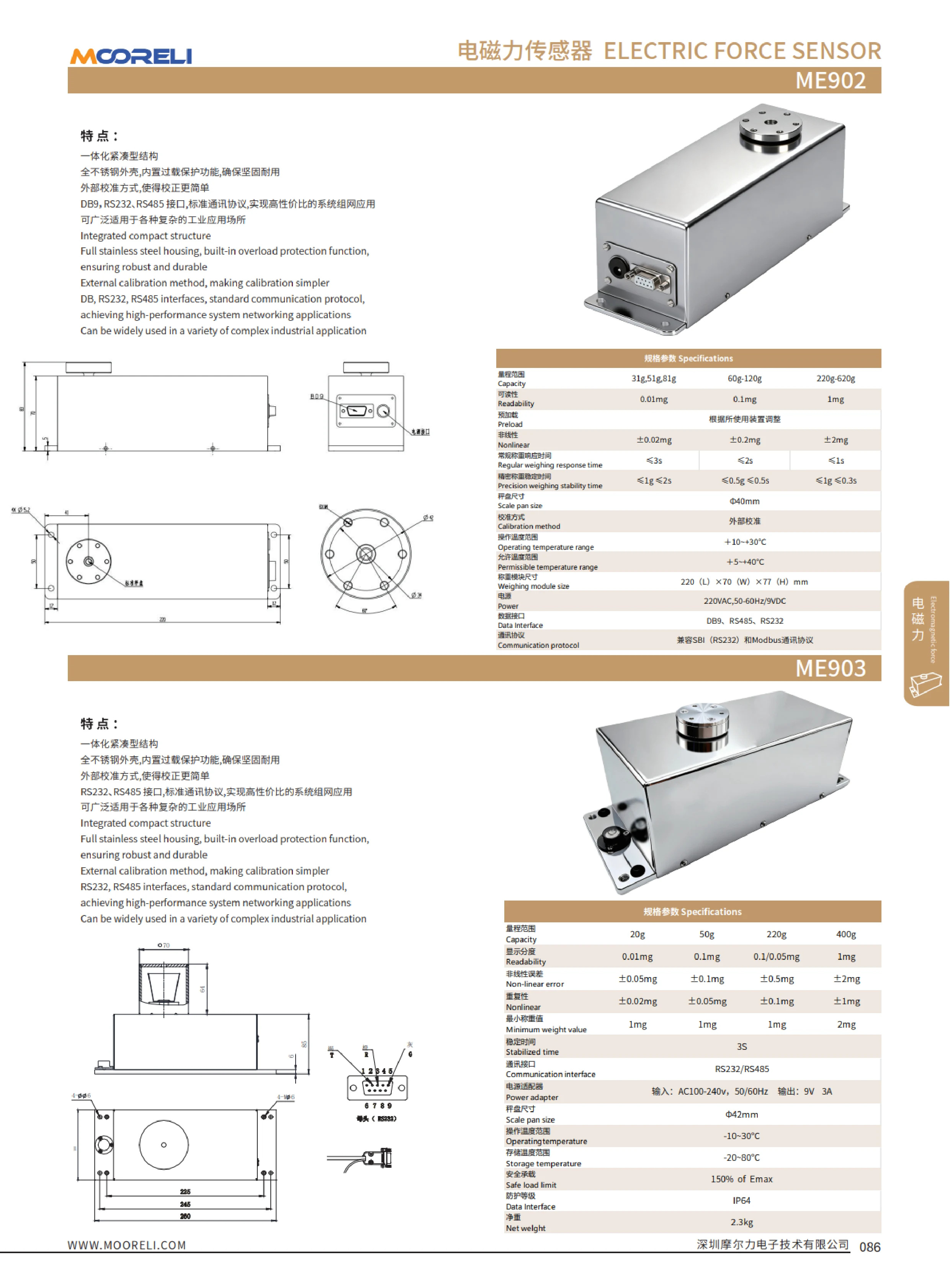
Electronic Analytical Balance
The electronic analytical balance features a compact, integrated design and a durable all-stainless-steel housing with built-in overload protection, making it suitable for demanding industrial and laboratory environments. External calibration is quick and easy. RS232 and RS485 data interfaces support the SBI (RS232) and Modbus standard communication protocols, enabling cost-effective system networking and data acquisition. Capacities of 20g, 50g, 220g and 400g have corresponding readability values of 0.01mg, 0.1mg, 0.1mg and 1mg, meeting both micro and routine weighing needs. The balance is suitable for precision weighing in pharmaceutical, chemical, food and precious metal testing applications, as well as teaching and research.

Compact High-Precision, High-Speed Analog Amplifier
This series of compact, high-precision, high-speed analog amplifiers is designed to amplify and condition weak millivolt signals from strain-gauge sensors, such as load cells and torque sensors. With an input range of 0.5-10mV/V and high load capacity, the amplifiers use genuine imported electronic components to deliver a frequency response of up to 30KHz and an overall accuracy of ±0.019% F.S. Multiple voltage and current outputs are supported, including 0-5V, 0~±10V, and ±5V, making the series suitable for high-speed dynamic measurement and automated control loops in industrial environments.
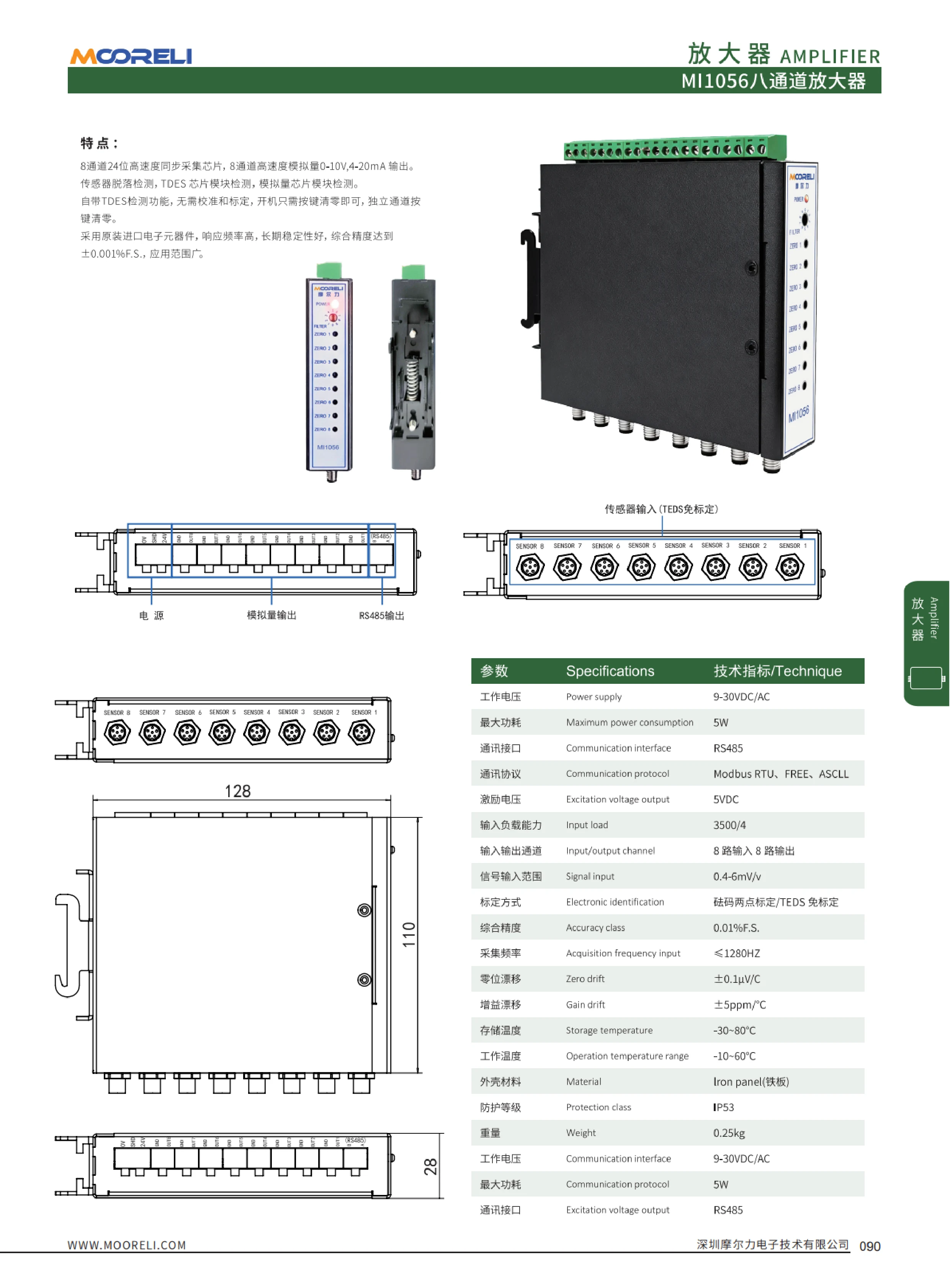
8-Channel High-Speed Synchronous Acquisition Module
This 8-channel high-speed synchronous acquisition module uses an 8-channel, 4-bit high-speed synchronous acquisition chip to simultaneously acquire data from eight sensors and provide eight channels of high-speed analog output (0-10V / 4-20mA). It has built-in TDEs chip and analog chip module testing capabilities. No calibration is required; setup can be completed with a button press at startup, and individual channels can be calibrated and zeroed. Made with original imported electronic components, the module offers a high response frequency, excellent long-term stability, and overall accuracy of up to ±0.001%FS. It is suitable for sensor data testing, TDEs chip module testing, and analog chip module testing. Supported power supplies are +5V/3.3V/5V. Analog output uses RS485 communication, and sensor input uses a calibration-free TDEs method.
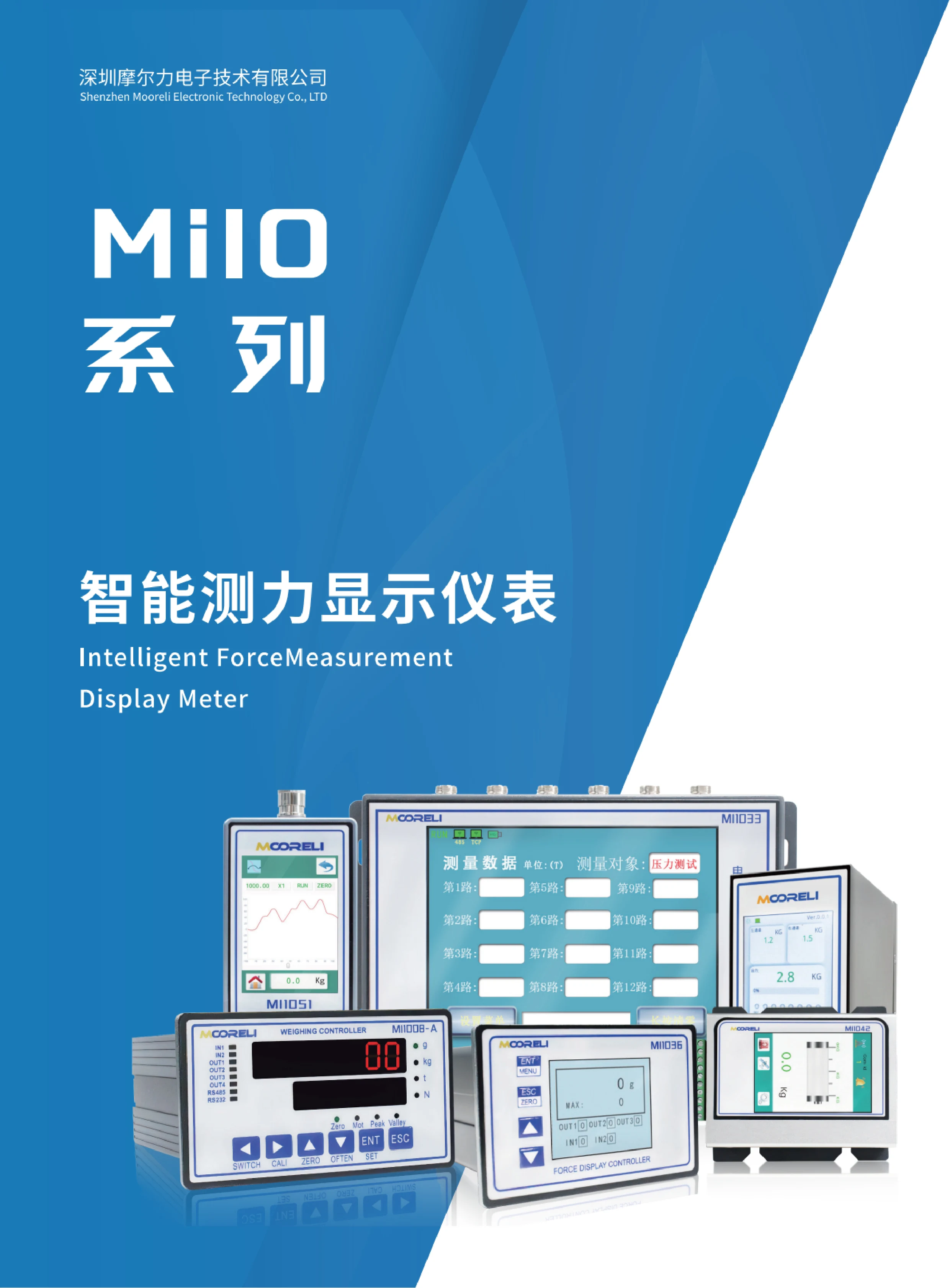
MiiO Series Intelligent Force Measurement Display Meter
The MiiO Series Intelligent Force Measurement Display Meter from Shenzhen Moerli Electronic Technology Co., Ltd. is an intelligent instrument for displaying force and pressure measurement data. The catalog shows a measurement data recording interface for pressure testing, with readings in kg organized by channel (channel 1 and channels 5 through 9). Multiple channels of force data can be viewed simultaneously, making it easier to monitor and evaluate force during press-fitting, assembly, inspection, and other processes. The instrument is an intelligent display terminal typically used with force sensors. Refer to the manufacturer's detailed specification sheet for the measurement range, number of channels, sampling rate, communication interfaces, and power requirements.
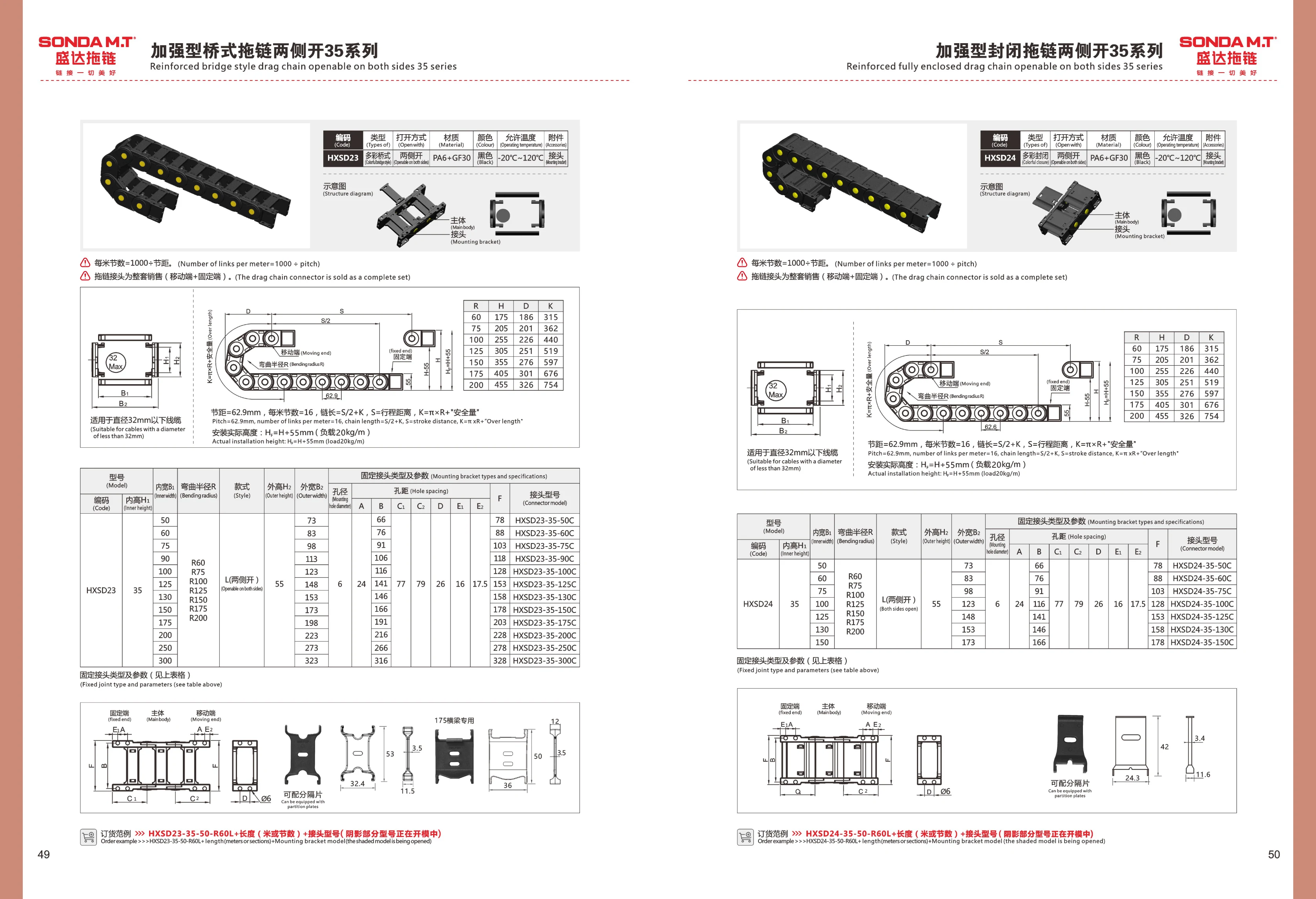
Reinforced Bridge-Type Cable Drag Chain, Side-Opening on Both Sides, Series 35
The Reinforced Bridge-Type Cable Drag Chain, Side-Opening on Both Sides, Series 35 features a multi-crossbar design with both sides opening for quick installation and maintenance of cables, air hoses, and other lines. It is made of black nylon PA6 reinforced with 30% glass fiber (PA6+G30) and operates at temperatures from -20°C to 120°C. The product comes with dedicated connectors for both the moving and fixed ends and is sold as a complete set. The pitch determines the number of links per meter (links per meter = 1000 ÷ pitch). The bending radius ranges from 50 mm to 6750 mm, and inner width B1 is available in various sizes (50 mm–6750 mm? Should the actual inner width be fixed?). It is suitable for protecting cables in a wide range of automated equipment.

Digital Display Meters
The digital display meter acquires and displays sensor or measurement signals, supports 24-bit A/D conversion, and features adaptive communication at baud rates of 4800~24000. RS485 communication and analog output are optional. Automatic zeroing is activated by a soft-touch button, making it suitable for digital display of field measurements, displacement, or process variables. The rated operating voltage is 24VDC±30%, maximum power consumption is 3W, the display has 5 digits, and overall accuracy is 0.01%F.S. Current documentation for this series does not specify a model coding scheme; selection should be based on communication, output, and display requirements.

Weighing Indicator
The weighing indicator features a 3.5-inch TFT true-color display, a hot-swappable USB TypeC data interface, and 24-bit A/D acquisition. It can switch between units including g, kg, N, KN, and MN. It provides an audible buzzer alarm and can display peak, real-time, valley, and comparison values on the same screen. A soft-touch key enables automatic zeroing. Communication options include RS485 or RS232, with optional analog output. The indicator also provides 2D input and 2D output, peak/valley hold, up to 1,000,000 display divisions, and automatic baud rate adaptation from 4800-230400. The operating voltage is 24VDC±30%, with a 12-30VDC/AC model also available. Maximum power consumption is 3~5W, the display has 6 digits, and overall accuracy is 0.01%F.S. Calibration is digital or magnetic-code based. Zero drift is ±0.1μV/℃ and gain drift is ±5ppm/℃. Suitable for load cell signal acquisition, industrial weighing, and batching control.

EtherCAT Weighing Transmitter
The EtherCAT weighing transmitter converts load cell signals into digital weight values and connects to automation control systems via the EtherCAT bus. It features peak/valley hold, supports up to 1,000,000 display divisions, and automatically adapts to baud rates from 4800 to 230400. Powered by 24VDC±30%, it provides 2 digital inputs and 5 transistor outputs. It is DIN rail mounted, rated IP65, and suitable for industrial weighing, batching, packaging, and checkweighing. The specification table on the original page contains numerous duplicate or missing entries; some electrical specifications remain to be provided.

3.5-inch Capacitive Touchscreen Weighing Display Controller
This 3.5-inch capacitive touchscreen weighing display controller provides data display and control for industrial weighing and batching systems. Its intuitive touchscreen interface allows parameters to be set without external buttons. An RS485 bus interface, one digital input and 10 digital outputs enable integration with PLCs, host computers or external actuators for weighing signal acquisition, evaluation and sorting control. It supports both digital calibration and calibration with test weights, allowing quick span calibration without weights or greater on-site accuracy using standard weights. The catalog lists specifications such as operating voltage, unit weight, maximum power consumption, communication interface and calibration methods. Refer to the product nameplate and accompanying manual for specific values. It is suitable for display and control in applications such as electronic scales, batching scales, checkweighing and sorting.

Four-Channel Force Indicator
The four-channel force indicator is an industrial instrument for acquiring, switching between, and displaying signals from force and weighing sensors. It supports four inputs, allowing users to switch between channels and view force readings in real time. It features both RS485 and RS232 communication interfaces and supports calibration-free TEDS operation, automatically reading sensor electronic data sheet parameters to reduce on-site calibration work. The baud rate is automatically adjusted from 4800~230400. The unit operates on 24VDC±30%, with rated power consumption of 3W, maximum power consumption of 2W, and a weight of approximately 0.28kg. Its operating temperature is -10~60℃, storage temperature is -30~80℃, and relative humidity is ≤85%RH. It is suitable for multichannel force monitoring in testing machines, force measurement platforms, batching and weighing systems, and similar applications.
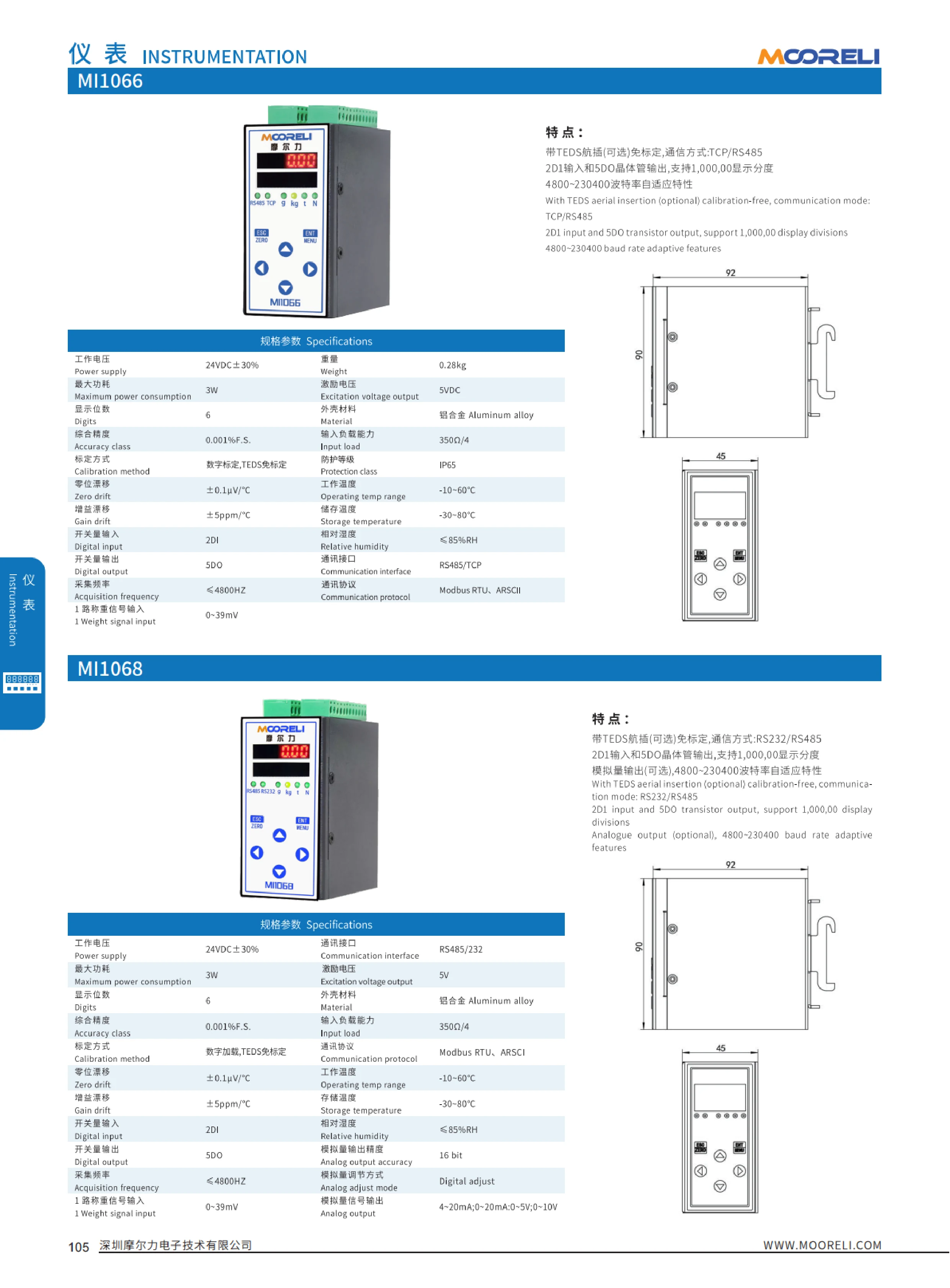
Weighing Indicator and Controller
The weighing indicator and controller acquires, displays, and provides logic control for industrial weighing signals. It features a 6-digit display with a resolution of up to 1,000,000 divisions. It has 2 digital inputs and 5 transistor digital outputs, with an optional analog output. Communication is supported via RS232/RS485 (TCP/RS485 is also specified in the Chinese text), with an adaptive baud rate of 4800–230400. An optional TEDS interface enables calibration-free operation. Applications include load cell connectivity, weight monitoring, batching, and integration with automated equipment. The operating voltage is 24VDC ±30%, and maximum power consumption is approximately 3W (6W is also specified).

Force Display Controller
The force display controller acquires and displays signals from strain-gauge weighing and force sensors on site. It supports RS485/232 communication with automatic baud rate detection from 4800 to 230400, and can be integrated with a host computer or PLC to form a weighing or force measurement system. Its TEDS feature automatically identifies the range and parameters of a TEDS-compatible sensor, eliminating the need for manual calibration. Optional analog output enables easy connection to devices such as variable frequency drives and recorders, while a soft-touch panel button provides one-touch automatic zeroing. Multi-channel switching and force display allow one instrument to monitor multiple stations in turn. Key specifications include zero drift of ±0.1μV/℃, temperature drift of ±5ppm/℃, and overall accuracy of approximately ±0.28%. It is suitable for a wide range of force measurement and weighing applications.
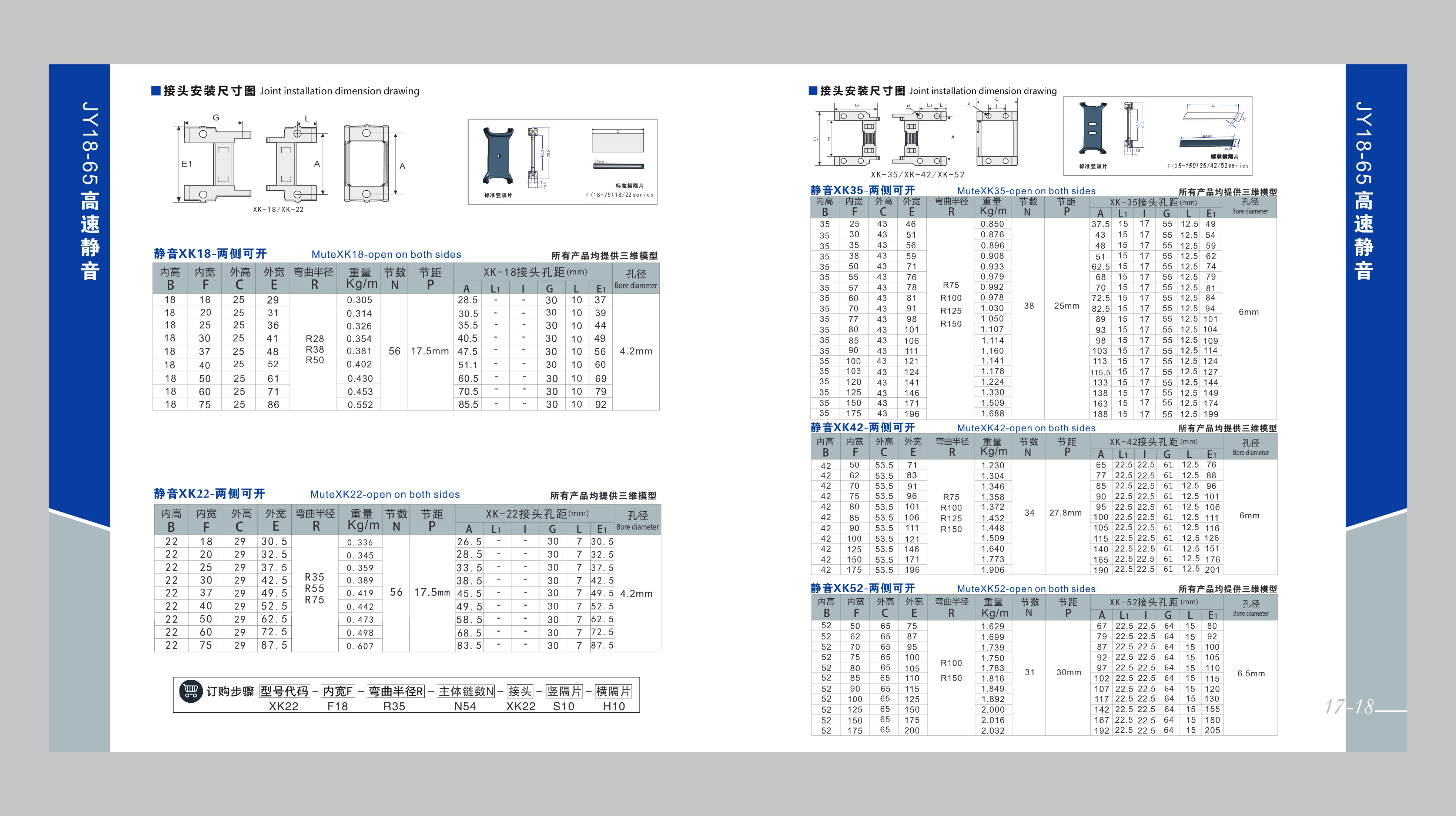
XK Series Low-Noise Cable Chains
XK series low-noise cable chains are made of engineering plastic and support, guide and protect cables and pneumatic lines in machine tools, automated equipment, robots and other applications. They offer quiet operation and low wear. The covers open from both sides for easy cable installation, maintenance and replacement. Taking the XK18 as an example, it has an inner height of 18mm and an outer height of 25mm, with inner widths from 18~75mm and outer widths from 29~86mm. Bend radius options include R28, R38 and R50. The connector hole diameter is 30mm, the weight is 0.305~0.552 kg/m, and the chain has 56 links. Pitch varies with inner width and is approximately the inner width plus 10.5mm (for example, a pitch of 28.5 for an inner width of 18, and 85.5 for an inner width of 75). Larger sizes such as XK22 and XK35 are also available in the series, with connector hole spacing specified for selection based on travel length and bend radius.
XK Series Low-Noise Cable Carrier
The XK series low-noise cable carrier is molded from engineering plastic for smooth, quiet operation. It protects cables on machine tools, automated equipment, robots and more. The XK18 has an inner height of 18mm and an outer height of 25mm, with inner widths from 18~75mm (outer widths 29~86mm). Available bending radii are R28/R38/R50, with a pitch of 28.5~85.5mm, a weight of 0.305~0.552 kg/m and a connector mounting hole diameter of 30mm. Links open on both sides for easy cable installation and maintenance, and the number of links can be customized to suit the travel distance. Larger sizes, including XK22 and XK35, are also available. Specify the inner width, bending radius and length when ordering.
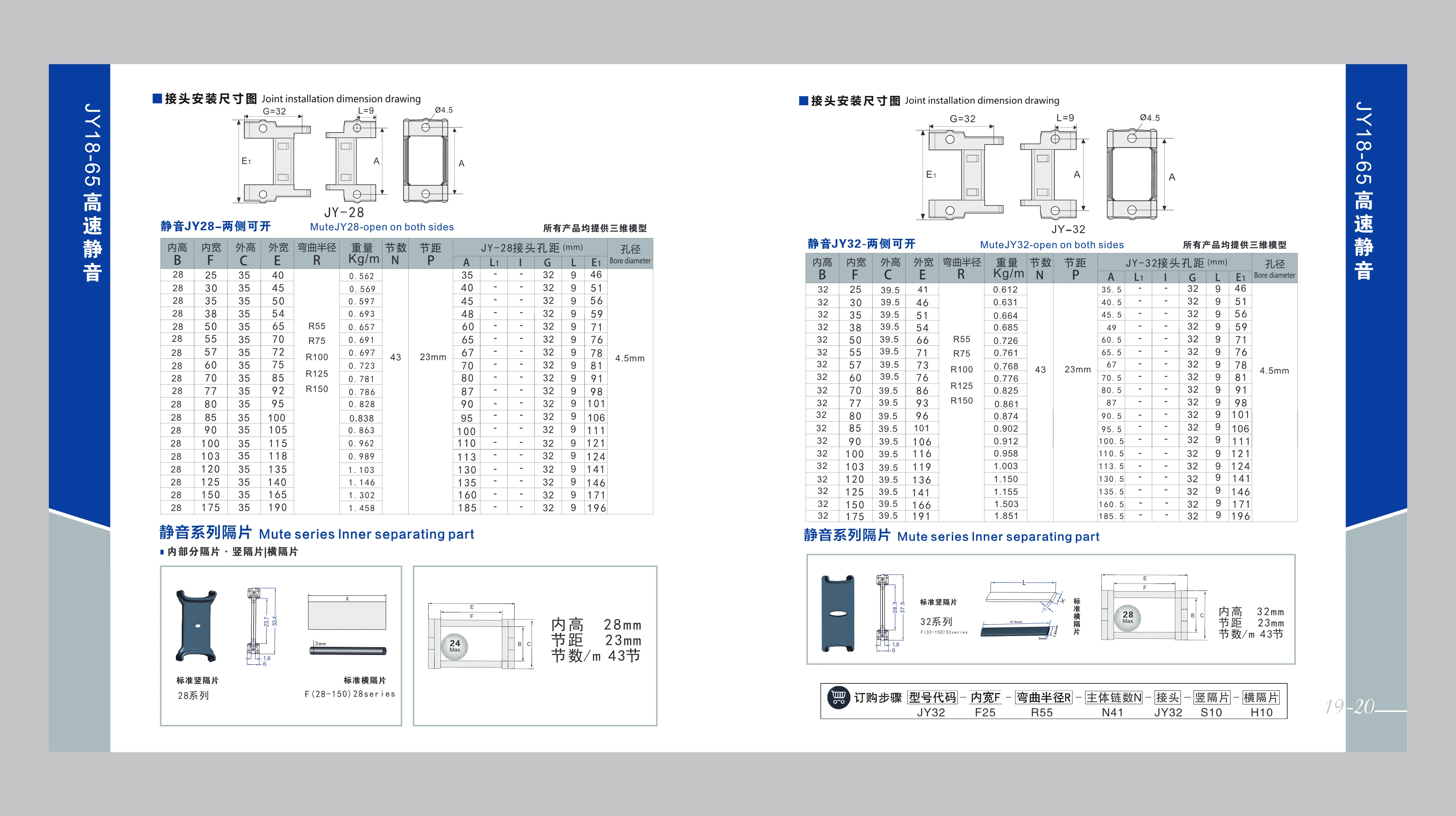
Silent Series Separators
Silent series separators (internal separators) are components installed inside silent engineering plastic cable carriers to separate power cables, signal cables, pneumatic tubes, hydraulic hoses and other lines within the same cavity. They prevent friction, tangling and wear during operation while complementing the low-noise design to reduce noise during high-speed reciprocating motion. Separators can be inserted at any pitch position as needed, allowing the inner width F to be divided into multiple compartments. When selecting separators, ensure compatibility with the cable carrier's inner height B, inner width F, outer height C, outer width E, bend radius R, pitch P, number of links N and JY-28 mounting bracket hole spacing. They are generally made of wear-resistant engineering plastics such as PA66 and offer self-lubricating, wear-resistant and impact-resistant properties. They are suitable for high-speed, low-noise applications involving machine tools, robots, automated production lines and material handling systems.
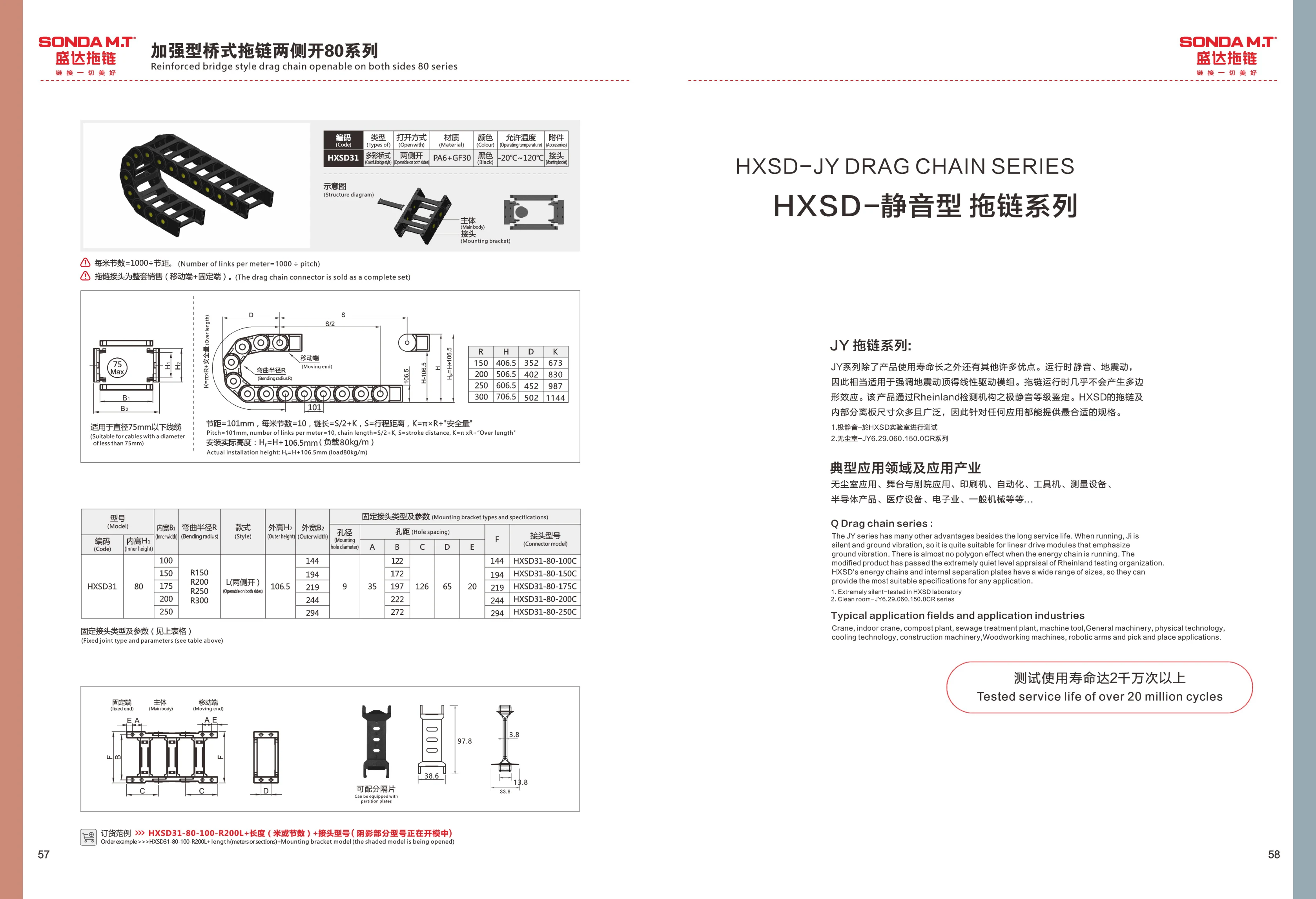
HXSD Silent Cable Carrier Series
The JY Series is HXSD’s silent cable carrier series. It features ultra-quiet operation and low vibration, making it ideal for linear drive modules sensitive to vibration. The cable carrier runs with virtually no polygonal effect and has been certified for ultra-quiet performance by Rheinland. A variety of sizes and separator options are available to meet the needs of different industries. Typical applications include cleanrooms, stages, printing presses, automation systems, machine tools, measuring equipment, semiconductors, and medical equipment. Service life exceeds 20 million cycles.
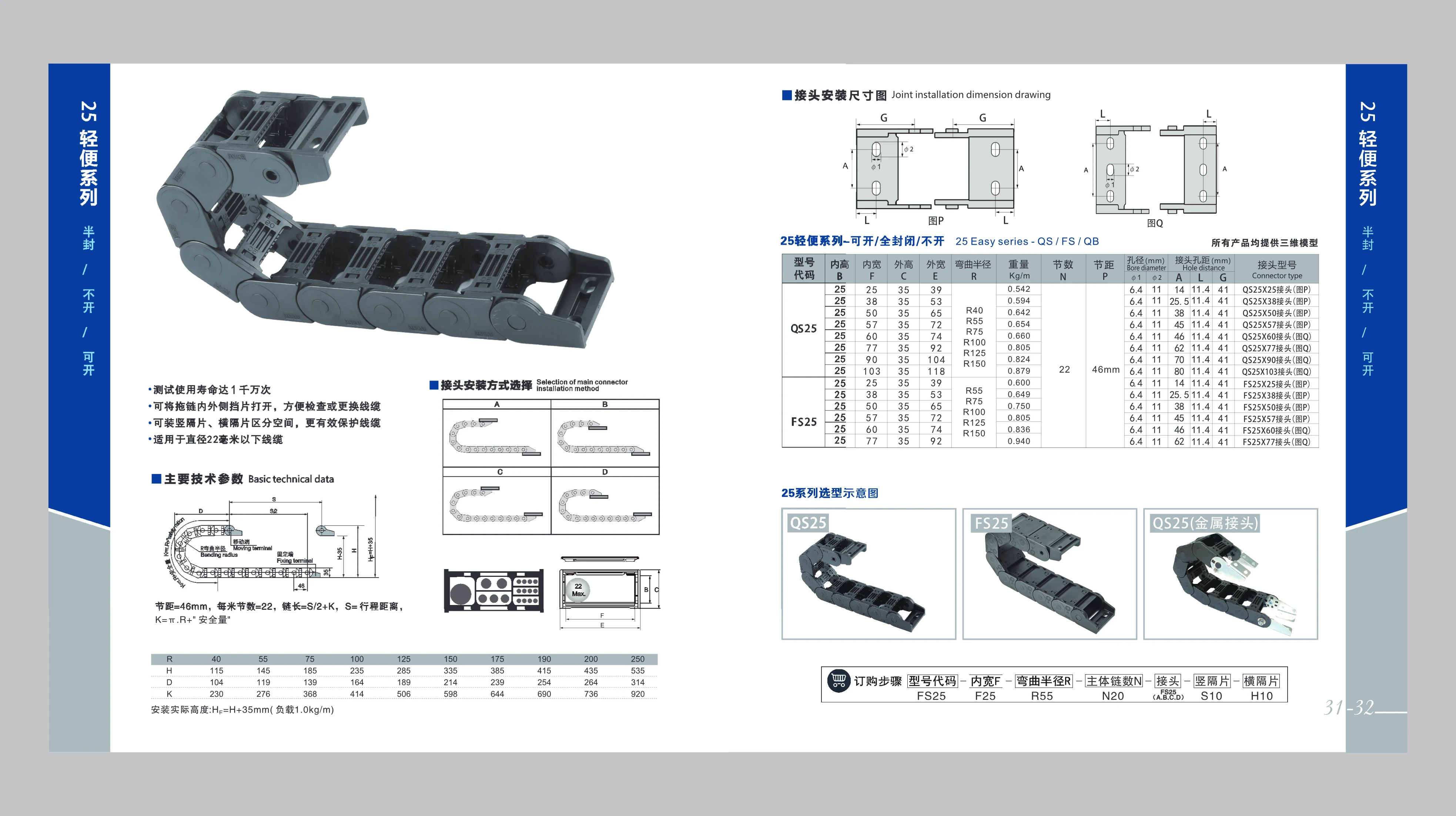
25 Lightweight Series Cable Chains (QS/FS/QB)
The 25 lightweight series cable chains are available in three configurations: QS (openable/semi-enclosed), FS (fully enclosed), and QB (non-openable). Made with engineering plastic links, they guide and protect cables less than 22mm in diameter. Tested service life reaches 10 million cycles. The inner and outer crossbars can be opened for easy cable inspection or replacement; vertical and horizontal separators can be added to divide the interior. Pitch is 46mm, with 22 links per meter. Chain length is calculated as S/2+K (S is the travel, K=πR+safety allowance). Bend radii range from R40 to R250, and the actual installation height is HE=H+35mm (load 1.0kg/m). This page lists the QS25 series, with inner widths of 25–103mm, an outer height of 35mm, and outer widths of 39–118mm, paired with QS25X series connectors.

GD Series Long-Span Cable Chains
The GD series long-span cable chain features a new mechanically engineered design with embedded steel pins. Its side plates have a three-layer composite construction secured by embedded steel pins, making the structure strong, easier to open and less likely to come apart. This substantially increases load capacity and unsupported length, allowing a 6 m unsupported span without sagging. A single crossbar has been load-tested to 101KG, and dividers can be added to separate cables into layers. The carefully selected metal mounting brackets are wear-resistant, durable and resistant to breakage. They can be installed on the inside or outside of the chain body (installation at the outer “A” position increases the overall width by 16mm). Mounting hole specifications are 38/44 for the distance between holes. The inner channel has smooth, rounded corners that prevent abrasion of cables and tubing and reduce friction-related wear. The series is divided by inner height into two extra-long-span subseries, GD65 and GD80: GD65 offers 16 inner widths from 50–300mm (50/60/75/90/100/110/117/125/130/150/175/200/225/250/275/300), with an outer width approximately 42mm greater than the inner width; GD80 offers dozens of inner widths from 75–340mm. All sizes in the catalog share a bending radius of R=390,
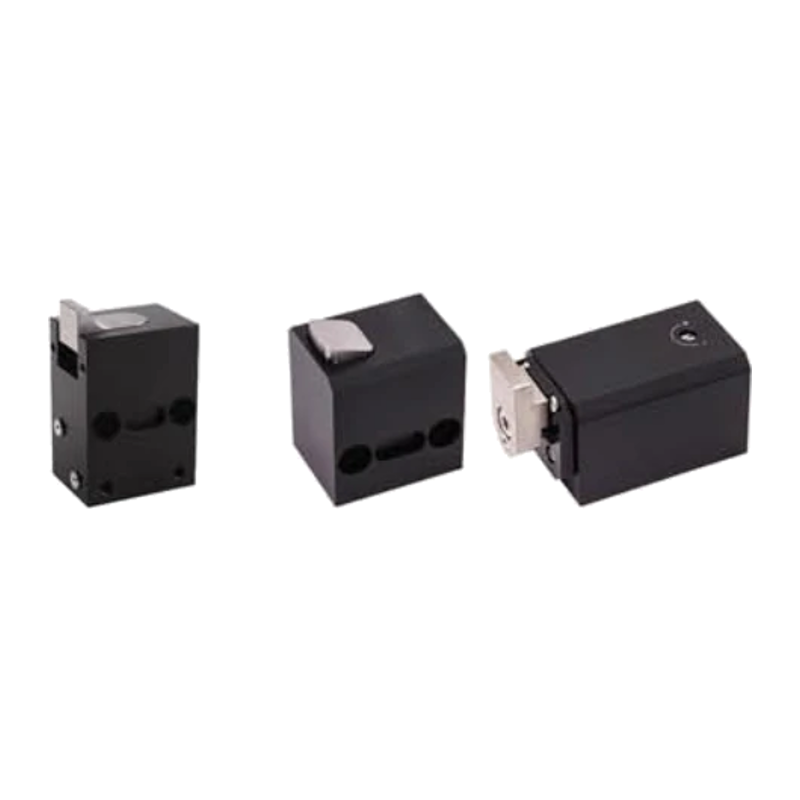
ZDQ Series Stopper Cylinders
ZDQ series stopper cylinders are pneumatic actuators used for station positioning and accumulation on automated conveyor lines, including belt conveyors, roller conveyors, and double-speed chain conveyors. The piston rod extends to stop a carrier pallet or workpiece, then retracts to release it after assembly, inspection, routing, or other operations are complete. Magnetic models can be fitted with external magnetic switches to provide stop and release position feedback for PLC interlock control. ZDQ is the primary model designation for the series. The model suffix 32 indicates the bore size, while the number following it indicates the effective stopping stroke (for example, ZDQ32-10 has a 32 mm bore and a 10 mm stroke). The suffix S (magnetic) indicates a built-in magnetic ring for use with a magnetic switch. The series also includes models designated ZHQ. Key selection factors include bore size, stopping stroke, permissible stopping load, cushioning, and magnetic sensing. During installation, ensure the stopping direction is aligned with the workpiece's direction of travel and provide rigid support for the cylinder body.
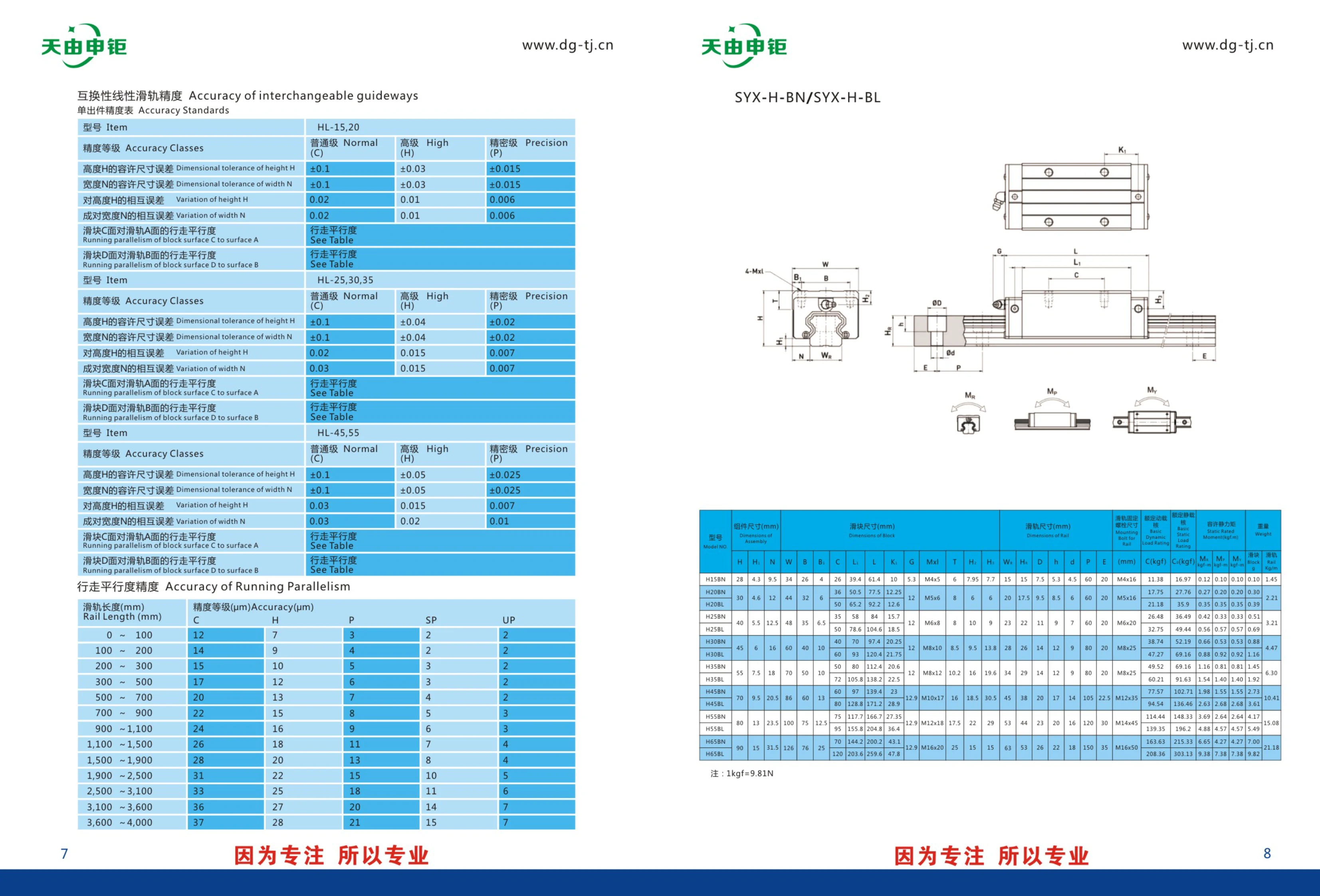
SYX-H-BL Series Linear Guide Rails
The SYX-H-BL series consists of linear guide rail and block assemblies designed to guide linear motion in automation equipment. The series is available in a range of accuracy grades and sizes, and offers high rigidity and load capacity. Made from high-quality steel and precision-machined, these assemblies ensure smooth movement and accurate positioning. The close fit between the block and rail meets the demands of high-speed, heavy-load applications.
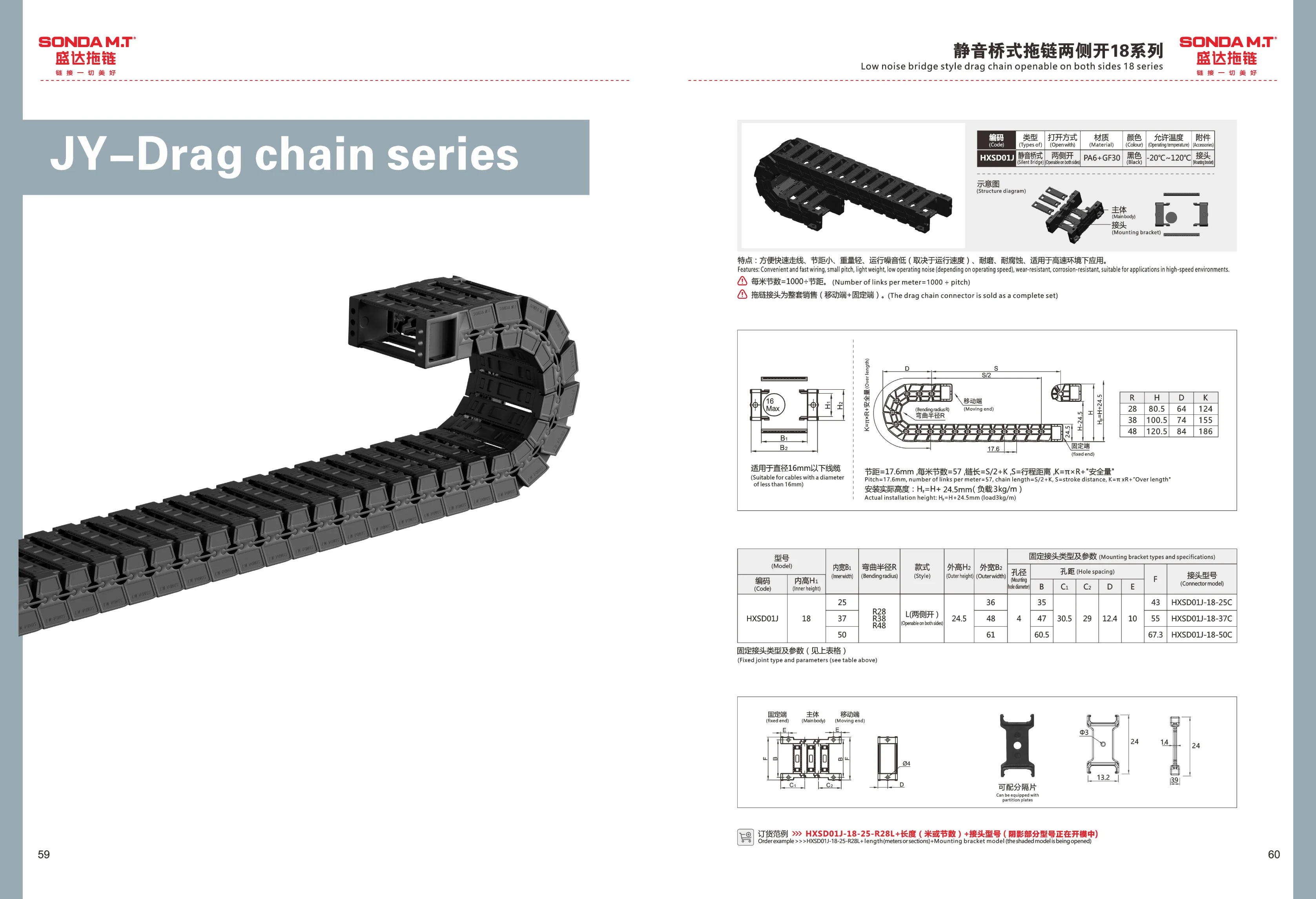
JY Cable Carrier Series
The Shengda JY cable carrier series is designed to guide and protect cables, oil hoses, and air hoses in automation equipment. Made from high-strength engineering plastics or stainless steel, these products are wear-resistant, corrosion-resistant, and quiet in operation. A variety of inner widths (B1) and bend radii (R) are available, with different styles, such as open and enclosed types, available to order. The outer height (H2), outer width (B2), mounting-hole spacing, and hole diameters accommodate a range of wiring requirements. Suitable for horizontal or vertical installation, these cable carriers are widely used in CNC machine tools, robots, and automated production lines.
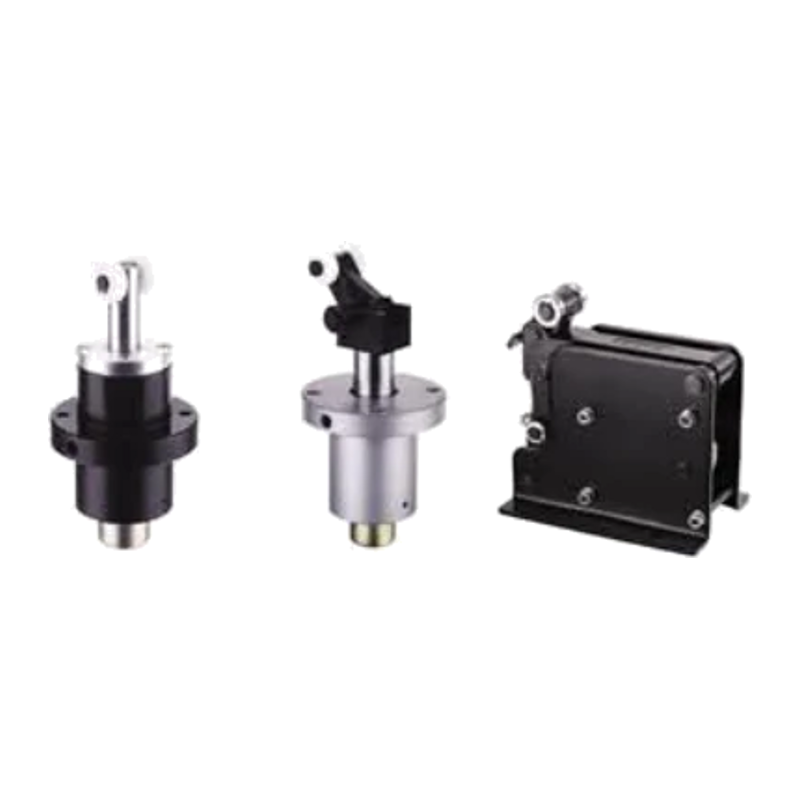
QX Series Stopper Cylinders
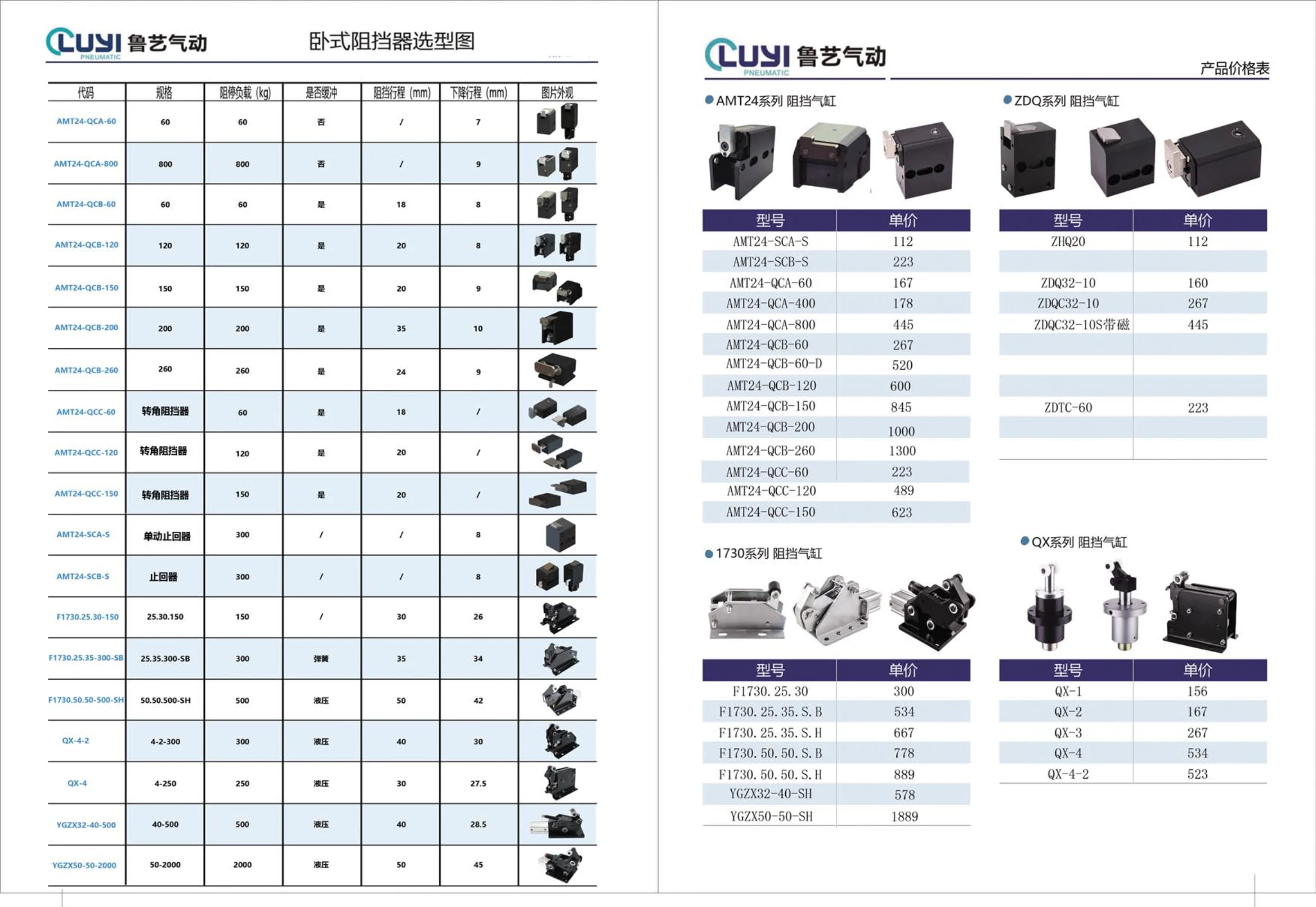
QX series stopper cylinders stop, position and release workpieces or pallets on automated conveyor lines. Their hydraulic cushioning absorbs impact smoothly under heavy stopping loads, reducing noise and damage to workpieces. The series includes QX-1, QX-2, QX-3, QX-4 and QX-4-2 models. The QX-4 corresponds to specification 4-250, with a stopping load of 250 kg, a stopping stroke of 30 mm and a lowering stroke of 27.5 mm. The QX-4-2 corresponds to specification 4-2-300, with a stopping load of 300 kg, a stopping stroke of 40 mm and a lowering stroke of 30 mm. Both feature hydraulic cushioning. Select a model based on stopping load (kg), stopping stroke (mm) and lowering stroke (mm) to match the line cycle time and workpiece weight. The cylinder mounts on the side of the conveyor line for cushioned stopping and rapid release.
YGZX Series Stopper Cylinders
YGZX series stopper cylinders, also known as stop cylinders or hydraulic-buffered stoppers, stop, position and release individual workpieces or pallets on automated conveyor, assembly and logistics sorting lines. Their hydraulic cushioning smoothly absorbs kinetic energy under high impact loads, reducing workpiece impact and operating noise. Key specifications include bore or size code (such as 32 and 50), stopping stroke (40 and 50 mm), lowering stroke (28.5~45 mm), stopping load (500 and 2000 kg), and cushioning type (spring SB, hydraulic SH). Select the stopping load and stroke based on workpiece weight and line speed. The cylinders are compact, easy to install and can be used with sensors for automated interlock control.